Imagine a digital employee who never gets tired, is always in a good mood, and can answer every customer question precisely. Sounds too good to be true? That's exactly what an AI chatbot is! Forget everything you've heard about sluggish question-and-answer bots — we're talking about a genuinely intelligent conversation partner that works with the world's most powerful language models and knows your company's knowledge.
Your Tireless Digital Conversation Partner
An AI chatbot is clever software that uses Artificial Intelligence (AI) to simulate human conversations. Don't think of a rigid robot — think of a lightning-fast, extremely well-informed colleague. This colleague has access to a vast universe of knowledge — and to your specific company know-how — and uses it to formulate accurate, natural responses in real time.

The secret behind it? Generative AI. Rule-based systems from previous generations that could only fall back on hard-coded responses are a thing of the past in the enterprise world. LLM-based chatbots have completely replaced them. A modern bot generates each response fresh and precisely tailored to the specific request — making conversations dynamic, personal, and incredibly useful.
The key advantage of generative AI is that you can get started immediately. The AI models are already pre-trained on broad general knowledge. You don't even need your own company data to get started!
What Really Makes an AI Chatbot Special
A modern AI chatbot is much more than just a nice gimmick. It's a genuine game-changer for your customer communication. Let's take a closer look at what makes it so special.
To give you the key points at a glance, this table summarizes the core characteristics of a generative AI chatbot.
| Feature | Description |
|---|---|
| Generative Responses | Generates answers fresh instead of relying on rigid scripts. |
| Context Understanding | Remembers the conversation flow and draws relevant connections. |
| Natural Language | Communicates fluently and in a human-like way, adapting tone to the situation. |
| Multimodality | Processes not just text, but also images, documents, and voice inputs. |
| Proactive Assistance | Actively solves problems, helps with product searches, or books appointments. |
| Ready Out of the Box | Works immediately thanks to pre-trained models — no setup required. |
These capabilities lay the foundation for an entirely new service experience that your customers will love.
The market for these smart assistants continues to grow unabated. The market size for AI products in Germany has already exceeded the forecast of around 9 billion US dollars for 2025 — and growth is continuing unabated into 2026. If you want to dive deeper into the numbers, you'll find exciting insights into the growth of the AI market in Germany at statista.com.
How Generative AI Brings Your Chatbot to Life
Ever wondered how a chatbot can respond in such a surprisingly human and creative way? The magic behind it has a name: generative AI. It's the spark that transforms a simple bot into a brilliant conversation partner. Forget the old rigid scripts — here, every single response is created fresh in the moment of the conversation.
Think of it this way: the AI has devoured a massive digital library — countless books, articles, and websites. But it hasn't just mechanically memorized facts. Much more importantly, it has internalized the patterns, rhythm, and fine nuances of our language. With this wealth of knowledge, it can recognize logical connections and "generate" entirely new, on-point sentences.

That's the decisive difference from the chatbots of the past. Instead of just running through a pre-made script, it conducts a real, dynamic dialogue. Modern chatbots are also multimodal: they can not only process text, but also analyze images, evaluate PDFs, and respond to voice inputs. This opens up entirely new fields of application — for example, a chatbot that receives a photo of a defective product and then initiates the correct repair process.
The Power of Large Language Models
The technical core of this impressive capability is the Large Language Models (LLMs). You can think of these models as the brain of your chatbot. They were trained on an almost unimaginable amount of text from the internet and can therefore not only understand language, but also produce it themselves.
In 2026, companies have access to a whole range of powerful base models: GPT-5 from OpenAI, Claude Sonnet 4.6 and Opus 4.8 from Anthropic, and Gemini 2.5 from Google are among the current flagships. For enterprise deployments, RAG (Retrieval-Augmented Generation) has also established itself as the standard: the model's general language knowledge is combined with specific company knowledge — manuals, product data sheets, internal guidelines. The chatbot thus doesn't generate answers "into the blue," but instead refers to concrete, verified sources from its own knowledge store.
The bottom line for you? These models are already "pre-trained." So you're not starting from zero!
The biggest advantage of generative AI is that you can get started immediately, without needing any of your own company data. The AI already brings broad general knowledge and is ready to conduct dynamic dialogues right away. For company-specific depth, you add RAG — and that's achievable today within a few hours.
In plain terms: an AI chatbot is useful from the very first moment and delivers responses that truly fit the context. It can, for example:
- Answer questions logically, even if they've never been asked in that exact form before.
- Adapt its tone, depending on whether a customer is excited, frustrated, or simply curious.
- Summarize complex matters and present them with crystal clarity.
- Evaluate documents and images, when a multimodal model is in use.
It's precisely this ability to communicate spontaneously and relevantly that brings your chatbot to life. It becomes a valuable digital team member that doesn't just process your customers, but genuinely delights them.
What Benefits an AI Chatbot Brings to Your Company
Let's talk concretely about how an AI chatbot can propel your company forward. It's about so much more than just saving a few euros. It's about giving your customer service a real upgrade.
Just imagine your customers getting immediate help at any time. 24 hours a day, 7 days a week. Completely without hold times.
The numbers speak for themselves: current studies from 2026 show that AI chatbots in customer service now resolve 60–70% of all incoming requests fully automatically — without any human employee needing to intervene. This is no longer a promise — it's proven practice.

Boost Efficiency and Relieve Your Team
By automating all those standard requests, you create space for your team. Instead of answering questions about delivery times or password resets for the hundredth time, your employees can finally focus on the things that really matter: solving complex customer problems, thinking strategically, and providing personal attention where it matters most.
An AI chatbot is not a pure support tool. Rather, it's a smart pre-filter that immediately handles the simple things and only routes the demanding cases to your experts. This increases efficiency across the entire company.
This gained time is not only worth hard cash — it also generates significantly more motivation within the team. But the chatbot can do much more, for example as a tireless sales assistant:
- Qualify leads: It identifies potential customers, collects the first important information, and routes them directly to the right salesperson.
- Schedule appointments: The bot can book meetings directly in the chat, making the whole process super simple and fast.
- Provide product advice: It helps customers find the perfect product and answers questions about features or availability.
- Handle voice support: Voice-based AI chatbots are gaining significant traction in 2026, taking over more and more initial phone inquiries.
These capabilities give you a real competitive advantage. Over 90% of German companies have now at least piloted AI-powered chatbots or already have them in production use.
If you want to go deeper, take a look at how you can profitably deploy an AI chatbot for your company.
Inspiring Real-World Use Cases
Theory is all well and good, but practice is where you really see what a technology is made of! Let's get to the most exciting part: how are well-known companies already using generative AI chatbots in clever and successful ways?
Take Deutsche Bahn as an example. Anyone who has ever planned a trip knows the complexity involved. Their digital assistant is a real game-changer here. Instead of laboriously clicking through menus, travelers simply ask naturally about timetables, tickets, or delays and get the right information immediately.
Or let's look at the telecommunications sector. Major providers like Telekom use AI chatbots to take their customer service to a new level. The bots handle the most frequent inquiries about bills, tariffs, or outages — around the clock. The result? Service hotlines are relieved and customers are happier because they don't have to wait endlessly on hold.
Discover the Diversity of Applications
But an AI chatbot is so much more than just a helper for customer service. It's a true Swiss Army knife for almost every industry! The possibilities go far beyond classic support requests.
This graphic provides a great overview of where AI chatbots have the greatest leverage:
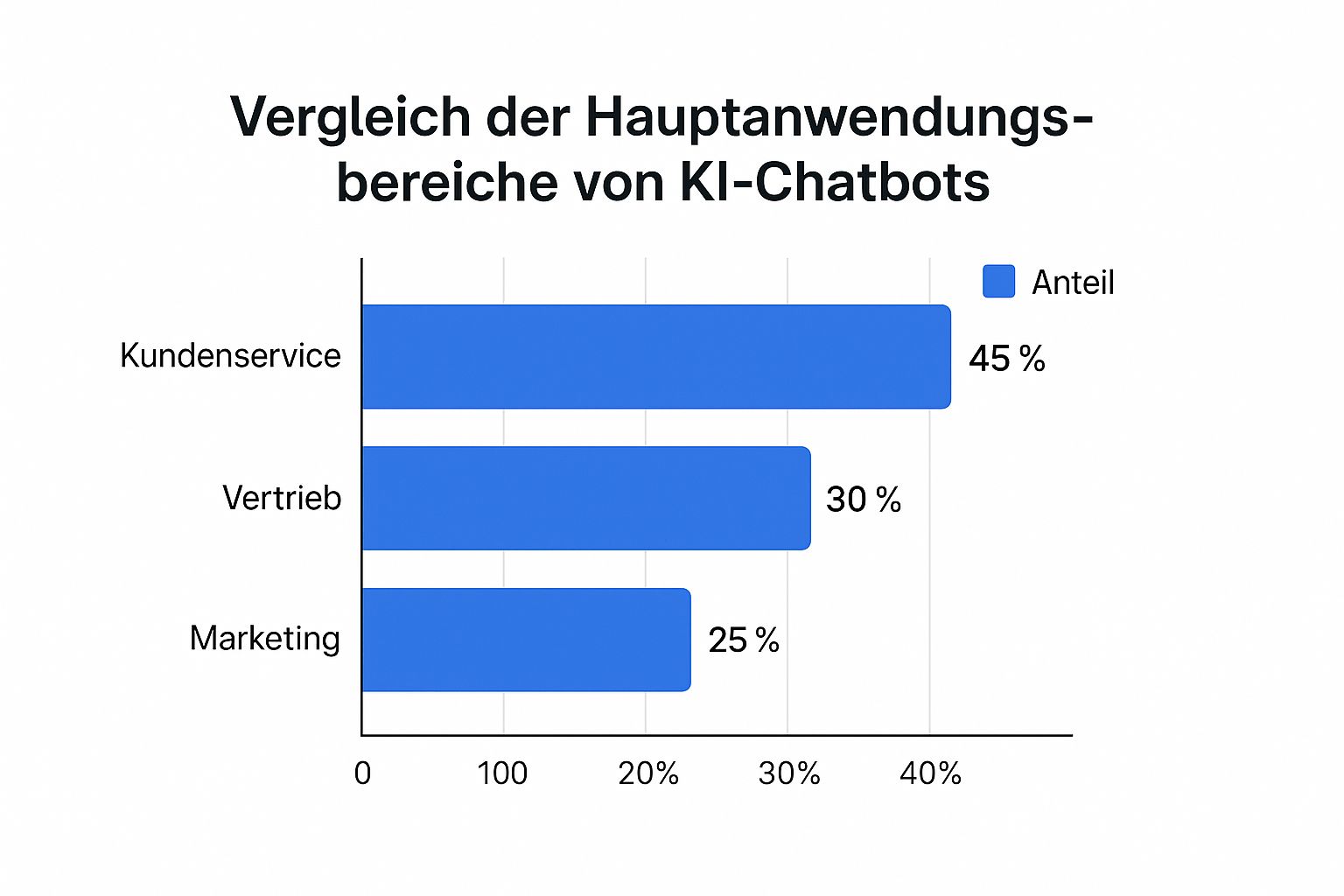
You can see immediately: customer service leads with 45%. But right after come sales and marketing — areas where chatbots can accelerate sales processes and make customer outreach more personal.
The best part? For all these use cases, you don't have to start from scratch or own huge volumes of data. A modern generative AI is immediately ready to go and can jump straight into communication with your customers.
Here are some of the most exciting scenarios that deliver results right away:
- Product advice in e-commerce: Imagine your chatbot as a personal shopping advisor in a store. It asks targeted questions about preferences, makes suitable suggestions, and guides the customer charmingly through to purchase.
- Appointment scheduling for service providers: Whether it's a doctor's office, hair salon, or tax consultant — the bot checks the calendar, finds available slots, books them directly, and even sends the confirmation. It couldn't be simpler!
- Interactive FAQs on your website: No more endless text pages that nobody reads! A chatbot answers your visitors' questions precisely and guides them exactly to the information they're really looking for.
- Voice chatbots for company hotlines: Voice-based AI chatbots are gaining significant traction in 2026. They answer phone calls, resolve simple requests directly, and seamlessly route complex cases to the responsible employee.
As you can see, the application possibilities are incredibly flexible. An AI chatbot can help you streamline internal processes and deliver an experience that truly delights your customers.
To make this even more tangible, let's look at how different industries are using AI chatbots in concrete terms.
Comparison of Use Cases by Industry
An overview of how different industries use AI chatbots to solve specific challenges.
| Industry | Typical Use Case | Key Benefit |
|---|---|---|
| E-Commerce | Personalized product recommendations & order tracking | Increasing conversion rate & reducing support requests |
| Financial Services | Account balance inquiries, product FAQs & lead qualification | 24/7 availability & relieving advisors from routine tasks |
| Healthcare | Appointment scheduling, symptom checker (initial information) & FAQs | More efficient practice organization & improved patient communication |
| Tourism & Travel | Booking inquiries, travel planning & real-time flight updates | Immediate assistance for travelers & personalized travel suggestions |
| Real Estate | Initial qualification of prospects & appointment scheduling for viewings | Faster response times & focusing brokers on promising leads |
This table illustrates nicely that there isn't a single one-size-fits-all solution. The trick is deploying the chatbot exactly where it creates the greatest added value for your company and your customers.
Your Simple Path to Your First AI Chatbot
Ready to get started yourself? Great! The best news first: getting started in the world of AI chatbots is easier than you might think. The days when you needed massive proprietary datasets or an entire development team for this are definitively over thanks to modern AI. The great thing about it is: you can truly start immediately!
But the key to success isn't just the technology alone — it's a clear strategy. Before you dive headfirst into selecting a tool, take a moment for a few fundamental questions. Good preparation is everything.
Your Checklist for Getting Started
Think of your chatbot like a new digital employee. For it to do a great job from day one, it needs a clear job description. Simply go through the following points:
- What is your main goal? Do you want to reduce the load on customer service? Do you want to generate more qualified leads? Or perhaps take the sales consultation on your website to a new level? Define a clear, measurable goal.
- What tasks should the bot take on? Should it answer the top 10 customer questions in its sleep, book appointments directly in the calendar, or actively guide visitors through your offerings?
- What personality fits your brand? Define the tone. Should your bot chat in a relaxed and humorous way, or inform in a professional and factual manner? Its language must fit your brand perfectly.
- What about data protection? Especially in enterprise use, the question of GDPR compliance and EU hosting is a knockout criterion — more on that in the next section.
Once you know exactly what your goals are, selecting the right tool becomes child's play. This way you ensure that you're specifically leveraging the diverse possibilities of AI for companies and getting the maximum out of it.
GDPR-Compliant Chatbots: What to Watch Out for When Choosing Your AI Provider
When companies deploy AI chatbots today, one question tops the agenda: Where does our data end up? This isn't an academic question — it has real legal and business implications. Many of the best-known chatbot providers from the US process and store conversation data on servers outside the EU. This directly conflicts with GDPR and can be costly for European companies.
Why Server Location Determines Compliance
The problem is structural: American companies are subject to the CLOUD Act, which grants US authorities access to stored data under certain conditions — regardless of which continent that data physically resides on. For European companies processing customer data in AI chatbots, this is an unacceptable risk. Supervisory authorities such as the Bavarian State Office for Data Protection Supervision have repeatedly made clear that such transfers require special protective measures.
Additionally, the EU AI Act, which has been fully in force since 2026, has introduced new transparency obligations: chatbots must clearly identify themselves to users as AI. This transparency requirement is mandatory and must be implemented technically and in the user interface — those who ignore it risk significant fines.
What You Should Systematically Check in a Provider
Before introducing an AI chatbot in your company, you should systematically check the following criteria:
- EU hosting: Are the data stored and processed exclusively on servers within the European Union? Have this confirmed in writing contractually.
- No training with your data: Does the provider use your conversation data to further develop its models? Reputable enterprise providers contractually exclude this — and it must be in writing.
- Data Processing Agreement (DPA): Is there a legally sound DPA that fully meets the requirements of Art. 28 GDPR?
- Zero retention option: Can conversation content be configured so that it is not stored permanently after processing?
- Encryption: Is data encrypted throughout both during transmission (in transit) and during storage (at rest)?
- ISO 27001 / BSI C5 / SOC 2: Does the provider hold recognized security certifications that are regularly audited externally? Without these certificates, internal IT approval and customer conversations become difficult.
- Transparency labeling under the EU AI Act: Does the provider technically implement the requirement to identify AI? This must be visible and unambiguous before the conversation begins.
- Role-based access controls (RBAC): Who in your company is allowed to configure the chatbot, view conversation logs, and connect new data sources? A GDPR-compliant platform offers granular access rights that you control yourself.
innoGPT: Governance and GDPR from a Single Source
This is exactly where innoGPT comes in. The platform was developed specifically for companies that want to use AI securely and in a demonstrably GDPR-compliant manner. All data is processed on German and European servers. A legally sound DPA is included as standard. There is no use of your company data for model training, zero retention is configurable, and all connections run encrypted.
innoGPT is not a single-model tool: you choose from all relevant LLMs — GPT-5, Claude, Gemini, and more — the model that best fits your use case. With the integrated knowledge base (RAG), you enrich your chatbot with company-specific knowledge: manuals, FAQs, product data, or internal guidelines are available to the chatbot as a reliable foundation, without information leaking out in an uncontrolled manner.
The result: no more shadow AI proliferation, where employees use private chatbot tools because official solutions are lacking. Instead, a centrally managed, measurable, and secure AI platform — rolled out across the entire company, with clear governance.
innoGPT helps companies deploy AI securely: all relevant models, your own company knowledge, and governance in one GDPR-compliant platform. This transforms shadow AI into productive, measurable enterprise AI.
In short: GDPR-compliant AI is not a brake — it's a competitive advantage. Companies that take data security and compliance seriously gain the trust of their customers and avoid costly data breaches — and they're well prepared for the increasing requirements of the EU AI Act.
From Simple Chatbot to AI Agent: The Next Evolutionary Step
Anyone who still believes an AI chatbot is a nice addition to the FAQ page has missed the developments of the last twelve months. The technology has evolved fundamentally — and the next evolutionary step is already in full swing: AI agents.
What Is the Difference Between a Chatbot and an AI Agent?
A classic chatbot — even a modern, LLM-based one — is reactive. It waits for input, processes it, and delivers a response. An AI agent, on the other hand, acts proactively and purposefully. It can independently plan and execute multi-step tasks without requiring human input at every step.
Concretely, this means: a chatbot answers the question "What is the status of my order?" An AI agent can independently retrieve this information from the inventory management system, identify a shipping delay, proactively formulate an apology to the customer, and simultaneously create a credit note in the CRM system — all in a single pass, without manual intervention.
The Technical Foundation: Tools, Memory, and Planning
What distinguishes AI agents from simple chatbots are three core components:
- Tool use: The agent can call external systems — APIs, databases, calendars, CRM systems, or email. It is not limited to what is in its context window, but actively operates across system boundaries.
- Memory: Agents can store and use information across individual sessions. They know the context of previous interactions and can build on it — for personalized and consistent user experiences.
- Autonomous planning: An AI agent can break down an overarching goal into sub-tasks, work through them sequentially or in parallel, and adjust its plan in the face of unexpected results. This so-called "agentic loop" is the heart of modern AI agents.
Practical Examples of AI Agents in Enterprise Use
The application possibilities are enormous and extend far beyond classic customer service:
- HR onboarding: An agent greets new employees, provisions access, answers frequent questions, and coordinates onboarding appointments — fully automated and across multiple systems.
- Sales support: The agent qualifies incoming leads, researches publicly available information about the company, and prepares the responsible account manager with a structured briefing.
- IT helpdesk: Instead of just assigning a ticket number, the agent attempts to solve the problem independently — by restarting services, granting permissions, or directly looking up the knowledge base.
- Compliance monitoring: An agent continuously monitors internal processes for adherence to guidelines, documents deviations, and escalates to the responsible party when needed.
What This Means for Your AI Strategy
The transition from chatbot to agent is not a switch you flip once. It's a maturity process. Many companies sensibly start with a well-configured chatbot based on their own company knowledge. With growing experience and increasing trust in the AI platform, they gradually expand capabilities toward agent-based automation.
What's decisive is that the platform deployed supports this evolution — with a stable governance layer that ensures even autonomous AI actions remain traceable, logged, and controllable. Because with greater autonomy comes greater demands for transparency and control.
Companies that lay the right foundations today — a clean data base, a GDPR-compliant platform, clear usage guidelines — will be able to deploy AI agents in a targeted and secure manner tomorrow. The question is no longer whether, but how quickly and how structured the entry will be.
Ready for the Future of Communication? Let's Go!
Congratulations, you're now in the picture! You not only know what an AI chatbot is, but you've also gotten a feel for how it works and what enormous potential lies within it. And the most important thing to take away is this: the era of complicated, prohibitively expensive AI projects is definitively over.
Thanks to modern generative AI, the hurdles that once looked like enormous walls have simply disappeared. You don't have to be a data guru or invest months in preparation.
The best part? You can start immediately, without a single dataset from your company. The technology is ready to go and delivers real value from day one, taking your communication to the next level.
So what are you waiting for? While you might still be hesitating, your competitors are already racing past in the fast lane. The future of customer communication is here — it's interactive, smart, and always available.
Grab your opportunity now and secure your head start. Those who invest in a smart AI chatbot today are actively shaping the customer experience of tomorrow and gaining an advantage that's worth its weight in gold.
Intrigued? Great! You probably still have a few questions swirling around in your head. That's a good thing! Let's address the most common points so you can start your AI chatbot project with a really good feeling.
Do I Already Need My Own Company Data to Get Started?
Good news: No, absolutely not! That's what's so brilliant about modern, generative AI. The language models behind a good chatbot have already been fed with an incredible mountain of knowledge. Think of it like a new employee who already has a top education and can start immediately.
You don't have to spend weeks collecting and preparing data first. Sure, later you can teach your bot specific knowledge about your company — via RAG (Retrieval-Augmented Generation) — to make it even more precise and reliable. But for getting started? Not needed at all.
Does an AI Chatbot Really Understand Complex Requests?
Absolutely! That's precisely the huge leap forward compared to the old, rigid chatbots that only responded according to a fixed script. A modern AI chatbot grasps the context of a conversation. It notices when information is missing and even asks follow-up questions. Multi-step problems are no obstacle for it, and it can even read the mood of your customer from a message and respond accordingly. Thanks to multimodal capabilities, it also processes images, PDFs, and spoken requests.
The point isn't to completely replace humans. For the really tricky cases, the chatbot elegantly hands the conversation off to a human colleague — who is already fully briefed and can help directly.
What About Data Security? Is My Customers' Data Safe?
A very important point that has top priority! When choosing your provider, make absolutely sure that they not only know the GDPR, but actually live it. The key requirement: the servers must be located in the EU and the entire data processing must be crystal clear and secure.
Professional platforms today offer standards that truly stand up to scrutiny — for example "zero retention," which means your requests aren't stored at all, plus rock-solid encryption. Also important: the EU AI Act has required since 2026 that chatbots be clearly labeled as AI — make sure your provider technically implements this transparency requirement.
Ready to give your communication a real boost and give your team superpowers? innoGPT is your GDPR-compliant AI platform that brings all relevant models, your own company knowledge, and clear governance together in one solution. Why not give it a try — the first 7 days are free! Get started with innoGPT now
Weekly AI news in your inbox
New models, practical tips & expert insights — free for everyone.