Use AI in Your Company: How to Safely Adopt Generative AI (GDPR-Compliant)
Discover how to use AI in your company to boost productivity while staying GDPR-compliant and making a safe start.
tl;dr:
- The real game-changer: Generative AI is the key to massive efficiency because it actively creates new content like emails, proposals, or code, instead of just analyzing existing data.
- The hidden danger: Using US platforms like ChatGPT with company data is a GDPR nightmare that leads to uncontrollable data leakage and the rise of dangerous shadow IT.
- The secure solution: A GDPR-compliant platform like innoGPT prevents shadow IT by offering an attractive, legal alternative with full data control and European sovereignty.
The dilemma: full power ahead – but please, safely!
You know the scene: a key account manager wades through a mountain of emails, broods over complex proposals, and tries to squeeze notes from hours of meetings into a few sentences. A daily battle against the clock in which the most important thing – real, personal customer care – often falls by the wayside. This is exactly where generative AI steps in and promises a productivity revolution.
But many hesitate, because one thought always lurks in the background: "I loved ChatGPT – until I realized I had just uploaded our sales strategy to the internet."

It's right in this tension between the burning desire for more efficiency and the huge, often overlooked security risks that the crux lies. The temptation is huge – quickly conjuring a text or brainstorming ideas. But have you ever asked yourself what really happens to the info your people type into these freely available tools?
Shadow IT: the Trojan horse inside your own house
This wild, uncontrolled use of AI applications in everyday work has a name: shadow IT. Employees use these tools on private laptops or simply in the browser because it's fast and delivers great results. But in doing so, they unwittingly open huge gates for data leaks. Every piece of confidential information – from customer data and internal strategies to financial plans – can end up uncontrolled on third-party servers, mostly in the US.
The biggest risk isn't ignoring AI. The biggest risk is letting it into the company uncontrolled and without a plan. A pure ban culture, by the way, is doomed to fail – your employees will always find a way to make their work easier.
This guide shows you a better way. A way in which you can truly revolutionize your processes with generative AI without putting your most valuable capital on the line: your company data.
How to master the safe leap into the AI world
This isn't about giving up the enormous benefits of AI. On the contrary! It's about setting the right course from the start. A strategic rollout needs a solution that perfectly unites two things: satisfying employees' hunger for productivity while upholding the strict rules of GDPR and IT security.
- Take back control: Instead of a sprawl of private accounts, you need a central platform managed by the company.
- Create legal certainty: Make sure all data stays in Europe and is processed according to the highest data protection standards.
- Delight your employees: Offer an alternative so brilliant and easy to use that no one even thinks of reaching for insecure tools anymore.
The key to success is building an official bridge that combines convenience and security. That's the only way entry into the world of artificial intelligence works – safely, successfully, and at full throttle.
What generative AI really means for your company
Let's clear up a common misunderstanding right away. When we talk about how AI can really make everyday work easier, we're talking about generative AI.
Unlike classic analytics systems that dig through mountains of data and spit out complex reports, generative AI creates something entirely new. It drafts emails, composes blog articles, writes lines of code, or sums up a 50-page document in a few sentences. The focus is crystal clear on creative output, not on data analysis or reporting tools. We're talking about a tool that actively thinks along and handles very concrete tasks.
An intelligent assistant for every team
That's exactly what makes models like GPT-4 or Claude so revolutionary for daily work in sales, marketing, or HR. They essentially give every team member a personal assistant at their side, taking over tedious routine tasks and freeing up valuable time for strategic and creative work.
Just imagine: your salesperson no longer spends an hour drafting a proposal. Instead, they enter the key facts and receive a perfect draft in seconds – in the correct corporate wording, of course. That's the power we're talking about here!
Despite this enormous potential, there's still a certain hesitation in Germany. A ZEW study showed that in 2023 only about 12 percent of commercial companies were using artificial intelligence. That number is stagnating, which really surprises me given the huge productivity boost that generative AI has enabled since late 2022. The dark figure is probably higher, since in many companies AI is already so seamlessly integrated into software that it isn't even noticed as a standalone technology anymore. You can read more in the study on AI use in German companies.
From pure data analyst to creative partner
The decisive difference lies in the result. Conventional AI systems give you answers based on existing data. Generative AI delivers brand-new content that didn't exist before.
- Analytical AI: Finds patterns in your sales figures from the last five years.
- Generative AI: Writes a compelling email campaign to push exactly those sales numbers higher in the next quarter.
Generative AI is not a pure analytics tool. It's an active partner that participates in the creative process. It doesn't just handle tasks, it accelerates ideation and execution at a pace previously unthinkable.
It's precisely this ability to actively create and co-shape that makes it the perfect tool for finally breaking through the typical efficiency bottlenecks in everyday business. Ultimately, it's about giving employees time – time they can use for the truly demanding and value-adding tasks. The technology is here and ready to go. The next step now is a deliberate and, above all, secure implementation.
Why ChatGPT and the like aren't enough
Sure, the temptation is huge. There are countless, often free AI tools out there from the US that deliver incredible results at the push of a button. But this seemingly simple path is highly dangerous for companies – a true digital Trojan horse.
Your employees use these handy helpers on the sly on their smartphones or directly in the company browser because it's so convenient. What they don't realize: they're tearing open barn doors for data leaks and unwittingly opening the way for your most valuable company knowledge to drain out. A simple ban? Completely pointless. It only drives usage deeper into the shadows.
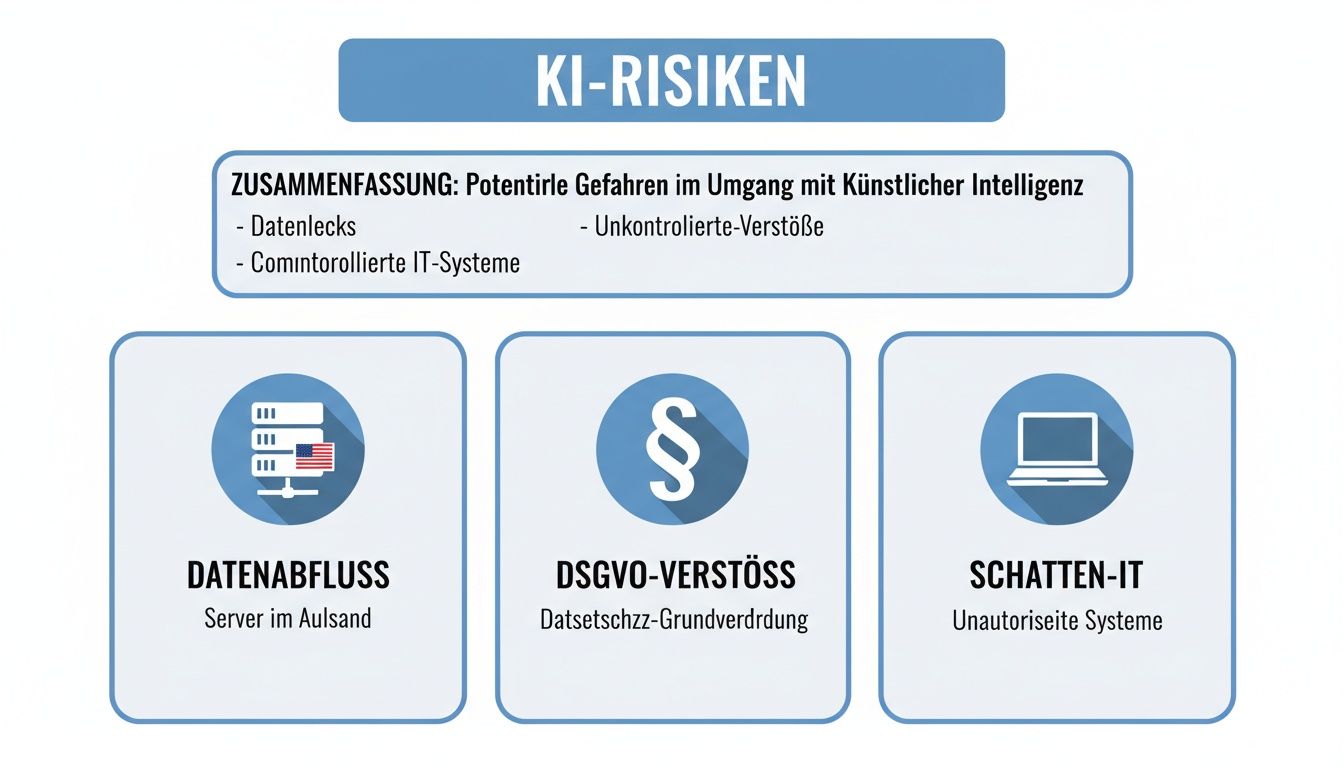
The whole dilemma can be broken down into three critical risks that every decision-maker must have on their radar before they want to use AI in the company.
The uncontrolled data drain to the US
The most obvious problem first: every time an employee types an internal sales strategy, a customer list, or a draft for a new product into such a public tool, that data leaves your company's protected environment. Forever. Most often it lands on servers in the US, where completely different, laxer data protection laws apply. From that moment on, you have zero control over who accesses it or what the data is really used for.
The ticking GDPR time bomb with sensitive data
As soon as even the smallest shred of personal data comes into play – a name, an email address – you're entering a legal minefield. The General Data Protection Regulation (GDPR) is crystal clear and tough on this, especially when data moves to third countries like the US. Violations threaten hefty fines of up to 4% of global annual revenue and massive reputational damage.
The rise of shadow IT through bans
And what happens when the IT department blocks access to well-known AI sites? Your employees switch to private smartphones, use VPN tunnels, or find new, unknown tools. Welcome to the world of shadow IT. The result is the worst-case scenario: usage still happens, but completely invisible and uncontrolled. A strict ban is not a solution – it only makes everything worse.
InnoGPT: the European answer on data security
Right at this crossroads we need a smart, strategic solution that puts European data sovereignty center stage. A central, GDPR-compliant platform like innoGPT closes exactly this gap. It becomes the official, secure bridge across which your teams can enter the AI world – without the risks of data leakage and GDPR violations.
Freedom of choice instead of vendor lock-in
A huge advantage of such an enterprise solution is independence. Instead of betting everything on one card, platforms like innoGPT bundle the best available AI models under one roof. Your teams can flexibly switch between leading models like GPT-4, Claude 3, or Gemini – depending on which is best suited to the current task. That prevents the dreaded "vendor lock-in" and always gives you access to the absolute cutting-edge technology.
100% GDPR-compliant, data stays in Europe
This is the decisive point: a European solution guarantees you a clean, legally sound basis from the ground up. Through consistent hosting in ISO-certified EU data centers and a strict "zero retention" policy, it's guaranteed that your sensitive company data never leaves your company. No training of third-party models, no uncontrolled data drain across the Atlantic – your information remains 100% your property.
Agility in the fast-moving AI market through rapid updates
The AI market evolves at a breathtaking pace. A specialized platform like innoGPT is agile and can integrate new features and models significantly faster than large, slow-moving corporations. This ensures your teams always work with the most modern and capable tools.
Effectively avoid shadow IT
Issuing a ban is easy, but it rarely works. Offering an attractive, legal alternative is the much smarter route. When you provide your employees with an official, powerful, and user-friendly platform, the incentive to secretly fall back on insecure tools disappears on its own. That simply makes shadow IT redundant.
Concrete use cases that deliver immediate value
Theory is good, but the real magic of generative AI only unfolds in practice. Where exactly can you use AI in the company to see results right away? Here are four practical examples:

- Project management: summarize meeting minutes in a heartbeat
Description: Just upload the transcript of a meeting. The AI fishes out the most important decisions and to-dos and creates a punchy summary.
-
Efficiency gain: Project managers save around 30 minutes a day that would otherwise go into follow-up work and manual task planning.
-
Sales: create personalized proposals at the push of a button
Description: Give the AI a few bullet points about product and customer, and it conjures up a tailored proposal draft in corporate wording in seconds.
-
Efficiency gain: Sales teams can easily save 45 minutes per employee per day and invest that time directly into active customer care.
-
HR: write job ads that attract talent
Description: Give the AI the core requirements for an open position, and it drafts an ad that is not only professional but also speaks to exactly the right people.
-
Efficiency gain: HR saves up to 60 minutes per document, which considerably speeds up recruiting.
-
Marketing: draft social media posts in record time
Description: Based on a few keywords, the AI delivers creative drafts for social media posts, blog articles, or newsletters that perfectly fit your brand.
- Efficiency gain: Teams can boost the speed of their content creation by up to 50% and have more time for strategic planning.
These examples make it clear: the entry doesn't have to be complicated. With a secure platform like innoGPT, you can unlock this potential right away without compromising on data security. The ROI becomes directly tangible.
Your 3-step roadmap for secure AI implementation
The thought of introducing AI in your company can quickly feel like a huge project. But don't worry: with a clear plan, the start is easy and safe.
Step 1: Define a pilot team & identify initial workflows
Start small with a motivated pilot team from an area like marketing or sales. Together, identify two or three concrete, time-consuming tasks (e.g., writing proposals, drafting social media posts) to make the benefit of AI visible right away.
Step 2: Choose a GDPR-compliant platform
Choosing the technology is the pivot point. Look for an enterprise solution that hosts exclusively in the EU, offers a guaranteed zero-retention policy, and integrates seamlessly with your systems. Be sure to inform yourself about all technical and organizational measures a provider takes to protect your data.
Step 3: Scaling & change management
Was the pilot a success? Great! Now roll out the solution step by step to additional departments. Accompany the process with clear communication and targeted training to secure broad acceptance across the company and reduce anxieties. Share the success stories from the pilot team to ignite enthusiasm.
Interestingly, experience shows that larger companies are often faster here. Current figures show: in 2024, 48 percent of German companies with more than 250 employees were already using AI, while among small companies it was only 17 percent. Still, Germany is above the EU average across all size classes – so the potential is huge, as you can read in the latest surveys on AI use. A well-thought-out roadmap particularly helps mid-market companies catch up quickly.
So what now? Your path into the AI future
If you take only one thing away from this guide, let it be this: generative AI is not a toy for tomorrow, but a real, hard-hitting competitive advantage you can secure today. The catch? This advantage only unfolds when you approach the topic strategically, securely, and absolutely watertight under GDPR rules.
It's about setting the rules of the game yourself from the very beginning. Don't wait until shadow IT in your company becomes an uncontrollable wildfire. Now is the moment to take the helm.
From talking to doing
Theory always sounds great, sure. But the real "wow effect" only comes when you see AI live in action. When a colleague has a 20-page meeting transcript summarized in 30 seconds, or a perfectly formulated proposal in corporate wording materializes out of thin air, the potential becomes tangible.
The best time to set the course for secure AI use was yesterday. The second best is right now. Take the wheel before others do.
A central, secure platform is far more than just a technical gimmick. It's a strategic decision for data sovereignty and future-readiness. You create a kind of safe harbor where your employees can unleash the full power of AI – without you losing sleep at night.
Take the first step
You now know the risks, the enormous opportunities, and have a clear roadmap in front of you. Now the ball is in your court. The first step is often the most decisive. Request a free demo and see for yourself how you can anchor generative AI safely, smartly, and profitably in your company.
Stop just imagining the future – experience it live! Request your free, no-obligation demo for innoGPT now. Find out how you can truly relieve your teams and raise productivity to a level you previously thought impossible.
Related articles
Use ChatGPT – Safely: The GDPR-Compliant Alternative for Businesses
Learn how to use ChatGPT safely and avoid GDPR risks. Discover innoGPT as the GDPR-compliant alternative that protects your data.

Generative AI in Industry: GDPR-Compliant Assistants for Production, Sales & Engineering
Discover how generative AI in industry revolutionizes your processes. Use GDPR-compliant AI assistants safely in production, sales, and engineering.
AI Text Rewriting: How to Reformulate Content GDPR-Compliant Without Endangering Your Data
Learn how to rewrite text with AI while staying GDPR-compliant. Practical tips for secure, efficient, and privacy-compliant content.