The Key Takeaways at a Glance:
- Massive data protection risks: ChatGPT transmits your data to US servers, stores it for an unclear duration, and processes it opaquely — a direct conflict with the core principles of GDPR and a high risk of fines.
- Real liability consequences: A GDPR violation is no minor offense. Fines of up to 4% of your global annual revenue and personal liability for management in cases of negligent use are very real risks.
- EU AI Act in force since 2026: In addition to GDPR, the EU AI Act now applies — with additional transparency and documentation requirements for AI systems used in enterprise settings.
- innoGPT as a GDPR-compliant solution: As a European alternative, innoGPT guarantees you complete data sovereignty and legal certainty through EU-based servers, a strict no-training-data policy, and the option for local installation (on-premises).
Generative AI like ChatGPT is on everyone's lips, but for your company it raises a massive question: what about data protection? Anyone who doesn't look closely here can quickly slide into a serious GDPR conflict. Sensitive company data could flow unprotected across the Atlantic to the US. Since 2026, the EU AI Act adds yet another regulatory framework that governs AI use in enterprise environments even more strictly. That is why a secure, data-protection-compliant alternative is not just a nice-to-have for European companies — it is an absolute necessity.
A Closer Look at ChatGPT's Concrete Data Protection Risks

For you as a project manager or executive who needs to balance efficiency with legal compliance, every second counts. Think of ChatGPT like an open-plan office in a foreign country: anyone could potentially overhear, and you have no idea who is reading your notes. A GDPR-compliant solution like innoGPT, by contrast, is your own firmly locked vault inside your company building — only you hold the key and maintain full control.
A German mid-sized technology company had to learn this difference the hard way. After sensitive project details leaked through a US tool, the company pulled the emergency brake and switched to innoGPT. Today, all AI processes run in a secure, shielded environment — without the constant worry of data leaks and GDPR fines. That was not just a technical decision; it was a strategic turning point toward a secure future.
Data Transfer to the US: The Classic GDPR Problem
The most fundamental issue with ChatGPT and data protection is actually quite straightforward: data transfer to the United States. OpenAI, the company behind ChatGPT, is based in the US. In plain terms: everything you enter — whether personal data or strictly confidential trade secrets — is processed and stored on American servers.
Sure, new agreements like the "EU-US Data Privacy Framework" keep emerging. But honestly, the legal situation remains an unstable construct. European courts have already struck down similar agreements in the past — think Schrems I and Schrems II. The current framework, under the working name "Schrems III," continues to face criticism and is being challenged by privacy advocates and supervisory authorities. The concern that US agencies could access European companies' data under laws like the Foreign Intelligence Surveillance Act (FISA) is and remains very real. As of June 2026, there is no definitive legal certainty — anyone relying on this framework is building on a foundation that could collapse again at any time.
Lack of Transparency and Unclear Retention Periods
Another enormous sticking point is the lack of transparency. GDPR Article 5 is crystal clear on this: data processing must be traceable for the data subject. With ChatGPT? Not the case. You are essentially staring into a black box.
- What are my data used for? OpenAI uses inputs from the free and team versions by default to further train its models — including GPT-5, which launched in early 2026. This means your sensitive company data could become part of the general knowledge of the next model generation. A nightmare for any trade secret.
- How long is everything stored? There are no simple, clear statements about the exact retention period for your conversations. Once in, in forever? You simply don't know for certain.
- Who else is reading? Beyond the machines, human reviewers at OpenAI can also view your chat histories, ostensibly for quality control.
This lack of transparency makes it practically impossible for you as a user to maintain control over your information. That contradicts almost everything GDPR stands for.
Control over one's own data is not a nice extra — it is a fundamental right enshrined in EU law. A tool that systematically undermines this control is an untenable risk for any responsible company.
Missing Right of Withdrawal and Other Data Subject Rights
GDPR gives you and your customers powerful rights: the right to access, the right to rectification, and of course the "right to be forgotten." Great — but extremely difficult to exercise with ChatGPT. How do you ensure that your data, once incorporated into the model's training, is truly and completely removed?
And these are not theoretical games. In March 2023, ChatGPT experienced a real data protection incident. Users could suddenly see the chat titles of other users. Since then, several EU data protection authorities have initiated formal proceedings against OpenAI — including Italy's Garante and Ireland's DPC, which serves as the lead authority for OpenAI in Europe. These proceedings were still ongoing as of 2026 and could result in binding orders or fines. This incident and the ongoing investigations vividly illustrate how vulnerable such centralized US systems are to European legal standards.
Ultimately, one crucial point is missing: data sovereignty. You hand over control of your most valuable data entirely to a third-party provider in a legally uncertain country. For European companies that depend on the security and protection of their information, this is a dangerous leap of faith.
The Legal Consequences: What a GDPR Violation Really Costs
Data protection violations? Surely that's only a concern for large corporations, right? Wrong. They are no longer an abstract threat — they are hard business reality with extremely painful consequences. Many executives brush them off — until the first letter from the supervisory authority lands in their inbox. And by then, it is usually too late.
This is not about legal technicalities. We are talking about concrete, existential threats to your company arising from the careless use of non-GDPR-compliant US tools. And frankly: ignorance is definitely no protection from punishment here.
Fine Risks That Can Threaten Your Existence
The penalties provided for under the General Data Protection Regulation are not trivial. They are designed to hurt and to send a clear message: data protection is not a courtesy gesture — it is a core corporate obligation.
GDPR is anything but a paper tiger. The fines are deliberately set high enough to hit companies where it hurts most — in their finances. A violation can thus instantly become a strategic mistake with bitter, long-term consequences.
The fine framework is immense and can amount to up to €20 million or 4% of global annual revenue from the previous financial year — whichever is higher. For a solid mid-sized company with €50 million in annual revenue, that could easily translate into a fine of up to €2 million. Ouch.
Personal Liability of Management
One point that is often criminally overlooked is the personal liability of management. If you as a CEO order the use of a sensitive tool like ChatGPT — or simply tolerate it silently — without having conducted a proper review (a so-called data protection impact assessment), you are acting negligently.
If things go wrong — such as a data breach or a regulatory order — executives can be held personally liable. This is not just about money; it can also have employment law consequences.
The following infographic captures the key pillars of GDPR against which any AI use must be measured.
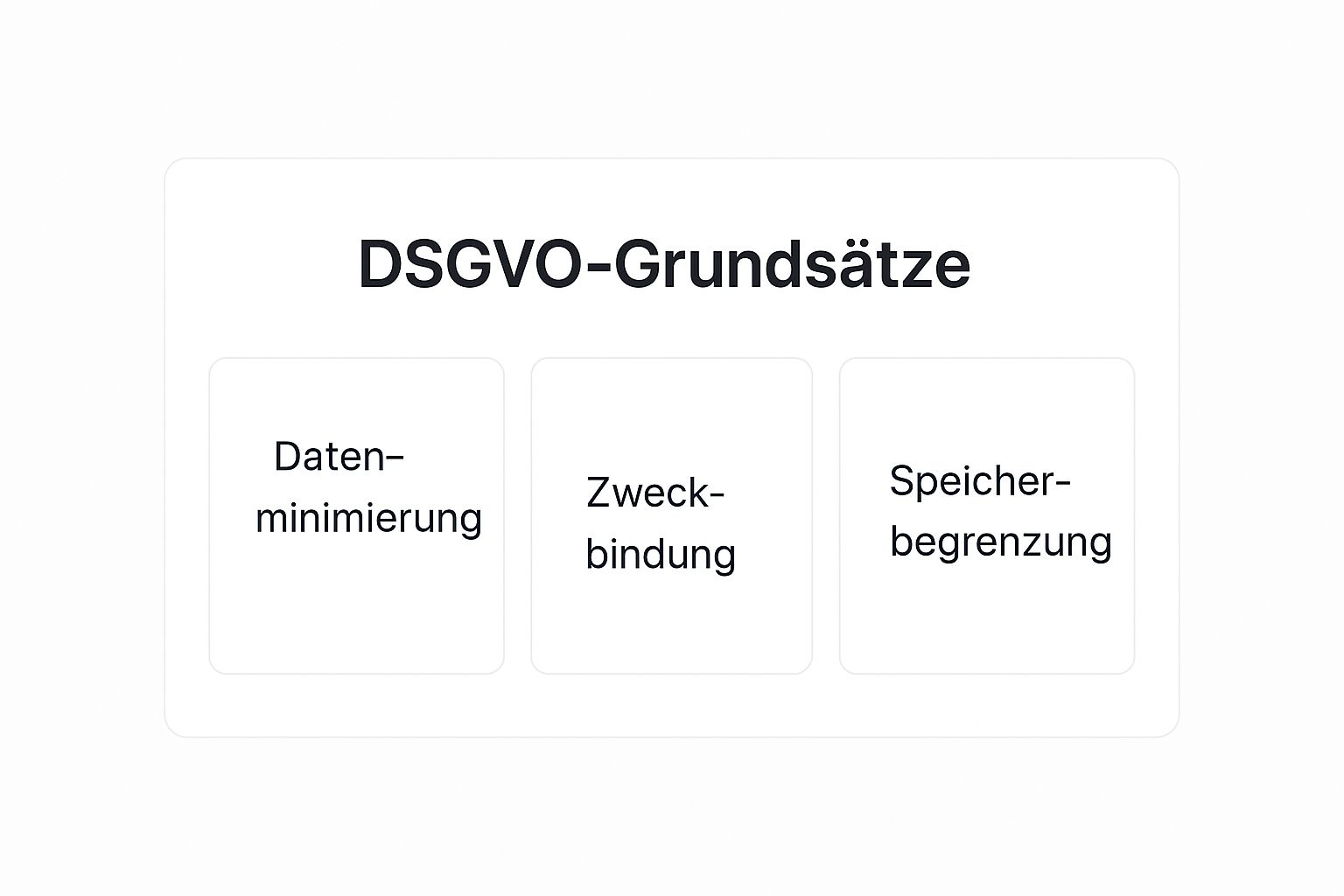
These three pillars — data minimization, purpose limitation, and storage limitation — are the very foundation that is seriously crumbling with many US tools.
How Supervisory Authorities Operate in Practice
Don't assume that data protection authorities only step in when there is a massive data breach. Often, a complaint from a single employee, a dissatisfied customer, or a vigilant competitor is enough to trigger an official review — and then the spotlight falls squarely on which tools you are using.
Since 2024, and with increasing frequency in 2025 and 2026, multiple EU data protection authorities have launched specific proceedings related to AI tools. Ireland's DPC has initiated formal investigations as lead authority for OpenAI in Europe. Poland's UODO and Germany's DSK have published guidelines for the lawful use of AI, which in practice mean: without a demonstrable legal basis, a data processing agreement, and a data protection impact assessment, you are heading straight for the next fine notice.
What follows is anything but pleasant:
- Investigations and bans: Authorities can demand comprehensive disclosures and prohibit the use of specific software at a moment's notice.
- Massive reputational damage: A public fine proceeding is a PR disaster. The trust of customers and partners is sustainably damaged afterwards.
- Exploding follow-on costs: In addition to the actual fine come steep invoices for lawyers, technical overhauls, and crisis communications.
Every executive must understand: the decision to use an AI tool is always also a compliance decision. The hoped-for efficiency gain must never outweigh the enormous risks of a GDPR violation.
innoGPT as the Contrast Solution: Your Digital Vault
Phew — after examining all the risks and the legal gray area surrounding ChatGPT data protection, it is time for solutions! Honestly, mainstream US AI tools feel like an open-plan office in a foreign country. You put your confidential notes on the table with no idea who might be looking over them. An uncomfortable feeling — and rightly so.
Now imagine the exact opposite: a massive digital vault, firmly anchored inside your own company building. Only you have the key — you and your team. Every single piece of information is safely locked away and always under your full control. That is the philosophy behind an absolutely GDPR-compliant solution like innoGPT. Here you don't hand over control — you keep it.

European Servers for Guaranteed Legal Certainty
The all-decisive difference begins at the very foundation: the server location. While your data takes a transatlantic journey with ChatGPT and suddenly falls under US law, with innoGPT your data stays exactly where it belongs — in Europe.
And that is far more than just a technical detail. It is a strategic decision that gives you real legal certainty.
- European jurisdiction: Your data is subject solely to European and German data protection law. No US law like FISA can simply compel access here.
- No data transfer risk: The entire dance around the EU-US Data Privacy Framework and its potential pitfalls (Schrems III)? Gone entirely. Your data simply does not leave the European legal area.
- Certified data centers: Hosting takes place in ISO-certified data centers meeting the highest security standards.
This geographic and legal anchoring in Europe is the absolute bedrock for ChatGPT data protection that you can truly rely on in your company.
Full Transparency Instead of a Black Box
Remember the OpenAI black box where you never quite know what happens to your data? A GDPR-compliant alternative turns this principle on its head. Here, complete transparency governs every single processing step. You always know exactly what is happening with your information, how it is processed, and — most importantly — when it is deleted.
A promise like "Zero Retention" — the iron-clad guarantee that your inputs and data are not used to train the general AI model — is not just a nice extra. It is the absolute prerequisite for professionally using AI with sensitive company data.
This clarity finally gives you as an executive the assurance that no trade secrets, no customer data, and no internal strategies are drifting away uncontrolled. You can finally use AI the way it was intended: as an incredibly powerful tool that sends productivity through the roof — without the constant worry of a data leak.
On-Premises — the Gold Standard of Data Sovereignty
For companies with the very highest security requirements — in financial services, healthcare, or research, for example — there is even a step beyond: local installation, also known as on-premises.
Imagine not just bringing the digital vault into your own building, but placing it directly in your own, shielded server room.
- Maximum control: The entire AI infrastructure runs on your own hardware. There are no external connections that are not personally controlled by you.
- Shielded environment: You create a hermetically sealed bubble for your AI applications. Data never leaves your corporate network at any point.
- Highest data sovereignty: This is the gold standard for anyone who treats their data as sacred. More security and control is simply not possible.
This option transforms the discussion about ChatGPT data protection from a vague risk assessment into a crystal-clear strategic decision. Instead of hoping that an external provider will somehow protect your data, you take protection into your own hands. What was an incalculable risk becomes a controllable, secure, and enormously valuable resource for your company — the definitive step from the open office to the impregnable vault.
Practical Guidance: Switching to innoGPT
Excellent! Deciding to reclaim control of your own data is the first and most important step. But how do you make the leap from an insecure tool like ChatGPT to a GDPR-compliant solution like innoGPT without productivity collapsing or projects grinding to a halt? With a clear checklist, the switch becomes a smooth and strategic win for your entire organization.
The good news: you don't have to reinvent the wheel. Your existing workflows are the perfect blueprint for casting them in a more secure and even more efficient form. The goal is not to eliminate AI, but to place it on a solid, legally sound foundation.

Checklist for Switching from ChatGPT to innoGPT
For project management & leadership:
- [ ] Conduct a risk audit: Where is generative AI already being used informally? Identify processes involving the most sensitive data (e.g., HR, Legal, R&D).
- [ ] Communicate clear guidelines: Develop a binding company policy mandating the exclusive use of approved, GDPR-compliant AI tools.
- [ ] Plan a pilot phase: Start with a pilot project in one department. Use the learnings for the company-wide rollout.
- [ ] Involve the Data Protection Officer: Coordinate the switch and new processes closely with your DPO to meet all compliance requirements.
For marketing & sales:
- [ ] Transfer your prompt library: Collect your most effective prompts for campaigns, emails, or social media posts and test them in innoGPT.
- [ ] Connect your knowledge base: Feed innoGPT with your product brochures, case studies, and brand guidelines. You'll get perfectly tailored content aligned with your company.
- [ ] NO customer data in prompts: Ensure that even in the secure environment, no personal customer data is entered into prompts unless an explicit legal basis exists.
For IT & development:
- [ ] Analyze existing processes: Where can innoGPT make existing processes (e.g., code generation, documentation) more secure and efficient?
- [ ] Evaluate API integration: Assess how innoGPT can be integrated via its API into your existing systems (e.g., Jira, Confluence) to avoid media breaks.
- [ ] Identify training needs: Offer targeted technical training sessions showing how to work securely with the new solution and protect sensitive code snippets or configurations.
The switch is so much more than a purely technical migration. It is a strategic turning point that sharpens awareness of ChatGPT data protection across the entire organization and truly brings a culture of data security to life.
The usage is more intensive than you might think: research shows that in Germany, around 9 percent of users use ChatGPT multiple times a day, with a further 18 percent using it several times a week. At this frequency, a watertight security concept is not an option — it is a must.
A new tool is only ever as good as the people working with it. Be transparent, explain the "why" behind the switch, and demonstrate the tangible benefits of the new, secure solution. This not only ensures GDPR compliance — it ultimately even boosts efficiency, because the AI can finally work safely with your internal knowledge.
The Most Pressing Questions About AI and Data Protection
Almost there! We've examined the risks, discovered the secure alternative, and paved the way for the switch. But in my experience, a few tricky questions always remain — ones that keep a responsible executive like you up at night. That's why I've gathered the most common and important questions about ChatGPT data protection here — with clear, direct answers. Think of this section as your personal FAQ for the final lingering uncertainties.
Is the Enterprise Version of ChatGPT Really a Safe Bet?
One of the most frequently asked questions revolves around ChatGPT's paid enterprise versions. OpenAI offers two enterprise options — ChatGPT Enterprise and ChatGPT Team — with different data protection guarantees. With ChatGPT Enterprise, OpenAI promises that inputs are not used for training public models and that data is not shared. ChatGPT Team has weaker guarantees and is not suitable for sensitive company data. Sounds fantastic at first glance for Enterprise — but does it really solve the core problem for us in Europe?
The honest answer is: unfortunately, only partially. Even if your data no longer flows into the large global training pool, the fundamental problem remains:
- The servers are still in the US: Your data leaves the European legal area. It therefore continues to be subject to US laws like FISA, which can grant US authorities access to your company data in certain circumstances.
- The legal gray area persists: The core problem of data transfer to a country without an adequate level of data protection is not resolved by this. The legal situation remains unstable — especially given the Schrems III debate.
- No real data sovereignty: You continue to hand control over your data to an external provider. On-premises installation in your own data center is simply not an option.
The Enterprise version therefore removes one risk (training) while leaving the fundamental GDPR conflicts (data transfer, US access) untouched. For companies that need to be on the safe side, that is simply not enough.
Are There Other Secure Alternatives Besides innoGPT?
Absolutely! The AI solutions market is exploding and there are various ways to make generative AI safer. Some companies, for example, rely on open-source models hosted on their own servers. That is a viable path, but it requires enormous technical expertise, substantial upfront investment in hardware, and a team dedicated full-time to maintenance and updates.
Other providers use European cloud providers. The decisive advantage of a specialized solution like innoGPT, however, is that multiple security aspects are bundled into one coherent package:
A truly secure enterprise AI solution is so much more than just a language model hosted in Europe. It is a complete package consisting of guaranteed GDPR compliance, a strict zero-retention policy, the option for on-premises installation, and seamless integration into the existing IT landscape.
innoGPT was built from the ground up for the demanding requirements of the European market. It is not a US solution that was retrofitted — it is a system where ChatGPT data protection was at the center from the very first line of code.
Can't We Simply Anonymize All Personal Data?
The idea sounds so compellingly simple: we just delete all names, addresses, and customer numbers from our prompts, and everything is fine. In practice, unfortunately, things look very different. This approach is not only extremely error-prone — it is often simply impossible. Who can honestly guarantee that no internal project number, customer detail, or piece of information slips through that, in the right context, immediately makes a person identifiable again?
Even data that looks anonymous at first glance can become personal again through context. If you describe "the sales manager in Anytown who has been with the company for 15 years," that person can be identified almost instantly in most companies. Manual anonymization is not a reliable strategy — it is a risky game of chance.
How Do We Train Our Team to Handle Sensitive Data?
The best technology achieves nothing if people don't know how to use it. A lived culture of data security is absolutely essential.
Here are three golden rules for your team:
- Create awareness, not fear: Educate your team about the risks, but focus on the positive — namely the new, secure solution. Show them how they can finally use AI without worry to do their work better and faster.
- Define clear ground rules: Create a simple, understandable guide. What can go into the AI, and what absolutely cannot? Are there particularly sensitive projects? Clear rules provide security and prevent mishaps.
- Make security a habit: Integrate the topic of data protection into your regular team meetings. Designate a point of contact for questions. When security is perceived as a normal part of everyday life, it gets lived.
Ultimately, choosing a GDPR-compliant AI platform is an investment in the digital sovereignty and future of your company. You are not just protecting your data — you are finally giving your team the freedom to safely unleash the full power of AI without compromise.
Are you ready to place generative AI on a secure, GDPR-compliant foundation and reclaim full control of your data? Discover innoGPT and find out how to perfectly combine efficiency and legal certainty.
EU AI Act and GDPR: What This Means for ChatGPT Users in Enterprise
On August 2, 2024, the EU AI Act officially entered into force — and since early 2026, the central obligations for providers and users of AI systems have been binding. This is a paradigm shift: previously, GDPR was the primary legal framework for enterprise AI use. Now, a second regulatory regime — specifically tailored to AI — has arrived that companies must know and comply with.
What exactly is the EU AI Act?
The EU AI Act is the world's first comprehensive AI regulation. It classifies AI systems into risk categories — from "minimal risk" to "unacceptable risk" — and attaches different obligations to each category. Generative AI like ChatGPT falls under the "General-Purpose AI" (GPAI) category, making it subject to specific transparency and documentation requirements.
What does this mean concretely for ChatGPT users?
For companies using ChatGPT or similar AI tools, the EU AI Act creates new obligations on two levels:
First, as users (referred to as "deployers" in the AI Act): anyone deploying an AI system in their company must ensure that the AI is used in accordance with the provider's instructions, that human oversight is guaranteed, and that employees working with the AI are appropriately trained. There is also a transparency obligation: when AI-generated content is delivered to humans — for example, automatically composed emails or chatbot responses — these must be labeled as AI-generated.
Second, in combination with GDPR: the EU AI Act and GDPR complement each other but also overlap. Both require documentation, risk analysis, and accountability. For high-risk AI systems (such as those used in HR for applicant screening), companies must conduct a comprehensive conformity assessment — analogous to the data protection impact assessment required under GDPR Article 35.
The Transparency Obligation: AI Must Identify Itself as AI
One of the most important innovations from the EU AI Act is the transparency obligation for AI-generated content. Concretely: if your company uses ChatGPT to communicate automatically with customers — whether via chatbot, generated email, or AI-drafted offer — this must be disclosed to recipients. Failure to do so risks violations not only of the AI Act, but also of Germany's UWG (Act Against Unfair Competition), which prohibits deception in commercial transactions.
Documentation Requirements and Audit Trails
The EU AI Act requires companies using GPAI systems to maintain traceable documentation of their usage. This sounds bureaucratic but makes sense: in the event of a dispute — whether before an authority or a court — you must be able to demonstrate how, for what purpose, and under what conditions you used the AI. With cloud-based AI tools like ChatGPT, this is difficult because you have no insight into the provider's technical infrastructure and logs are typically held by the provider.
Where innoGPT Does Better
innoGPT was built from the ground up as a platform that meets both GDPR requirements and those of the EU AI Act. This means: complete transparency over data processing, European infrastructure, clear audit trails, and usage governance that enables control at the enterprise level. Companies that adopt a GDPR-compliant platform today are also better equipped to meet the growing requirements of the EU AI Act — without having to launch costly compliance projects after the fact.
Practical Checklist: Is Your AI Tool GDPR-Compliant?
Theory is fine — practice is better. Many companies know that GDPR compliance is important, but have no clear picture of how to actually assess their AI tool's compliance. This checklist gives you a concrete tool to work with. Go through it point by point — the more items you have to answer "No," the more urgently you should reconsider your current AI setup.
1. Server Location and Data Transfer
- Is data processed exclusively on servers within the EU or EEA?
- Is there a valid Data Processing Agreement (DPA) pursuant to GDPR Article 28 with the AI provider?
- If data is transferred to third countries (e.g., the US): is there a valid legal basis (e.g., standard contractual clauses plus a Transfer Impact Assessment)?
- Has a Transfer Impact Assessment (TIA) been conducted and documented?
2. Data Storage and Training
- Does the provider contractually guarantee that inputs are not used to train its models (Zero Retention)?
- Is the retention period for conversations clearly defined and contractually fixed?
- Can data be completely and verifiably deleted on request (right to be forgotten)?
3. Transparency and Data Subject Rights
- Have employees and, where applicable, customers been informed about AI use (information obligations under GDPR Articles 13/14)?
- Is there a documented process for handling access requests from data subjects?
- Are rectification requests (e.g., correcting incorrect data) operationally executable?
4. Risk Analysis and Documentation
- Has a Data Protection Impact Assessment (DPIA) been conducted pursuant to GDPR Article 35, where required?
- Is AI use documented in the Record of Processing Activities (RoPA)?
- Has the Data Protection Officer been involved in the decision and given their sign-off?
5. EU AI Act (binding from 2026)
- Is it ensured that AI-generated content delivered to external parties is labeled as AI-generated?
- Is there human oversight over AI-assisted decisions affecting individuals?
- Are employees using AI tools appropriately trained and informed?
- Is there documentation of AI use that can be presented in the event of an audit?
6. Organizational Measures
- Is there an internal policy governing which data may be entered into AI tools?
- Have the provider's technical and organizational measures (TOMs) been reviewed and documented?
- Is there an incident response procedure in the event of a data protection incident at the AI provider?
Evaluating the Checklist
If you run through this checklist for ChatGPT (even the Enterprise version), you will find a clear "No" or "unclear" for at least 8 to 10 items. This is no accident — ChatGPT was not primarily developed for European enterprise use under GDPR requirements.
With innoGPT, on the other hand, these points are addressed from the architecture up: European servers, a zero-retention guarantee, complete DPA documentation, clear audit trails, and governance features that give you control over AI use in your organization. Instead of laboriously patching compliance gaps, you start with a platform where data protection and governance were built in from day one.
This checklist is not a one-time document — it is a living tool. Review it at least annually, and whenever your AI provider changes its terms of service, privacy policy, or technical infrastructure. When in doubt: have your Data Protection Officer review it. It takes little time and protects against costly surprises.
Weekly AI news in your inbox
New models, practical tips & expert insights — free for everyone.
All articles: ChatGPT & Privacy

ChatGPT vs. Gemini: Why You Don't Have to Choose — All AI Models in One Secure Platform
chatgpt vs gemini: 2026 overview of performance, cost, and security — discover which platform best fits your AI requirements.

ChatGPT for Companies? Why European Businesses Need a GDPR-Compliant Alternative
Discover the risks of ChatGPT for companies and how InnoGPT, as a secure GDPR-compliant alternative, makes generative AI power usable for your business.

ChatGPT for Businesses: Why European Companies Need a GDPR-Compliant Alternative
ChatGPT for businesses? Learn how GDPR-compliant alternatives enable safe AI use and compliance in everyday work.
Use ChatGPT – Safely: The GDPR-Compliant Alternative for Businesses
Learn how to use ChatGPT safely and avoid GDPR risks. Discover innoGPT as the GDPR-compliant alternative that protects your data.