AI for Business: Everything About Safe Implementation, GDPR Compliance and Real-World Use
Find out how to use AI safely in your business and avoid data leaks and legal risks with GDPR-compliant solutions.
tl;dr:
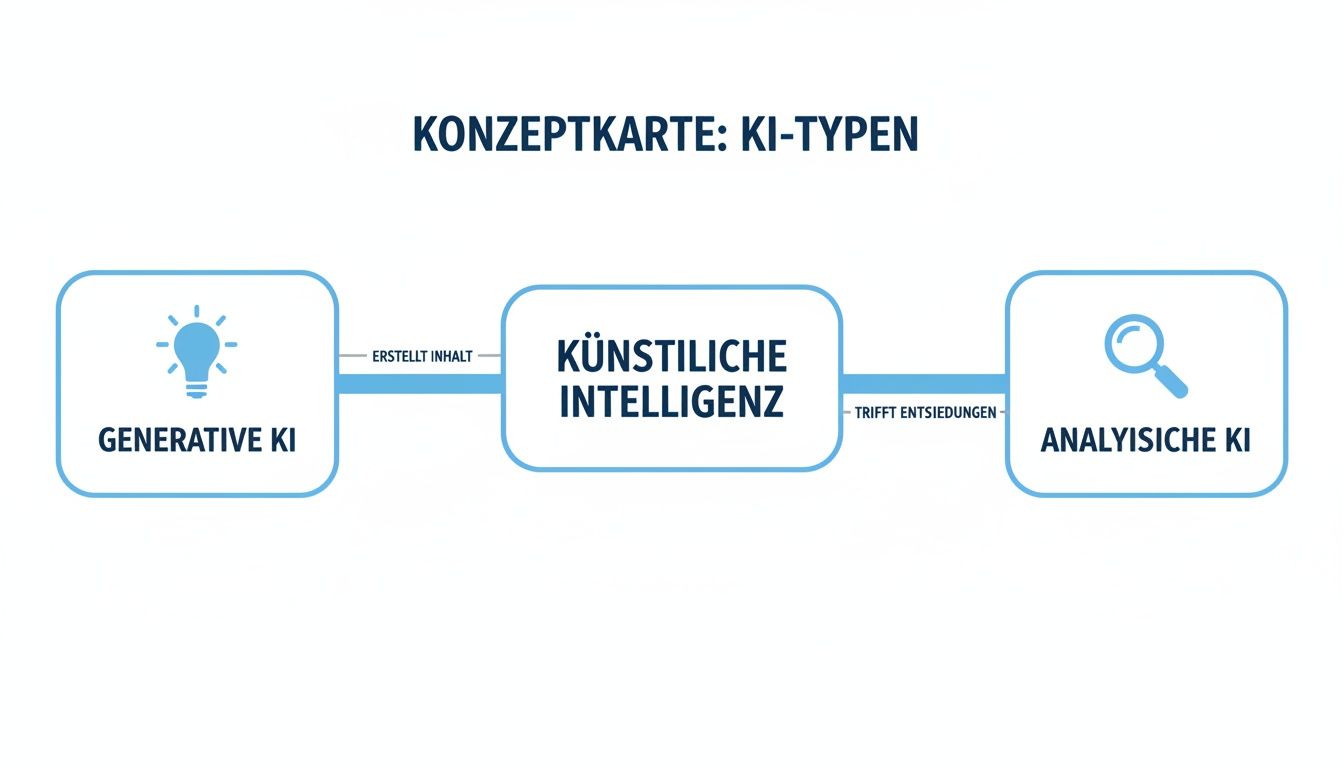
- What is generative AI? It creates completely new content such as text, code or ideas (e.g. ChatGPT, Claude). That sets it apart from analytical AI, which only evaluates existing data. This article focuses exclusively on generative AI.
- Why does data protection matter? When employees paste confidential company data into public US tools, that data lands on US servers and can be used to train third-party AI models — a massive GDPR risk and data leak.
- How do companies use AI safely? With GDPR-compliant AI platforms hosted on European servers. They bundle leading AI models such as GPT-4 and Claude in a protected environment and prevent both shadow IT and the leakage of trade secrets.
What is AI? The decisive distinction for your business
An employee pastes confidential customer data into ChatGPT to get a quick summary. What many people don't know: that data lands on US servers and can be used to train third-party AI. This scenario isn't rare — it's everyday life in many companies and a massive security risk.
You wouldn't hand your house key to someone whose address you don't know. With free AI tools, companies do exactly that with their most valuable data — without knowing where it ends up, who has access, or how long it's stored. Time for your own, secure set of keys.
To understand the risks and opportunities of artificial intelligence (AI), we first need to distinguish clearly. For businesses there are two decisive types of AI:
- Analytical AI: the data detective. Its job is to analyse existing data sets (e.g. sales figures) to spot patterns and trends. It answers questions like: "Which product sells best?" It optimises what already exists.
- Generative AI: the creator. Instead of just analysing, it creates entirely new content: text, code, concepts, images. Prominent examples are ChatGPT by OpenAI, Claude by Anthropic and Gemini by Google. It's also called a large language model (LLM).
This guide focuses exclusively on generative AI, because that's where the biggest potential for efficiency gains lies — and the biggest danger to your data security.
Why AI is now indispensable for businesses
AI is no longer a future topic for companies — it's business-critical. It's a tool that today determines efficiency, innovation and competitiveness. Get it right and you secure decisive advantages:
- Efficiency gains: routine tasks like summarising meetings or drafting emails are done in seconds. A key-account manager saves an average of 5–8 hours per week.
- Competitive edge: teams can focus on strategic work instead of wasting time on repetitive tasks. The result: faster innovation and higher quality in customer conversations.
The question is no longer whether, but how you integrate AI into your workflows safely and under control. Blind action goes straight into a legal and security dead end.
The invisible danger: data protection risks at US providers
Uncontrolled use of free AI tools by employees creates dangerous shadow IT. Out of a desire for efficiency, people adopt tools that expose your company to massive risk:
- Data leaks: confidential information leaves your company's secure IT environment unprotected. Once gone, gone for good.
- GDPR violations: processing personal data on US servers is playing with fire and can lead to draconian fines.
- Loss of trade secrets: imagine your brilliant ideas and strategies flowing directly into the training data of global AI models. A nightmare for any innovative company.

Every employee who uses an unsecured AI tool is handing a digital house key to your most valuable company data to a complete stranger.
GDPR-compliant AI: what does that actually mean?
To harness the power of AI without losing control, you need GDPR-compliant AI. That isn't a mere formality — it's a strategic decision for data security and independence. A secure AI solution rests on three pillars:
- European hosting: your data never leaves the EU and is therefore subject to the strict protections of the GDPR.
- No training on your data: the provider contractually guarantees (zero-retention policy) that your inputs are never stored or used to train AI models.
- Full transparency: clear contracts, and you know at any time what happens to your data.
These three points are the foundation of real data sovereignty.
Data sovereignty: why European solutions are the game-changer
Data sovereignty means maintaining unrestricted control over your own digital information. You decide where your data sits and who can access it. Specialised European platforms are the game-changer here.
Platforms like innoGPT bundle all leading AI models (Claude, GPT-4, Gemini) in a GDPR-compliant environment — so employees get access to state-of-the-art AI without company data leaving the EU. Requests to the big models are anonymised, so you combine the best of both worlds: the innovative power of global AI and the uncompromising data protection of European standards. You'll find more details in our guide to GDPR-compliant AI.
Real-world use: concrete cases for safe AI
Theory is good, practice is better. Here are concrete examples of how safe generative AI changes everyday work:
- Key-account management: a key-account manager uses AI to create personalised customer presentations in minutes instead of hours — without customer data reaching third parties.
- Project management: notes from long meetings are turned into crisp summaries with clear to-dos at the push of a button.
- Marketing: from an internal strategy paper, the AI generates social media posts, blog article drafts and product descriptions that match the exact corporate wording.
- Sales: the AI writes tailor-made proposal emails and summarises complex customer requirements for the team.
Solutions like innoGPT take 30 to 60 minutes of pure writing work off employees' plates every day. This efficiency gain is driving the AI market, which in Germany will grow to 32 billion euros by 2028. Further insights on the German AI market at Statista confirm the trend.
Preventing shadow IT: how companies equip employees with safe alternatives
Bans against shadow IT don't work. The need for efficiency is stronger. The only sustainable solution is to give employees an alternative that is not only secure but also more powerful than the public tools.
A central, company-internal AI platform is the answer. It delivers:
- Access to the best AI models in a secure environment.
- Control and transparency for the IT department.
- Compliance with all internal policies and with the GDPR.
When the official solution is the best one, shadow IT loses its reason to exist.
Future: why speed matters in AI platforms
The AI market moves fast — new models appear every few weeks. If you rigidly commit to a single tool today, you'll fall behind tomorrow. Companies therefore need agile platforms.
A central AI platform acts as a hub that always integrates the best available models. Your company stays at the technological forefront without becoming dependent on a single provider. This agility is the key to building a real lead in a dynamic AI environment.
German mid-market companies have recognised this: 30 percent already use AI, and another 19 percent are planning to (DIHK on German companies staying the course in digitalisation). Instead of betting on individual tools, forward-thinking companies invest in flexible platform infrastructures — as described in our article on choosing the right AI platform.
Try InnoGPT free for 14 days — with all leading AI models, GDPR-compliant and hosted on European servers. Start your safe AI implementation today at www.innogpt.de.
Related articles
Generative AI in German: Why European Companies Should Choose GDPR-Compliant Solutions
Discover how to use generative AI in German in a privacy-compliant way, and how your company gains a competitive edge with GDPR-safe AI solutions.

The European ChatGPT alternative: Why companies rely on German GDPR-compliant AI
Discover a chatgpt alternative that is GDPR-compliant and strengthens data sovereignty. Why German AI solutions create trust.
Use ChatGPT – Safely: The GDPR-Compliant Alternative for Businesses
Learn how to use ChatGPT safely and avoid GDPR risks. Discover innoGPT as the GDPR-compliant alternative that protects your data.