AI Training That Truly Moves Your Team Forward
Get started now with hands-on AI training. We show you how to make your team fit for the future and sustainably boost productivity.

Let's be honest: AI training today is no longer a nice-to-have add-on, it's an absolute necessity for any forward-looking company. It puts the tools into your team's hands to use artificial intelligence productively, secures you a decisive competitive advantage, and lets you sleep more soundly at night because you have regulatory requirements like the EU AI Act under control.
Why AI training belongs on your agenda right now
The world of work seems to spin faster every day, and artificial intelligence is the unmistakable engine driving it. We see it clearly in many companies: an invisible divide is forming. On one side are the teams that confidently deploy AI tools like our innoGPT and push their productivity through the roof. On the other are those still clinging to old, manual processes.
The result is a two-tier system in the office. Some are flying, others stand still. But this is about so much more than pure efficiency. The ability to understand AI and use it strategically is becoming a new core competency – and that goes for almost every role in the company. A well-thought-out AI training programme is the only way to make sure everyone is on board and no one falls behind.
The gap between AI usage and know-how keeps growing
The numbers speak a clear language and show how urgent the need to act has become. While AI adoption in German companies is racing ahead, employee qualification is lagging miles behind.
Before we dive into the details, let's look at the current situation. The following table shows where Germany stands on AI today and what that means concretely for your training strategy.
The status of AI in German companies in 2026
This table summarises the most important metrics on AI adoption and the associated training needs in Germany, based on current studies.
Metric
Value
Meaning for your company
AI usage
36% of companies
The competition isn't sleeping. AI has firmly entered the mainstream.
Growth in AI usage
Doubled year over year
A clear sign that hesitation is no longer an option.
Companies without AI training
43%
Here lies your opportunity: with targeted training, you can leapfrog the competition.
Statutory obligation
100% of companies
The EU AI Act obliges everyone to ensure AI literacy.
These figures make it clear: anyone who fails to invest in their employees' knowledge now risks losing touch entirely.
AI usage is literally exploding. According to a brand-new Bitkom study from 2025, 36 percent of companies in Germany are already using AI – twice as many as the previous year. But this rapid development is opening up a dangerous skills gap: a startling 43 percent of these companies offer no AI training at all. You'll find more fascinating insights in the findings of the Bitkom report.
This discrepancy is a real business risk. Without the necessary know-how, the enormous potential of AI remains untapped, while the dangers of incorrect use grow.
"AI doesn't replace people, it replaces boring tasks. Good AI training empowers employees to focus on what really matters: creativity, strategic thinking and problem-solving."
This perspective makes one thing clear: it's not just about technology. It's about a completely new, smarter way of working.
Legal pressure from the EU AI Act
As if economic pressure weren't enough, regulators are now in the mix too. The EU AI Act, in force since the beginning of 2025, sets clear guardrails for the use of AI in companies.
Specifically, Article 4 of the regulation obliges companies to ensure their employees have sufficient AI literacy. This is not a casual recommendation but a hard requirement. Anyone who ignores it faces severe penalties of up to 30 million euros from August 2026 onwards.
A comprehensive AI training programme is therefore no longer just "nice to have", it's a central building block of your compliance strategy. It demonstrates that you are fulfilling your duty of care and have prepared your teams for the responsible use of AI.
Tap into the enormous economic potential
Beyond the risks and obligations, the biggest incentive lies in the gigantic economic potential AI holds. Forecasts suggest AI could boost German GDP by up to 4.5 trillion euros over the next 15 years.
But this incredible figure comes with a condition: 70 percent of the workforce must bring their AI skills up to date. Without a massive education push and targeted training programmes within companies, this potential remains pure theory. Every investment in AI training is therefore a direct investment in the future and success of your own business. Let's get to it.
How to design a training concept that really fires
Forget cookie-cutter training. An off-the-shelf AI training programme is like a suit that doesn't fit anywhere properly. It might look good but won't get you any further in everyday work. To celebrate real, tangible successes, you need a plan that fits your company, your teams and your goals like a glove.
A standard workshop can be a nice impulse, but lasting capabilities? They only emerge when we put in the effort to develop a truly thoughtful concept.
And that always starts by looking closely: where does it really hurt? In which departments are repetitive, manual tasks driving people up the wall? The answer is often surprisingly clear and the perfect starting point.
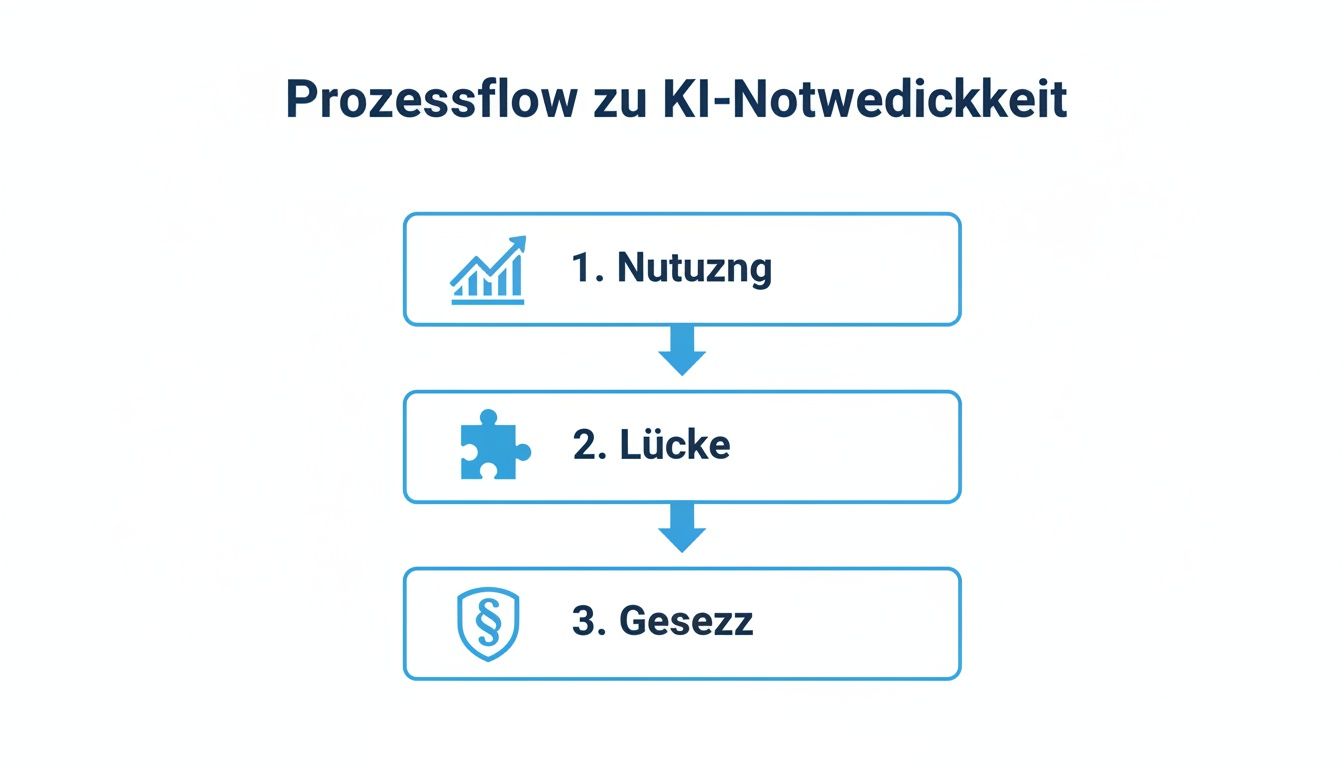
The graphic shows it well: AI usage is rising, creating a skills gap, and at the same time legal requirements are forcing us to act. Time for a plan.
The starting gun: a needs analysis that really goes deep
Leave the superficial surveys in the drawer. In my experience, the best insights come directly on-site. Go into the departments and sit down with the people doing the work. A short workshop or a few focused interviews work wonders for uncovering the real pain points.
To break the ice, I've had the best results with these questions:
- Where do you spend the most time on tedious writing or research tasks? Pure gold for identifying automation potential.
- Which information is super hard to find or laborious to dig through? This is where AI tools like innoGPT shine, capable of working through mountains of documents.
- Which tasks make you feel uncertain or simply overloaded? This helps us position AI as a supporting colleague, not a job killer.
Take your marketing team. Instead of asking, "Do you want AI training?", drill deeper: "Hand on heart, how long does it take you to put together a complete social media plan for the next month, including all copy and image ideas?" The answer will show you crystal clear where training with innoGPT will have the biggest leverage.
Define learning goals that inspire and are measurable
Once you know where the shoe pinches, get specific. Away with vague goals like "employees should understand AI". That motivates no one. Be specific and tie your goals directly to everyday work.
A strong learning goal always describes what an employee can do better, faster or more easily after the training.
A small tip from practice: people learn best when they see a direct, personal benefit. An abstract concept is quickly forgotten, but a skill that immediately makes my workday easier tomorrow? That sticks.
Here are a few examples of what this can look like for various departments:
Department
Practical learning goal with innoGPT
Expected gain
Marketing
Can independently draft a week's worth of social media campaigns in corporate wording.
Reduce time for content creation by 50%.
Sales
Can analyse 50-page tenders in 10 minutes and filter out the 5 most important knockout criteria.
Qualify proposals faster and increase win rate.
Legal department
Can have a standard contract reviewed for GDPR-critical clauses and have change suggestions formulated directly.
Significantly reduce manual review effort.
Customer service
Can answer recurring customer enquiries using AI-generated templates in three different languages.
Shorter response times and happier customers.
This clarity makes the value of AI training instantly tangible and participant motivation goes through the roof. Promise.
Build a modular curriculum for every level of knowledge
Your people are not all the same. Some may have already experimented with AI, others are hearing about it for the first time. A one-size-fits-all approach is a sure path to frustration. The solution is a modular curriculum.
Think of your training programme like a buffet, where everyone takes exactly what they need.
- Foundations module (the must for everyone): What is generative AI anyway? How does prompting work? And very important: what does the GDPR say? Ethical and legal guardrails are indispensable.
- Intermediate modules (department-specific): This is where it gets serious. Advanced prompting techniques, content creation for marketing, data analysis for sales or contract review for the legal department.
- Expert modules (for your "AI champions"): Train internal pioneers. They learn how to use innoGPT to build custom AI assistants based on internal documents (such as quality management manuals) and automate entire processes.
Such a flexible setup ensures you don't overwhelm anyone but don't bore anyone either. Beginners feel safely guided, and the pros can deepen their expertise in a targeted way. This is exactly how you create a learning culture that not only conveys knowledge but catapults your entire company to the next level.
From knowledge to application: the right training formats for your team
A clever training concept is one thing. But how do you bring all those great learning goals out of theory and into the heads – and above all into the daily work – of your people? Honestly: a single format will never be enough. Only the perfect cocktail of interaction, flexibility and real hands-on practice gets things rolling and ensures lasting success.
Just think about your team. There are those who really thrive in a workshop and have their best ideas exchanging with others. And then there are those who prefer to dig into a topic alone, at their own pace. A truly good AI training programme caters to both. It's about creating a learning atmosphere that motivates and ultimately delivers tangible skills for the job.
The trick is to combine formats so they reinforce each other and what's been learned clicks into place in everyday work straight away.
Get going together: the power of live workshops
Interactive workshops are the absolute heart of a successful AI training programme. They generate energy that's simply contagious. Especially at the start, this is invaluable for breaking down initial reservations and breaking the ice. Questions can be clarified immediately, ideas spun and first successes celebrated together as a team.
Picture this: your sales team sits together and learns live how to analyse a 50-page tender with innoGPT in a matter of minutes. The trainer demonstrates it, and everyone tries it out on a real example. These moments – this "Ah, THAT'S how it works!" – are priceless.
Workshops are the first choice for:
- Kick-off events: Get everyone on the same page and spark initial enthusiasm for the topic.
- Tricky topics: Such as advanced prompting techniques, where live demos and direct exchange are simply indispensable.
- Team challenges: Let departments tackle real problems together. It bonds people and the learning effect is huge.
E-learning: learning whenever and wherever it fits
Of course, not everyone can always make a fixed appointment. Calendars are full and day-to-day business calls. This is exactly where e-learning modules are the perfect solution. They give your employees the freedom to learn when it suits them best – morning, evening, lunch break. At their own rhythm.
An online module could, for example, show your customer service team how to answer recurring enquiries with AI-supported templates virtually at the push of a button. Everyone learns when they have time and can apply it immediately in the next customer conversation. This is learning that adapts to everyday life, not the other way around.
The decisive advantage of e-learning? It scales fantastically. Whether you're training 10 or 1,000 employees, the content is immediately available to all and ensures a uniform level of knowledge across the company.
Hands-on sessions: from watching to doing
OK, theory is important. But in the end only one thing counts: doing. Hands-on sessions are the moment of truth, when knowledge becomes capability. Here, people don't just listen, they click, type and try things out. Your people work directly in the system – for example with innoGPT – and solve tasks from their own area of work.
This focus on application is the be-all and end-all of sustainable AI training. Give your team concrete, practical exercises where they immediately feel the added value for their own work.
Practical examples for hands-on exercises with innoGPT:
Exercise
Department
Goal
"Meeting marathon in 60 seconds"
Everyone
Summarise the last 15-page meeting protocol in 5 crisp bullet points.
"The QM assistant"
Quality management
Build an AI assistant that answers questions based on the current QM manual.
"The international enquiry"
Customer service
Translate a complex customer enquiry from English and formulate a professional response in German.
"The campaign turbo"
Marketing
Develop a complete social media campaign for a new product, including 3 posts and matching image suggestions.
These are more than just exercises. They're the ultimate proof that AI is not an abstract monster but a seriously powerful tool that makes the job easier. Immediately. When you mix these formats cleverly, you create a learning culture that doesn't just convey knowledge but truly enables your employees to use AI confidently and productively.
How to master data protection and data security in AI use
Hand on heart: when introducing AI into your company, data protection and security are not a tiresome obligation but the absolute foundation. Excitement about new possibilities must never lead us to turn a blind eye when it comes to data security. That's exactly why every professional AI training programme must include a substantial block on legal and technical safeguards – only then are your people and your company truly safe.
The good news is: using AI safely is no rocket science. It just takes the right know-how and the right tools. Once your team has understood which data is sensitive and how to protect it, everyone can unleash the power of AI completely free of worries.
Take legal requirements seriously: the EU AI Act is a wake-up call
The days of being able to close your eyes to AI and the law are definitively over. The legal framework is becoming clearer – and the rules stricter.
Since 2 February 2025, it's official: Article 4 of the EU AI Act mandates demonstrable AI literacy for everyone using AI professionally. And anyone ignoring this training obligation faces severe penalties of up to 30 million euros or 6 percent of global annual turnover from 2 August 2026. Yet many still hesitate: although 93 percent of companies rate the effort as high, in the German Mittelstand a startling 43 percent still offer no AI training.
This makes it absolutely clear: it's high time to act. A properly documented AI training programme is the best proof that you are fulfilling your corporate responsibility.
Choosing the right platform is half the battle
The smartest and easiest way to ensure data security? Bet on an AI platform that has been built secure from the ground up. Instead of training your employees to handle countless – often dubious – web tools, give them a central environment that you control.
This is exactly where solutions like our innoGPT play to their strengths, because they are purpose-built for secure enterprise use. When choosing, look for these decisive criteria:
- GDPR compliance: Not an option but an absolute necessity as soon as personal data comes into play.
- EU hosting: Ensures your data does not leave the European legal area.
- Zero-retention policy: A guarantee that your inputs and documents are not misused to train global AI models or stored permanently.
Security begins with the architecture. A platform developed according to the "privacy by design" principle takes a great deal of worry off your shoulders and creates a safe working environment for your entire team.
By providing such a platform, you minimise the risk of data leaks and GDPR breaches from the outset. This is the foundation on which all further measures build. Another decisive factor is careful handling of data. For detailed information on fundamental data protection principles, we recommend taking a look at the topic of data protection.
Technical safeguards everyone should know
Beyond platform choice, there are concrete technical measures that further secure your AI use. A good AI training programme must explain these points so that even less technically inclined employees understand what's happening behind the scenes for their security.
Technical measure
Its function in plain language
AES-256 encryption
Ensures that your data is unreadable garbage for unauthorised parties – both in transit and at rest. Extremely strong protection.
Single sign-on (SSO)
Allows people to log in with their normal company credentials. Makes password management much easier and more secure.
Role-based access control
Defines crystal clear who is allowed to do what. So marketing doesn't get access to sensitive HR documents and vice versa.
These mechanisms create a robust safety net. They give you full control over who does what with the AI. But technology isn't everything – complementary organisational precautions are also crucial. Learn more about organisational data protection measures in our companion article.
Measuring success and proving the ROI of your AI training
Every investment in AI training has to pay off – not just in feeling, but in hard numbers. The best training is worthless if you can't prove crystal clearly to management what concrete benefit it has delivered to the company. Enough of vague goals. Now it's about making success measurable and presenting the return on investment (ROI) so convincingly that no questions remain.
Fortunately, this isn't rocket science. Instead of getting lost in theoretical debates, we set very concrete key performance indicators (KPIs) that document the added value in black and white. Only when you put the success of your AI training into numbers does the measure transform from a pure cost centre into a smart investment that any management will sign off with a nod.
Defining the right metrics
Everything begins with defining the right measurements. These KPIs must be tied directly to your learning goals and show what has actually changed in everyday work. It's not about asking whether people thought the training was "good", but what has factually improved since.
Here are a few powerful examples from practice:
- Time saved per person: How many minutes or hours does a team member save daily by using AI tools like innoGPT? Often 30 to 60 minutes per day is an absolutely realistic figure – a gigantic productivity boost.
- Shorter handling times: Measure how much faster customer service now responds to enquiries, or how rapidly sales sends out proposals. A reduction of 25% is no rarity here.
- Increased output: How many blog articles, social media posts or internal reports does the marketing team now produce compared to before? Doubling content output is often surprisingly quick.
- Lower external costs: How much money do you save because you have to outsource less to external agencies or freelancers, for example for translations or copywriting?
These numbers are the hard currency you need for your argument.
The best way to convince management? Speak the language of management. And that language is numbers, efficiency and a crystal-clear ROI. Show that your AI training is not a cost factor but a profit centre.
Methods for measuring success
To gather these KPIs, the best approach is a clever mix of different methods. A combination of quantitative data and qualitative feedback simply paints the most complete picture.
Before-and-after analyses are gold
The simplest and most effective way to demonstrate progress is a direct comparison.
- Baseline measurement (before): Capture the relevant KPIs before the training starts. For example, have employees track their time on certain tasks for a week, or analyse the average ticket handling time in support.
- Follow-up measurement (after): Repeat exactly the same measurement four to six weeks after the training. The difference between the two values is your direct, measurable success.
Evaluate AI platform usage data
Modern platforms like innoGPT deliver valuable insights straight from the system. Take a look at the dashboards and usage statistics:
- How many employees are actively using the tool?
- Which features are particularly popular?
- In which departments is usage skyrocketing?
This data shows you not only the success but also where you may need to fine-tune to further increase adoption.
Gather qualitative surveys and feedback
Numbers are the foundation, but the stories behind them bring them to life. Run short interviews or anonymous surveys. Don't just ask "How satisfied are you?", but go deeper: "Describe a concrete example where the AI training helped you solve a problem much faster."
Calculating and presenting the ROI
Now we bring it all together. The ROI is the one figure everyone is interested in at the end. The formula is simple:
(Net gain from the investment / cost of the investment) x 100% = ROI
The gain is derived from your KPIs, converted into euros. Multiply the time saved by the average hourly rate and add the saved external costs. The costs are simply the outlays for training and licences for the AI platform. If you want to draft a convincing business case for your AI project, our guide offers detailed instructions and templates.
Prepare a short, visually appealing report. Show the most important KPIs, present the ROI and back it all up with one or two strong quotes from the team. This makes the success of your AI training tangible for everyone in the company – and paves the way for future investments in your employees' competencies.
Your questions about AI training answered
You're planning AI training but a few question marks are still floating around in your head? Completely understandable. From countless conversations with companies, we know exactly where the shoe pinches. That's why we've collected the most frequent questions and answer them here – honestly, directly and from practice for practice.
Let's clear away the typical concerns. Because one thing is certain: a properly run AI training programme is not a cost factor, but the spark that catapults your team into the future.
Which departments benefit fastest from AI training
Honestly? The fastest and biggest wow effect arises wherever a lot of writing, researching, conceiving and communicating happens. Just think about your marketing and sales teams. With the right AI skills, colleagues suddenly conjure proposals, presentations and entire campaigns out of thin air in a fraction of the time.
And your customer service? Imagine enquiries being answered not just faster, but multilingually and at consistently brilliant quality. The HR department also experiences a huge boost, whether it's writing job ads that truly engage or in internal communication.
The trick is to start exactly where repetitive, time-consuming tasks pile up. That's where AI tools like innoGPT unfold their superpowers. We regularly see savings of 30 to 60 minutes per employee per day – a gain you'll feel immediately on the time clock.
How to inspire your team for AI and dispel reservations
Every change is initially met with scepticism. That's human and completely normal. The absolute key to getting your team on board is two things: radical transparency and a crystal-clear focus on the personal benefit for each individual. The most important message must come through loud and clear: AI doesn't replace you, only the most annoying parts of your job.
An unbeatable tip from practice: start a small pilot project with an open-minded team. As soon as the first colleagues are ecstatically telling people in the kitchen how they summarised a tedious meeting protocol with innoGPT in 15 seconds, a wave of curiosity rolls through the company all by itself.
Hammer the benefits home again and again:
- An end to the small stuff: Finally no more dull routine tasks.
- More time for what really matters: The mind is freed for creativity and strategic flashes of inspiration.
- A serious career plus: Anyone who masters AI is perfectly set up for the future.
Nothing is more convincing than your own aha moment. A free trial of AI platforms is the perfect way to make these benefits palpable without any risk. This is how initial scepticism turns into pure enthusiasm.
How to ensure that what's been learned actually gets applied
AI training is not a sprint that ends on the last workshop day. The real success only shows when the new knowledge is firmly anchored in everyday work. Sustainability is the magic word here, and you achieve it through a smart combination of seamless integration and continuous motivation.
Build the AI tool directly into daily workflows and familiar programmes. Connecting innoGPT to Microsoft Teams or SharePoint is a prime example. Usage must become as simple and self-evident as writing an email.
Something else that has proven extremely effective: appoint dedicated "AI champions" in the teams. These colleagues are the first point of contact, share their best tricks and act as internal motivators. Regular, snappy update sessions where new use cases and success stories are celebrated keep the energy high. Small competitions or gamification elements can provide an extra motivation boost.
In the end, however, it's crucial that leadership leads by example. When the boss naturally uses AI for their own tasks, it becomes the new standard in the company. The team will follow.
Want to experience for yourself how AI can unleash productivity in your company? innoGPT offers the secure and powerful platform to make your teams fit for the future. Start your free 7-day trial at https://www.innogpt.de and discover the full potential.
Related articles
Create Presentations with AI – Save Time and Wow Your Audience
Create presentations with AI: Discover how AI tools deliver professional drafts in minutes, save you time, and help you wow your audience.
How forward-thinking leaders revolutionise their teams with secure AI — without leaking data to US corporations
Discover how to deploy AI in management securely, stay GDPR-compliant, and empower your team without data risk. For leaders in the mid-market.
ChatGPT Alternatives: The 12 Best Tools in 2025
Looking for a ChatGPT alternative? Discover the 12 top alternatives in 2025, with overviews, pros and cons, and the criteria that matter most.