Upload PDFs Safely to AI Assistants: GDPR-Compliant Alternative to ChatGPT
Learn how to stay GDPR-compliant when uploading PDFs to ChatGPT. Discover secure alternatives for your company and protect sensitive data.
tl;dr:
- ChatGPT's PDF upload feature is convenient but poses data-protection problems for companies in Europe.
- Sensitive documents such as contracts, reports, or customer data end up on US servers outside the EU and could be used for AI training.
- InnoGPT offers identical functionality with full GDPR compliance, European servers, and guaranteed data security.
The invisible risk: where do your business PDFs really travel?
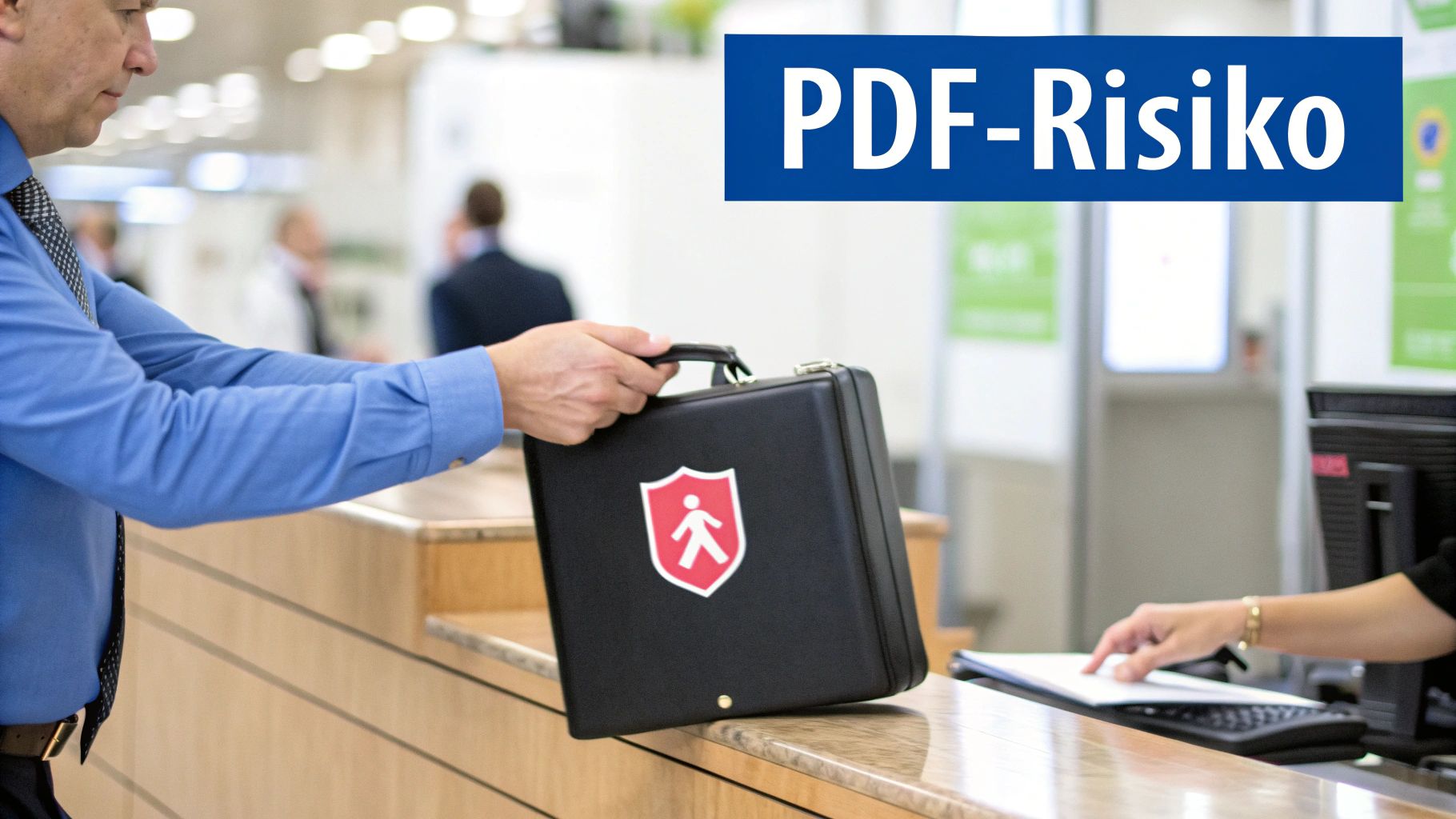
Imagine checking your suitcase at the airport – without knowing which country it's flying to, who's opening it, or whether you'll ever see it again. Absurd? That's exactly what happens when you upload confidential PDFs to ChatGPT.
The temptation is, of course, huge. Quickly analyze a 50-page customer contract during the project-management day, pull the key takeaways from an internal market analysis, or distill a long project documentation. Being able to upload a PDF to ChatGPT feels like the ultimate shortcut. And technically speaking, it often is.
That uneasy gut feeling …
But no sooner is the document in than the uneasy feeling surfaces: "Where does my data actually end up?" shoots through your mind. "Is it being misused to train the AI? Does it even stay in the EU?"
Believe me, these questions are not only justified, they're absolutely decisive for every company in Europe. A careless click here can not only ruin your customers' trust but also trigger seriously expensive fines under the General Data Protection Regulation (GDPR).
In day-to-day business, every minute counts, that much is clear. The efficiency that AI tools bring us is phenomenal. But that speed advantage must never come at the expense of data security and legal compliance.
There is a safe way!
This is exactly the point we're tackling. It's that everyday balancing act between wanting AI power and needing to retain sovereignty over your own data. We shine a light behind the scenes for you and show why US tools are a real problem for European corporate data.
This isn't about bashing brilliant technology like ChatGPT. On the contrary! It's about showing you a professional, secure, and above all GDPR-compliant path. In our comprehensive guide, you'll learn how to use AI to summarize a PDF without giving up control over your most valuable asset.
Because your data should work like travel: you always need to know where the journey is going and that your "luggage" arrives safely and intact. Fully under your control.
The ChatGPT trap: why PDF upload is risky for companies
ChatGPT is without question a brilliant tool. But the moment sensitive company data comes into play, enthusiasm quickly turns into a very tangible risk. Uploading a PDF to ChatGPT is technically trivial, but the crucial question is: what actually happens to your data behind the scenes?
As soon as you upload a document, it lands on servers in the US. That's precisely where the problem lies: data on US servers is not subject to strict EU data protection, but to the so-called CLOUD Act. This US law allows authorities to access data stored there – a nightmare for every European company that has to comply with GDPR.
The concrete risks at a glance
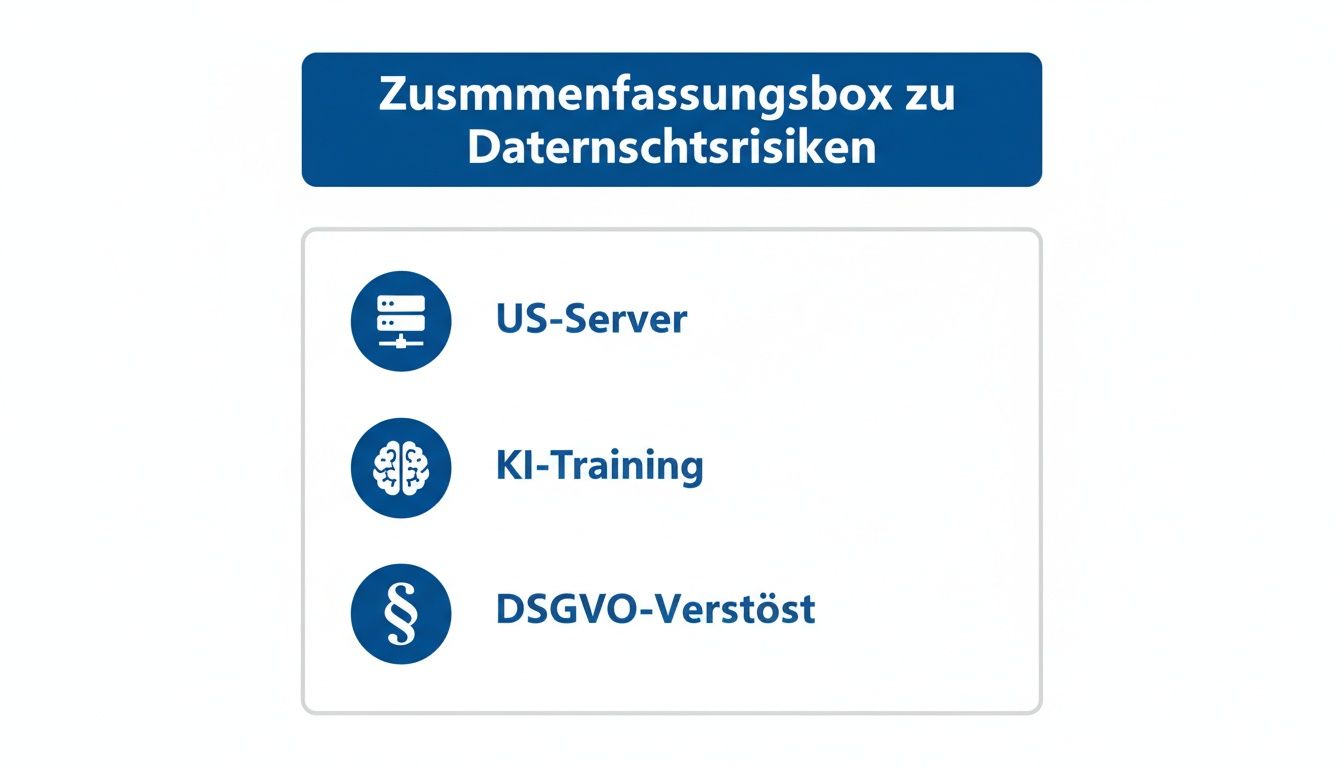
The biggest problem is the total loss of control. In the free and often even the paid standard versions of ChatGPT, your uploaded content can be reused to train the AI models. Concretely, this means:
- Server location USA: Your data leaves the EU and becomes subject to US laws like the CLOUD Act, which constitutes a GDPR violation.
- Use for model training: Contracts, financial reports, or internal strategies could become part of the global training dataset.
- No real control: There's no guarantee when or whether your data will ever be deleted, and you have no legal recourse, such as a data processing agreement (DPA).
This uncertainty is simply untenable for professional corporate use. Data protection here isn't a nice-to-have extra, but a business necessity.
For a company that takes GDPR seriously, there's only one logical consequence: uploading PDFs with personal or confidential business data to standard AI tools like ChatGPT is an absolute no-go. The contractual and technical basis for secure processing is simply missing.
The uneasy feeling that creeps in when you hit upload is therefore absolutely justified. The good news: solutions have long existed that give you the same technological power without having to give up control over your data. If you want to dive even deeper into the legal pitfalls, our post on the data protection challenges of ChatGPT provides valuable insight. It's time to harness the opportunities of AI – but in a secure and sovereign way.
InnoGPT: the grown-up alternative for professional use cases
OK, so the risks of uploading a PDF to ChatGPT are real – and a true no-go for every responsible company. Does that mean you have to forgo the fantastic efficiency gains of AI? Absolutely not! It only means it's time for a professional solution. One that's built for everyday business. And that's exactly where innoGPT comes in as "the grown-up alternative."
Instead of sending your sensitive data on an uncertain trip across the Atlantic, innoGPT offers you a safe harbor directly in Europe. Remember our suitcase metaphor? With innoGPT you not only know the "destination airport" (guaranteed German or EU servers), you also hold an official "baggage ticket" in your hand – the data processing agreement (DPA).
The direct comparison: ChatGPT vs. innoGPT
Let's make this concrete and put the two worlds side by side. Where ChatGPT offers vague promises and uncertainty, innoGPT provides contractually guaranteed assurances.
The contrast could hardly be greater. On one side a black box with no clear rules for your business data. On the other a transparent, contractually secured solution built from the ground up for the strict requirements of the European market.
FeatureChatGPT (Standard / Plus)InnoGPT (business solution)Server location🇺🇸 Data on US servers🇪🇺 German/EU servers with GDPR guaranteeData usage❓ Unclear data usage✅ Contractual purpose limitation, no model-training useCompliance❌ No enterprise compliance🔒 DPA, ISO certification, audit-readyThe table makes it clear: while ChatGPT doesn't meet fundamental enterprise requirements for data security and compliance, innoGPT offers a fully secured, professional environment.
At innoGPT, data sovereignty is not empty marketing talk, but the foundation of our entire platform. Your data belongs to you – before, during, and after every single analysis. We guarantee that to you in writing.
Security at innoGPT doesn't stop at server location. Our entire infrastructure is ISO-certified. That means our processes and security controls are regularly verified by independent auditors. That doesn't just make your compliance department happy – it also keeps your company "audit-ready" at all times.
Practical use cases that make a difference
OK, enough theory – let's get practical! Let's look at four typical business scenarios where a secure PDF upload makes the decisive difference.
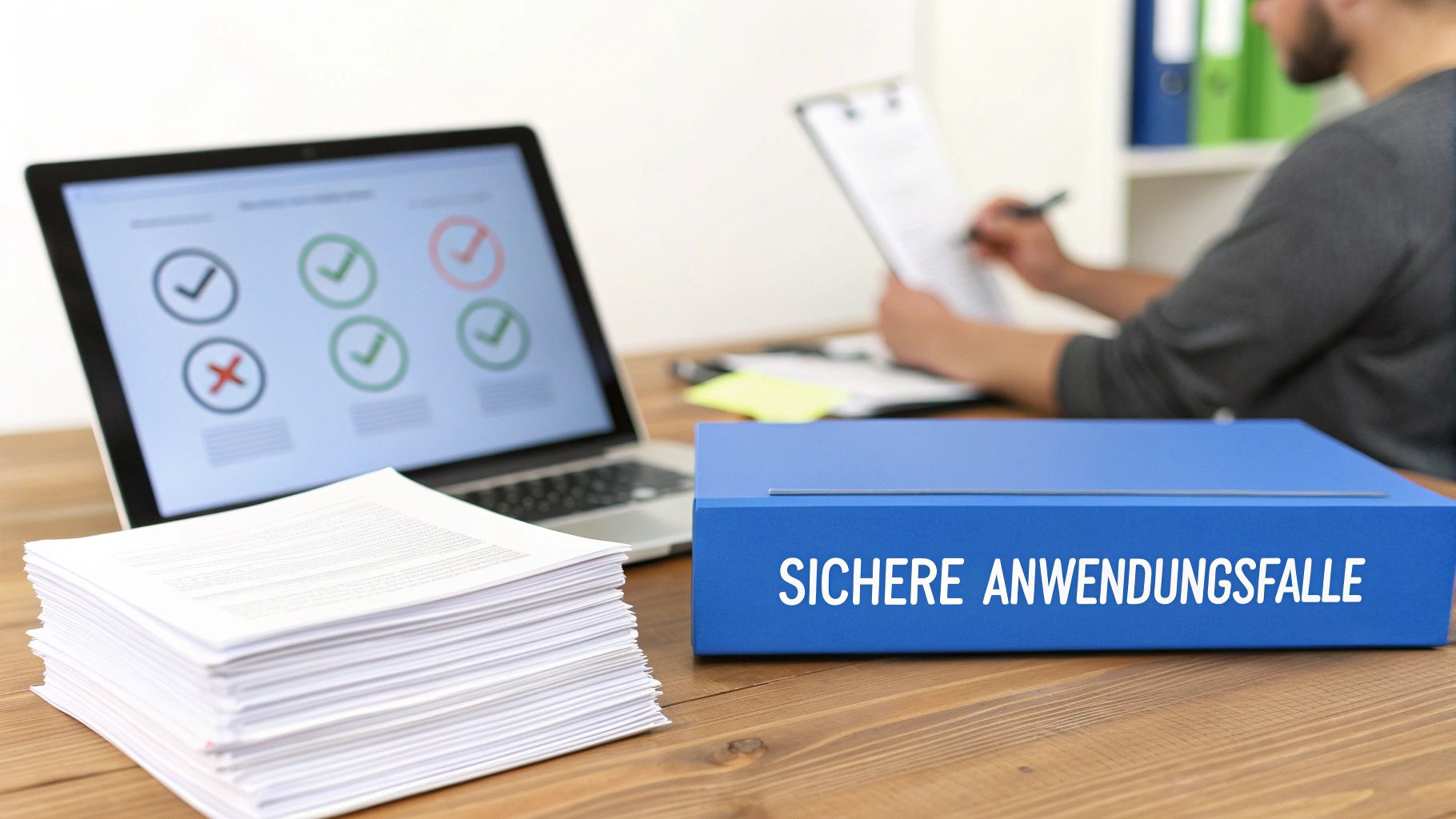
The use of AI-powered PDF tools has exploded in Germany since 2023. Whether mid-market or large enterprise, many report daily time savings of 30 to 60 minutes – just from quickly summarizing contracts or meeting minutes! Experts expect that by 2026 nearly 30% of German companies will rely on such smart helpers to stay competitive. More interesting figures on this can be found in these ChatGPT statistics in Germany.
1. Contract analysis for key accounts
A key account manager receives an 80-page master agreement from their most important customer. Instead of hours of digging, they upload the PDF securely to innoGPT and ask: "Which termination notice periods are hidden here?" or "List all our obligations." Within seconds the AI has all relevant data ready – and the highly sensitive contract data never leaves the secure EU environment.
2. Summarizing market research reports
A huge PDF report on the latest market trends lands in the inbox. The team uploads the report into innoGPT, and the AI conjures a punchy management summary, filters opportunities and risks, and organizes the most important data points clearly. The team can discuss it with solid grounding immediately, without the expensive study ending up in a US AI's global training pool.
3. Extracting action items from meeting minutes
The project meeting was important, the minutes exist as a PDF. The project lead uploads the document into innoGPT with the command: "Create a to-do list with responsibilities and deadlines from these minutes." Out comes a perfectly formatted list that can be copied straight into the project-management tool.
4. Reviewing compliance documents
A compliance officer has to align an internal handbook with a new legal requirement. They upload both PDFs into innoGPT and ask: "Which sections in our handbook contradict this new regulation?" The AI not only highlights the critical passages but even suggests rewordings directly.
Technical sovereignty: the best AI model for every task
If you opt for a secure alternative like InnoGPT, you get more than just a GDPR-compliant vault for your documents. The real kicker is the technological sovereignty you gain.
While with PDF upload in ChatGPT you're always chained to the current GPT model, with innoGPT you have access to a whole arsenal of the best AI models (such as Claude, GPT, Gemini) – all wrapped in a single, protected platform.
Flexibility is the real trump card
Imagine this: you can use the absolute best AI technology on the market for every individual task, without leaving your secure data environment.
- Creative text drafts? The linguistic finesse of GPT-4 is often unbeatable for that.
- Pulling precise data from tables in a PDF? Claude might take the lead with its analytical strength.
- Understanding complex relationships? Maybe this is where Gemini plays to its strengths.
You make this choice with a simple click. Your uploaded PDF doesn't budge a millimeter out of innoGPT's secure, European data space. You no longer have to choose between the best technology and maximum security. You get both.
The freedom to choose the optimal AI model for every task without having to spare a thought for security compromises – that's the real game-changer.
Instead of blindly handing over your valuable "data suitcase," you not only determine the safe destination airport but also pick out the most experienced pilot for the leg of the journey.
Your next step into a secure AI future
AI tools are incredibly practical, no question. But for European companies, the data protection risks of uploading PDFs to ChatGPT are simply too high. As soon as you click "Send," your sensitive company data ends up on US servers – outside your control and beyond the strict protection of GDPR.
This is where innoGPT comes in. You get the same impressive AI power, but with the decisive difference: your data stays safely in Europe. That gives you full control, contractual security via a DPA, and the certainty that your information will never be misused for other purposes. This shift toward secure, intelligent solutions is part of a bigger trend. You can see it everywhere: even companies like Bitfarms are pivoting from traditional business lines to AI computing. A clear sign that the future is data-driven and intelligent – but it has to be secure, too.
Are you ready to leverage the enormous productivity benefits of AI without making even the smallest compromise on data protection?
Test InnoGPT risk-free with your PDFs – your data stays in Europe, under your control. It's time to work not just smarter, but above all safer.
Your most pressing questions, our answers
Wondering what uploading PDFs to ChatGPT and data protection really look like? Totally understandable! Here I've gathered the most important points so you can make a secure and well-founded decision for your company.
Is it even legal for my company to upload PDFs to ChatGPT?
Honestly? It's a legal gray area with real bite. The main issue lies in the details, specifically in the data processing agreement (DPA) that GDPR mandates when third parties process your data. It simply doesn't exist in OpenAI's standard plans.
Imagine you upload a PDF file with customer data. That information ends up on US servers and is therefore subject to the so-called CLOUD Act. That means US authorities could gain access to it. Without a valid DPA and with this server location, you risk a serious GDPR violation. That can get expensive and cost you your customers' trust.
What does this "zero retention" at innoGPT mean in practice?
Zero retention is more than just a technical term – it's our promise to you that we don't hoard your data. We've spelled that out crystal-clear in our contracts.
For you in everyday work, that means:
- Your documents and the associated chats are simply not stored after the session. Period.
- Nothing you upload is ever misused to train AI models.
- Full control over your valuable information always stays with you.
Especially when it comes to trade secrets, strategy papers, or customer data, this very guarantee is the decisive factor.
Can innoGPT be integrated into our existing systems?
Yes, and that's one of the biggest advantages! We designed innoGPT from the outset to slot seamlessly into the tools your teams already use every day. We offer ready-made integrations for the big ones like Microsoft SharePoint, Microsoft Teams, and Google Drive.
That makes it incredibly easy. Your employees don't have to awkwardly hop between different programs – they can securely analyze documents directly from their familiar environment. That boosts not only productivity but also team adoption – all without compromising a shred on data security.
Ready to harness the power of AI securely and without data-protection headaches at last? Take the practical test! Try innoGPT risk-free with your own PDFs and feel the difference. Your data stays in Europe and always under your control – guaranteed. Find out more at https://www.innogpt.de.
Related articles
Zive alternative: innoGPT — workplace AI from Germany
Chat, knowledge base, search and tasks in one platform — bootstrapped, EU-hosted, ISO 27001-aligned.
Use AI in Your Company: How to Safely Adopt Generative AI (GDPR-Compliant)
Discover how to use AI in your company to boost productivity while staying GDPR-compliant and making a safe start.
Google Drive vs. GDPR: Why Europe Needs a Secure Alternative
Is Google Drive GDPR-compliant? Learn why US clouds pose a risk and how European alternatives truly protect your data.