Programming Your Own AI: A Beginner's Guide
Learn how to program your own AI. Discover proven step-by-step guides, tools, and real insights for your first AI project.
Many people dismiss the idea of programming their own AI as something reserved for the big tech giants. Wrong. The truth is that getting started has never been more accessible than it is today. Whether you prefer working with visual tools or diving straight into code, the goal is to turn that initial uncertainty into pure excitement and discover just how much is really possible.
Why building your own AI is an essential skill

Engaging with AI development is far more than a technical exercise. It is a direct investment in one of the most important skills of our future. Anyone who understands how AI models are built and how they work opens the door to entirely new career opportunities and can actively drive innovation within their own company.
You will not just learn how algorithms tick, but also how to read data correctly, identify patterns, and approach problems from a completely new perspective. The ability to make smart, data-driven decisions is invaluable across every industry, and is becoming more decisive every day.
How to find the perfect start for your first project
Don't worry, getting started doesn't have to be overwhelming. The trick is choosing the right path for your prior knowledge and goals. You don't need to start from scratch and reinvent complex neural networks from the ground up.
Essentially, there are two proven paths to begin with:
- The classic code-based route: Ideal if you already have programming experience, ideally in Python. You'll work with powerful frameworks like TensorFlow or PyTorch and have full control and flexibility over every detail of your model.
- The smart no-code/low-code approach: Perfect for anyone who wants to get started without deep programming expertise. With platforms like innoGPT, for example, you can build AI assistants for very specific tasks simply by uploading your own documents and data.
The table below compares the traditional, code-intensive approach with modern no-code/low-code platforms to help you decide which path is right for you.
Your path to your own AI: two approaches compared
Feature
Programming (e.g. with Python)
No-code/low-code platforms
Required skills
Deep programming knowledge (Python), data science, machine learning
Basic understanding of the use case, no programming skills required
Development time
Weeks to months
Hours to days
Flexibility
Maximum, every detail is customizable
Limited to the platform's features, but highly specialized
Costs
High personnel costs for developers, sometimes high computing power required
Transparent, often usage-based licensing costs, lower personnel effort
Ideal for
Complex, tailor-made solutions and fundamental research
Rapid prototypes, automation, and AI applications for subject-matter experts
Example
Custom image recognition model for medical diagnostics
Internal knowledge chatbot that responds based on company documents
Both paths absolutely have their merits. While the code-based approach requires deep technical understanding, no-code solutions deliver visible results almost instantly, and that is incredibly motivating in the early stages.
A look at the reality in German companies
How widespread is in-house AI development in Germany really? The answer depends heavily on company size. Recent data shows that 14.5 percent of large companies with more than 250 employees already develop their own AI methods. Among smaller firms, this share drops sharply, usually due to limited budgets and a shortage of skilled workers. You can find more on this in the report by the German Economic Institute.
AI development is no longer the exclusive domain of large corporations. Modern tools and platforms democratize access and enable smaller teams and even individuals to create impressive AI solutions.
At the end of the day, only one thing counts: taking the first step. Start with a small, manageable project. Automate an annoying, repetitive task in your day-to-day work, or analyze a simple dataset. Every small success will boost your confidence and pave the way for the truly big, exciting projects. This guide is your companion on that journey, so let's get started.
Choosing the right tools for your AI project
A great AI project doesn't begin with the first line of code, but with picking the right toolkit. This decision is the foundation for everything that follows. If you really want to roll up your sleeves and code, there is one clear recommendation: Python. And for good reason. The language is not only elegant and easy to read, it is also a true Swiss Army knife for data science.
But Python's real magic only unfolds through its enormous ecosystem. Imagine not having to start from zero, but being able to draw on a vast library of ready-made building blocks. That is exactly what countless libraries and frameworks designed specifically for machine learning offer you. You build on the work of thousands of brilliant minds around the world.
The heavyweights: TensorFlow and PyTorch
As soon as you dive deeper into the subject, you will inevitably stumble upon two names: TensorFlow and PyTorch. These are the heavyweights, the absolute leaders when it comes to building neural networks. Both are incredibly powerful, but they follow slightly different philosophies.
- TensorFlow: Developed by Google and known for its robustness. If you want to not only train a model but also actually run it inside an application later, TensorFlow is often the first choice. Thanks to the integration of Keras, getting started today is much friendlier than it was a few years ago.
- PyTorch: Originally developed by Facebook (now Meta), this framework has won over the hearts of researchers. Many find it more intuitive and more "Pythonic," which often makes experimenting and debugging easier. The community is huge and extremely helpful.
Which one is best for you? Honestly: in the beginning, it barely matters. Both are excellently documented and supported by massive communities. My tip: just try both briefly. Look at a few code examples and pick whichever feels better to you. You can always switch later.
The decisive factor for your success is not the framework, but your understanding of the concepts behind it. Whether you end up using TensorFlow or PyTorch is secondary, as long as you know how to prepare data, train a model, and evaluate its performance.
No data, no intelligence
Every artificial intelligence is only as smart as the data it is fed. That's the golden rule. You can have the most brilliant algorithm in the world, but without high-quality, relevant data, you'll only end up training digital garbage. And this is often where the biggest hurdle lies, especially for beginners.
So where do you get the valuable datasets?
- Public archives: Platforms like Kaggle, the UCI Machine Learning Repository, or Google Dataset Search are real treasure troves. There you'll find clean, prepared datasets for almost anything, from cat pictures to stock prices.
- Web scraping: Sometimes you need very specific data that isn't available for download anywhere. With tools like BeautifulSoup or Scrapy, you can pull it directly from websites. But be careful: always pay attention to the terms of use of the sites and the legal rules, especially GDPR.
- Creating data yourself: For very specific use cases, this is often the only way. That can mean taking hundreds of photos of a particular component, or meticulously logging process data. The effort is enormous, but in return, the data is perfectly tailored to your problem.
A classic beginner's mistake is to massively underestimate the effort required for data preparation. It is not unusual for up to 80 percent of the entire project time to go into collecting, cleaning, and labeling data. So plan generously rather than tightly for this step.
And remember: with modern language models, the quality of your instructions, the so-called prompts, is just as crucial as the quality of the training data. To become a real pro here, you should definitely look into the art of prompt engineering to understand how to steer an AI toward the results you want.
Building your first AI model in practice
Alright, now things are getting serious, and exciting. We're leaving dry theory behind and diving headfirst into practice. Think of this section as your personal roadmap, taking you from your first idea all the way to a working AI model. Don't worry, we'll tackle this in small, manageable steps.
And remember: your first model doesn't have to change the world. It's about going through the process once, learning from mistakes, and developing a feel for the subject. Once you've done that, the door is open for much bigger projects.
The non-negotiable truth about data
Before we even spend a thought on algorithms or training, we need to talk about the heart of every AI project: the data. It's an almost painful truth, but 80 percent of an AI model's success depends on the quality and preparation of the data. You could have the best algorithm in the world, but with garbage data, you'll only get garbage results.
Imagine you want to teach an AI to tell apples from pears. If you only feed it pictures of green apples and yellow pears, it will fail completely as soon as a red apple appears. Your dataset simply wasn't representative. And exactly this principle runs through every single AI project.
Data collection and preparation is the most critical and usually most time-consuming step. Plan plenty of time for it and be meticulous.
- Collect: Where does the data come from? Grab it from public archives like Kaggle, extract information from websites (but watch out: GDPR and usage rights), or, the royal road, build your own custom dataset.
- Clean: Real-world data is never perfect. You'll have to fill in missing values, hunt down duplicates, and correct errors. It's tedious, but absolutely critical for success.
- Labeling: Your AI needs to know what the correct answer is. In the apple/pear example, that means manually labeling every image: "This is an apple," "This is a pear." This process is called labeling or annotation.
The following workflow shows you the basic building blocks that come together on the path to your own AI.
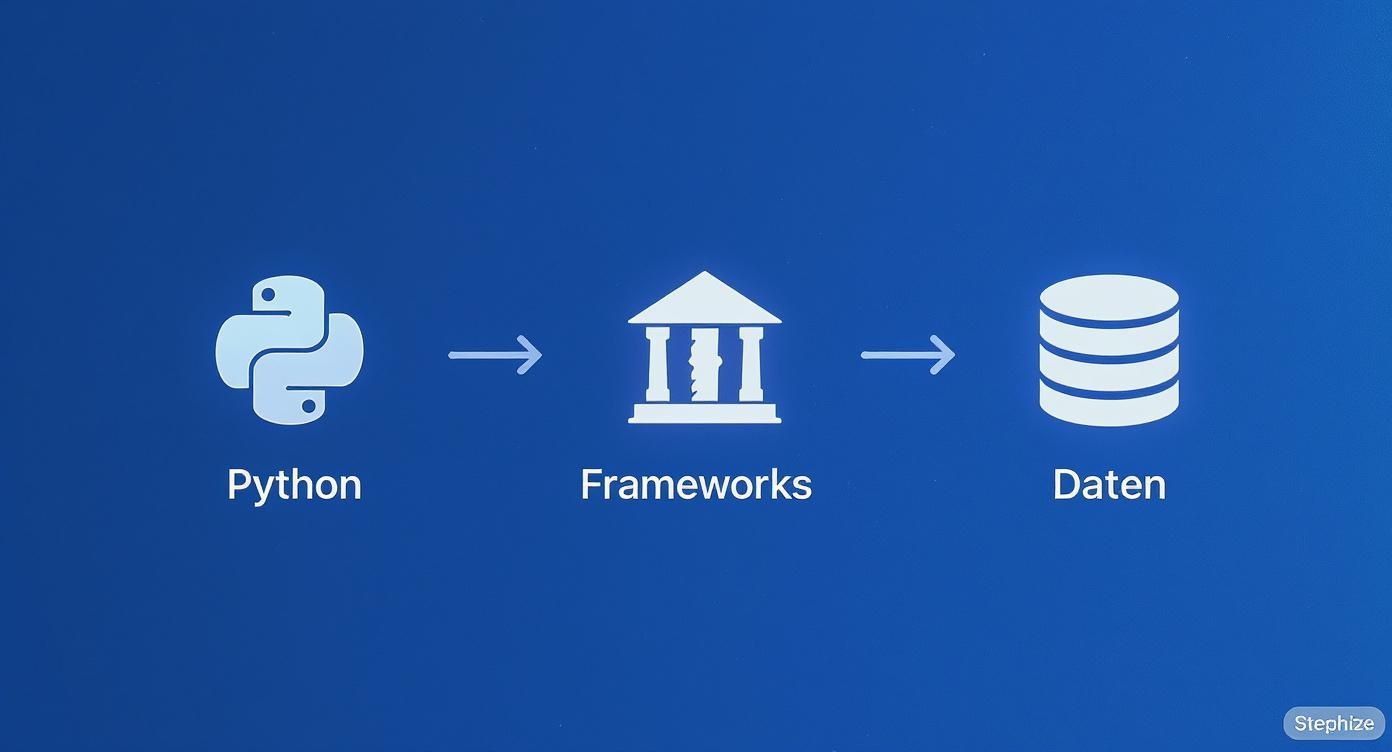
The graphic makes it clear: the choice of programming language, frameworks, and data are the three pillars on which your entire project rests.
Training: your model learns
Once your data is in top shape, the magic begins: training. Now you feed your clean data into the algorithm you've chosen. The model then tries to recognize patterns and connections in the data.
Think of it as a learning process. The model makes a prediction, compares it with the correct label from your data, calculates the error, and adjusts its internal dials to do better next time. It repeats this cycle thousands, sometimes even millions, of times.
Depending on the complexity and amount of data, training can take anywhere from a few minutes to days or even weeks. Patience is definitely a virtue here.
Fine-tuning: the art of refinement
The first result is rarely perfect. Often the model is still too inaccurate or, worse, it simply memorizes the training data instead of recognizing general patterns. This is called overfitting. And this is exactly where fine-tuning comes in.
In fine-tuning, you adjust your model's so-called hyperparameters. These are the dials you set before training, such as the learning rate or the model's complexity. It is a constant cycle of adjusting, retraining, and reviewing until you're happy with the performance.
A great tip for getting started: begin with an already pre-trained model and only adapt it to your specific data. This approach, also called transfer learning, saves you a tremendous amount of time and computing power.
Evaluation: how good is your AI really?
Congratulations, you have a trained and optimized model. But how do you know it's actually any good? Trust is good, verification is better. Evaluation is the moment of truth, where you objectively measure your model's performance.
For this, you need a portion of your data that the model has never seen during training: the test dataset. By unleashing your model on this unseen data, you simulate real-world use.
Depending on the task, there are different metrics for evaluating performance:
- Accuracy: What percentage of the predictions are correct? A simple starting point, but it often doesn't tell the whole story.
- Precision and recall: Extremely important with imbalanced datasets, such as in fraud detection, where fraud cases are thankfully rare.
- F1 score: A combined value of precision and recall that gives you a more balanced evaluation.
The goal is a model that not only shines on training data, but also reliably delivers in the real world with new, unknown data. If you'd like to dive deeper into the various ways to build your own AI, you'll find additional strategies and examples in our follow-up article. It is a constant process of learning and improving, and incredibly fun.
Successfully deploying your AI solution
Okay, your model is trained and delivers impressive results on your hard drive. A huge milestone, congratulations. But the real magic only unfolds when your AI goes out into the world and creates real value. Now things get serious: it's time for deployment. This is the crucial step that turns your clever experiment into a valuable tool for users or other systems.
The big question now is: where should your AI actually run? Essentially, you have two main routes to choose from, each with its own character and clear pros and cons.
On-premise vs. cloud: the strategic decision
This choice is more than just a technical question. It is a strategic decision for your project.
On-premise means running the AI on your own servers, in your own data center. This gives you absolute control. Every data flow, every configuration, everything is in your hands. This is often the only viable solution, especially in highly sensitive industries such as healthcare or finance.
The counterpart is cloud deployment. Here you rent computing power and infrastructure from major players like Amazon Web Services (AWS), Google Cloud Platform (GCP), or Microsoft Azure. The appeal of the cloud lies in its incredible flexibility. Need more power for a surge in demand? A few clicks, and capacity scales up. Quiet period? You scale resources down and save money. Especially in the beginning, this is usually the faster and more cost-effective way to get your AI live.
Think of the cloud like a fully equipped rental workshop: you have immediate access to professional tools without having to buy and maintain a single machine yourself. On-premise is building your own workshop, more effort, but you decide what color the walls are.
For most projects that come out of "programming AI yourself," the cloud is the most pragmatic and uncomplicated way to get started.
EU hosting and GDPR: a factor you cannot ignore
Especially in Europe, there's no getting around the topic of data protection. And that's a good thing. The General Data Protection Regulation (GDPR) sets clear rules for handling personal data. As soon as your AI interacts with data from real people, and it almost always does, you have to make sure your hosting is 100 percent GDPR-compliant.
This is exactly where EU hosting comes in. Many large cloud providers have understood this and operate data centers right in the EU, for example in Frankfurt, Dublin, or Paris. If you host your AI there, you can be sure that the data does not leave the European legal area. That saves you a lot of headaches.
When choosing a provider, pay close attention to these points:
- Server location: Are the servers guaranteed to be located exclusively in the EU?
- Data sovereignty: Does the provider commit to never using your data for its own purposes ("zero retention policies")?
- Certifications: Are key security certifications such as ISO 27001 in place?
Platforms like innoGPT have made exactly this their mission. They guarantee EU hosting and strict GDPR compliance from the outset, so you can focus on what matters: your AI.
Security and access control: not a "nice-to-have," but a must
As soon as your AI is online, it becomes a target. Securing your application is therefore not an optional extra, but an absolute foundation. You have to clearly define who or what is allowed to access your AI.
Be sure to put these security measures on your checklist:
- Authentication: Who are you? Every access must clearly identify itself, whether via login or secure API keys.
- Authorization: What are you allowed to do? Define precisely who can perform which actions. A regular user should never be able to retrain the model.
- Encryption: Always protect data, both in transit (via TLS) and at rest (e.g. with AES-256).
The gold standard here is role-based access control (RBAC). With it, you can fine-tune permissions and massively reduce your system's attack surface.
After deployment comes maintenance
Your work is not over once you go live, it just enters a new phase. An AI is not a finished product that you set up once and forget. It needs continuous care to remain effective over time. Monitoring is your most important tool here.
Always keep an eye on these metrics:
- Performance: How quickly does the AI respond? Are there any annoying latencies?
- Utilization: Are CPU, GPU, or memory under strain?
- Model drift: Is the quality of predictions declining because the data in the real world has changed?
If you notice that your model's accuracy is dropping (the dreaded model drift), it is time for retraining. You grab fresh, current data and train the model again to bring it back up to date. Plan these maintenance cycles in from the start. Because a well-maintained AI is a successful AI.
Tapping into Germany's AI ecosystem
When you set out on the journey of programming AI yourself, you are not doing it alone in a quiet room. On the contrary: you are stepping into an incredibly lively and growing scene. Germany has become a real hotspot for artificial intelligence in recent years, and this dynamic ecosystem offers you fantastic opportunities to take off.
Imagine being part of a movement driven by innovative startups, renowned research institutes, and visionary companies. This is exactly where the ideas and technologies of tomorrow are emerging, and you can be right in the middle of it. It's about networking, learning from each other, and growing together.
The vibrant startup scene as your engine
The startup landscape in particular is a clear sign of how much energy is in this field. The German AI startup sector is practically exploding, with around 687 active AI startups boldly forging new paths. Hotspots like Berlin with 209 and Munich with 136 founded ventures are true innovation hubs. This environment is perfect for you to find inspiration and learn from the best. Take a look at the latest statistics and trends on AI in Germany and see for yourself the potential lying dormant here.
At the same time, a growing talent pool is bringing fresh momentum. The increase in AI-focused degrees at German universities is impressive: while AI degrees made up only 13 percent of all computer science degrees in 2020, this share rocketed to a full 67 percent by 2024. That means more skilled professionals, more exchange, and a stronger community that you, too, can benefit from.
How to become part of the community
The easiest way to dive into this ecosystem? Get active and network. You don't have to wait until you're an absolute pro, just start right away.
- Attend meetups and conferences: In nearly every larger city, there are regular gatherings on topics like Python, machine learning, or data science. It's the perfect opportunity to meet like-minded people and gain practical insights.
- Get involved in online forums: Platforms like Stack Overflow, Reddit (e.g. r/MachineLearning), or specialized Discord servers are real goldmines of knowledge. There you can ask questions and benefit from the experience of others.
- Contribute to open-source projects: Nothing demonstrates your skills better than working on a real project. Browse GitHub for projects that interest you and start small, perhaps by improving documentation or fixing a small bug.
The value of a strong community cannot be overstated. You'll find not only technical help, but also motivation, new perspectives, and perhaps even your next job or co-founder. Be curious and open.
Your new skills as a career booster
The ability to program AI yourself is far more than just an impressive line on your resume. It's a real career accelerator that opens doors in practically every industry. Companies are urgently looking for people who not only apply AI, but also understand the logic behind it and can develop solutions themselves.
Whether in marketing, logistics, finance, or healthcare, an understanding of AI development makes you a valuable driver of change. You can optimize processes, develop new products, and take data-driven decisions to a whole new level. Use the momentum of Germany's AI ecosystem to sharpen your skills and position yourself as an expert in one of the most exciting future fields. Your journey starts now.
Common questions when you want to program your own AI
When you embark on the AI development adventure, you keep running into the same questions. I've gathered the most common ones here to help you clear up any last uncertainties and bring a bit more clarity to your path.
How much math do I really need to know?
Ah, the classic. I hear this question all the time. And the honest answer is: it depends on what you're planning.
To get started with no-code platforms or simply use ready-made libraries like TensorFlow or PyTorch, you don't need a deep understanding of math. All the complicated math is essentially already packaged into the tools for you.
But if you really want to go deep, optimize models, or even build them from scratch, things get exciting. Then knowledge in these areas is worth its weight in gold:
- Linear algebra: This is the language of data and neural networks. Almost nothing works without it.
- Statistics and probability: Indispensable for understanding what your model is actually outputting and how reliable the result is.
- Calculus: Super important for truly grasping the learning processes (keyword: gradient descent).
Can I build an AI without any programming knowledge?
Yes, absolutely. And it's one of the coolest developments of recent years. Platforms like innoGPT make it possible for subject-matter experts to create powerful AI assistants without writing a single line of code.
Imagine simply uploading your own documents, manuals, or your knowledge base, and the platform takes care of all the technical work in the background. It's the perfect way to see results quickly and experience the real value of AI within your own company.
The focus is shifting more and more. It's no longer just about programming, but about understanding the use case. Your job is to provide the right knowledge and shape the AI for a very specific task.
Which project is ideal for getting started?
My most important tip: start small. Pick a manageable problem that genuinely interests you or hits a real nerve.
That could be a simple image recognition task (the classic: distinguishing cats from dogs) or analyzing texts to separate positive from negative customer reviews. Such projects are perfect because you go through the entire process once, from data collection to final evaluation.
Every small success gives you a huge motivational boost and gets you ready for the truly big, complex challenges.
Want to put AI to work in your company without programming? With innoGPT, you can create your own GDPR-compliant AI assistants based on your company data in minutes. Try all features now free for 7 days.
Related articles

Learn to Prompt Properly: The Ultimate Guide to Effective AI Communication
Learn how to master prompting with the right instructions. Improve your AI results with practical techniques and immediately applicable tips.

Create PowerPoint Presentations With AI: Your Practical Guide for InnoGPT
Learn how to create AI presentations in English – from idea and structure to finished slides – with our InnoGPT guide.
Top 12 KI Tools für Unternehmen: Der Guide für 2025
Entdecken Sie die 12 besten KI Tools für Unternehmen in 2025. Steigern Sie Effizienz & Innovation mit unserem umfassenden Guide und Praxistipps.