What Does Compliant Mean: Compliance in Business – A Guide
What does compliant mean? Learn what compliance means in business – a compact guide to GDPR, AI Act & co. for legal certainty.

Enough jargon! Let's be honest – what does it actually mean to "be compliant"? At its core, it's quite simple: it means playing by the rules. Whether in everyday life, with technical standards, or in business – compliance ensures that everything runs according to plan and aligns with the rules, standards, or laws that apply.
Compliance as a strategic lever
Picture your company as a car in heavy rush-hour traffic. Laws like the GDPR and standards such as an ISO certification are basically the traffic code. Stick to them, i.e. act compliantly, and you not only avoid hefty fines but also massively build trust with customers and partners. That's worth its weight in gold!
Compliance is therefore much more than just tedious paperwork. It's a genuine strategic tool that ensures stability and sustainable growth. Those who know the rules of the game and smartly turn them to their advantage minimize risk and position themselves as reliable partners in the market. This applies to internal processes as much as to contracts. A decisive point, especially in business or with rental agreements, is financial reliability, which is often demonstrated with a credit check.
Truly living compliance means not seeing it as a burden, but as a real opportunity. It's the leap from reactive "having to" to proactive "wanting to", which creates security and really unleashes innovation.
Once you've grasped the basics, you can set the right course. At the core, there are three areas in which compliance plays a huge role:
- Legal compliance: this is about adhering to laws and regulations (e.g. data protection, labor law). No way around it!
- Technical compliance: this means meeting standards (e.g. ISO certifications, product safety). A genuine seal of quality!
- Internal compliance: this is about following in-house rules and processes (e.g. corporate wording, code of conduct). Ensures a smooth operation!
This guide prepares you for the jungle of requirements and shows you how to turn compliance into a real flagship for your company. Let's go
The central pillars of compliance in everyday business
Compliance in the company? It's far more than just a checkbox. Think of it like the load-bearing pillars of a bridge: if one breaks away, the whole structure starts to wobble. In business, this important foundation rests on three essential pillars.
1. Legal compliance – the non-negotiable must
The most well-known and probably most obvious pillar is legal compliance. This is all about strictly observing every relevant law, regulation, and rule down to the smallest detail. The classic example nearly everyone knows: the General Data Protection Regulation (GDPR). A violation here is no minor offense but can quickly lead to fines that can break a company's neck.
But how seriously was the topic really taken? A study shortly after the GDPR launched in 2018 painted a rather bleak picture: a mere 13% of German companies stated they were fully compliant. Even more shocking: a whopping 27% hadn't even started implementation! And that's despite fines of up to four percent of global annual revenue being on the table. The full Statista study from back then makes clear why the topic is more present today than ever.
2. Technical compliance – the quality promise
Right next to the law sits technical compliance. This pillar ensures that products, systems, and processes meet firmly established norms and standards. Think of an ISO certification – it's not just a fancy logo, but a genuine quality and safety promise to your customers. Without this compliance, products could become dangerous or different systems simply wouldn't "talk" to each other.
3. Social compliance – the good reputation
The third and often underestimated pillar is social compliance. This is about what isn't always cast in paragraphs: ethical principles and societal expectations. A company that creates fair working conditions, produces sustainably, and communicates openly acts in a socially compliant way. This is exactly what strengthens the brand, builds trust, and protects its reputation.
Smart compliance management is the common thread connecting these three pillars. It makes sure that rules don't just sit in a handbook but are lived in everyday work – and thus actively minimizes risk.
This chart sums it up: compliance, through protection and trust, creates the foundation for a healthy, successful company.
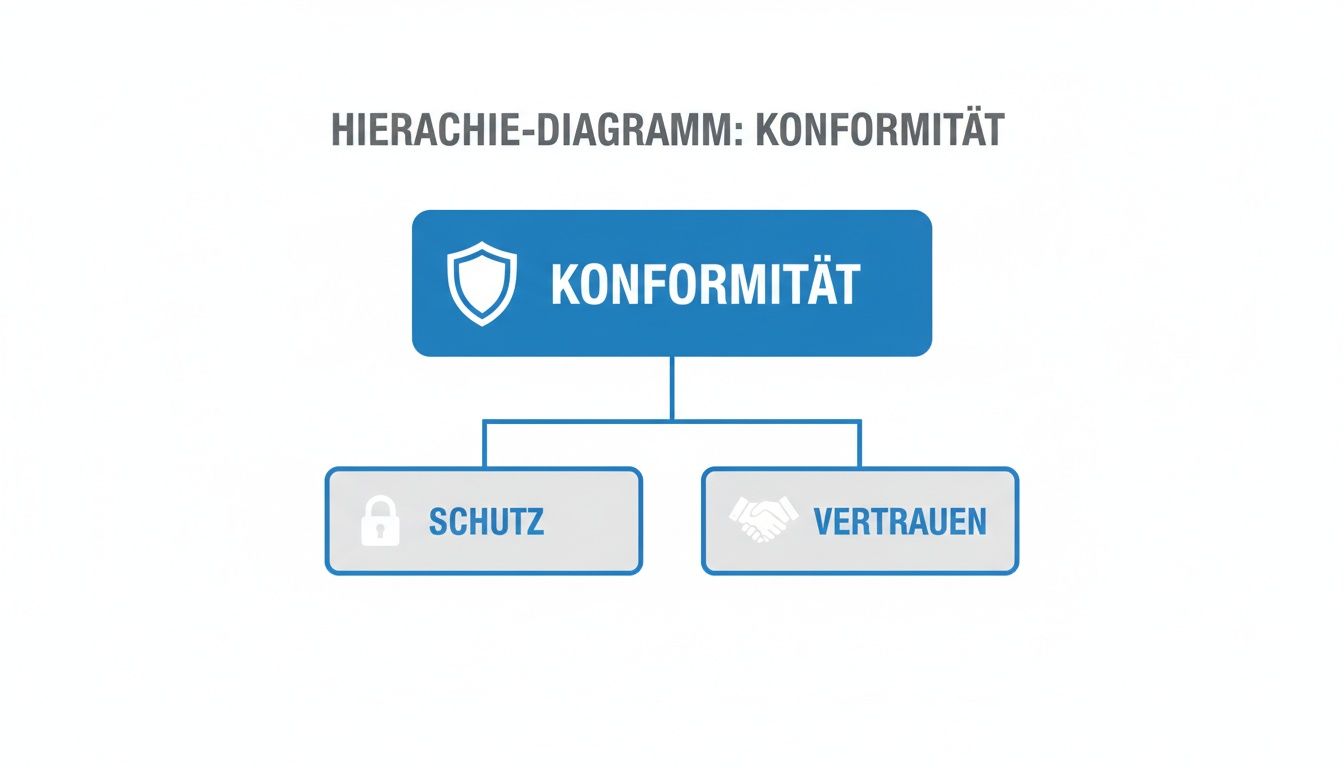
You can see it immediately: it's not just about avoiding trouble (protection), but also about building a strong foundation of trust for customers, partners, and employees. To keep these complex areas under control, specialized tools often come into play. You can learn more about how that works in our article on compliance management software.
Compliance in practice – where it shows up everywhere
To make all of this even more tangible, let's look at a few concrete examples. The following table shows where the various types of compliance meet us in everyday business, and what happens when you ignore them.
Type of complianceConcrete example in the companyConsequences of non-complianceLegalAdhering to the GDPR when processing customer data.High fines, warning letters, reputational damage, customer loss.TechnicalA medical device meets all patient safety standards (e.g. ISO 13485).Product recall, sales ban, liability risks, danger to users.SocialThe company observes its self-imposed ethical guidelines (code of conduct).Negative media coverage, loss of trust among customers & employees, boycott calls.As you can see, the consequences are anything but trivial. Living compliance is therefore not a tiresome chore but a strategic necessity that saves a company from serious problems.
Products, sustainability, and the compliance jungle
If you manufacture, import, or sell products, then "being compliant" isn't an abstract word but the pivot of your business. It's relentlessly about fulfilling the strict rules and standards of the European Union. Anyone who doesn't do so risks, in the worst case, a sales ban.
Imagine you're launching a new electronic device. Before you can even sell a single unit, it must be compliant with EU safety standards. The visible sign for this is the CE marking. But watch out, it's not a free pass! Market surveillance authorities such as customs are wide awake and rigorously check whether the products truly meet the requirements.
From marketing gimmick to hard obligation: sustainability compliance
Until now, sustainability was often a nice extra, a "nice-to-have" for the marketing department. But those days are over, because the rules of the game are changing dramatically. New EU requirements are turning sustainability into a hard obligation. Above all, the EU taxonomy creates a binding framework that clearly defines what counts as environmentally sustainable – and what doesn't.
Sustainability compliance is the new currency for trust and future readiness. Anyone who ignores the rules risks not only access to financing but also market relevance.
This shift has very concrete consequences: large companies with more than 500 employees have had to deliver detailed sustainability reports since 2022. But this pressure seeps through the entire supply chain down to mid-market suppliers. At the same time, banks look very carefully at taxonomy compliance when granting loans for green projects. The reporting obligations are therefore steadily expanding and will soon affect many small and mid-sized companies as well. You can read analyses of how strongly this shift is already shaping the business landscape in the context of the burden of reporting obligations.
It is therefore vital not to dismiss these new requirements as tedious burdens but to embrace them as real opportunities. Anyone who proactively tackles product and sustainability compliance not only secures their business but also positions themselves as a responsible, future-proof partner. That way, compliance turns from a pure cost factor into a genuine competitive advantage.
Designing AI systems to be future-proof and compliant
Artificial intelligence is an incredible engine of progress, no question. But it also raises completely new, complex questions. In the AI era, "being compliant" above all means one thing: meeting the strict requirements of the EU AI Act.
Especially high-risk AI systems will be scrutinized very closely in the future. So the big question is: how can you fully exploit the enormous potential of AI without violating data protection laws like the GDPR?
The game-changer: synthetic data
The solution is as clever as it is effective: synthetic data. Imagine you could train your AI models and rigorously test software – all with datasets that are absolutely realistic but entirely fabricated.
That's exactly what synthetic data makes possible. Instead of juggling sensitive, personal customer data, you work with artificially generated information that is statistically identical to the real data. That's the key to GDPR-compliant innovation.
This approach is already being used successfully in Germany: an IT service provider tests billing systems with fictional customer profiles, while an insurer simulates rate models without touching a single real dataset. Although the German mid-market generates enormous revenue – family businesses alone contribute 29.1% to the total €10,366.8 billion in revenue – data protection often slows innovation. The AI Act's strict assessment requirements only accelerate this shift further.
Synthetic data is more than just a technical gimmick. It's a strategic decision for future-proof, ethical, and unrestricted innovation in the AI era.
This ingenious approach gives you a decisive head start. You unleash the full power of AI without having to make a single compromise on data protection.
- Set risks aside: if you don't use real, sensitive data, you don't have to worry about data leaks.
- Accelerate projects: you get immediate access to high-quality training data without lengthy anonymization processes.
- Act future-proof: you are already well prepared today for the strict requirements of the AI Act.
By acting compliantly in this way, you make yourself fit for the next stage of technological development. Read in our article how you can build a GDPR-compliant AI in your company.
How compliance becomes a growth engine
Anyone who associates compliance only with tiresome obligations and costs is giving up enormous potential. Tackled correctly, compliance becomes a real growth engine and a powerful competitive advantage. The trick? Don't see compliance as a tiresome evil that somehow has to be managed, but as a strategic opportunity to be seized proactively.
Modern tools and clever platforms are completely reshuffling the deck here. They make it possible to operate absolutely by the book without sacrificing speed or flexibility. Quite the opposite: you can even accelerate processes because they systematically eliminate sources of error and deliver a proper efficiency boost.
From obligation to strategic strength
Just imagine: an AI platform like innoGPT conjures up absolutely compliant documents for you in seconds. Whether proposals, emails, or minutes – everything fits perfectly with your corporate wording and meets all legal requirements. That's not science fiction, but already lived reality in many companies today.
This automation of routine work frees up enormous resources. Your people no longer have to slog through dull typing and can finally use their energy for what really matters: strategic tasks, creative ideas, and revenue-driving projects. Suddenly, following the rules becomes the turbo for innovation.
Compliance becomes a growth driver when technology takes over complexity and gives people the freedom to focus on what matters: developing the business.
This very shift – from reactive error avoidance toward proactive value creation – makes the difference. The security guaranteed by EU hosting and state-of-the-art encryption creates the trust needed to boldly try new paths.
Here are the points that make compliance a real success factor:
- Accelerated processes: documents are produced automatically. That saves precious time every day and pushes the error rate toward zero.
- Strengthened trust: whoever demonstrably adheres to standards like the GDPR shows quality. That convinces customers and partners alike.
- Freedom for innovation: a secure and compliant technical foundation is the perfect springboard to conquer new business areas without plunging into incalculable risks.
If you anchor compliance as a fixed part of your strategy and support it with intelligent tools, it transforms from a perceived brake into the decisive catalyst for sustainable growth and real market success.
The burning questions on compliance – briefly and crisply answered
Compliance, breaches, violations … head spinning too? Don't worry, lots of people feel the same way! Let's dive together into the most frequent questions we keep meeting in everyday business. Here you get the answers that will really move you forward.
Is compliance the same as being compliant?
At first glance, the two terms look like twins, but the devil is in the detail. You could say: compliance is the compulsory part, being compliant is the freestyle.
Compliance specifically means adhering to laws and external regulations – everything imposed from outside. Being compliant goes a step further. It's about agreement with all the rules that are relevant to you. That includes laws, but also your own internal policies, technical standards, and even ethical principles. Being compliant is thus the broader, more encompassing term.
What's the difference between an incident and a violation?
Imagine a warning light flashing in your security system. That's just a security incident for now – an event that could have endangered security. That can even be a simple, failed login attempt.
A violation (or "breach"), on the other hand, is the real emergency. Here, a security gap was actually exploited and sensitive data has demonstrably fallen into the wrong hands. In short: not every incident is immediately a reportable violation, but every violation begins as an incident.
An employee forgets their password and tries the wrong one three times? A harmless security incident. An email with confidential customer data accidentally lands in the wrong inbox? That's a clear-cut violation!
How can I prove my company is compliant?
Talk is silver, documenting is gold! The best proof of your compliance is clean, end-to-end documentation that makes every step traceable. With this, you show not only auditors but also customers and partners that you're serious.
This includes above all:
- Regular risk analyses: you demonstrate that you don't simply ignore dangers, but keep them systematically in view.
- Clearly formulated policies: keep your internal rules and processes unambiguously in writing.
- Proof of training: document that your team is fit for purpose and knows the rules – regularly.
- Certifications: external seals, such as an ISO certification, are the strongest signal to the outside world that you're on the right technical track.
Those who actively maintain these points not only sleep better before audits but also build an invaluable foundation of trust.
Wish that compliance in your company just ran on the side without slowing down productivity? innoGPT creates AI-supported documents for you in seconds that exactly match your internal policies and corporate wording – GDPR-compliant and securely hosted in the EU. Discover how easy compliant work can be, and test innoGPT free for 7 days.
Related articles
AI for Business: Everything About Safe Implementation, GDPR Compliance and Real-World Use
Find out how to use AI safely in your business and avoid data leaks and legal risks with GDPR-compliant solutions.
Use ChatGPT – Safely: The GDPR-Compliant Alternative for Businesses
Learn how to use ChatGPT safely and avoid GDPR risks. Discover innoGPT as the GDPR-compliant alternative that protects your data.
The European ChatGPT alternative: Why companies rely on German GDPR-compliant AI
Discover a chatgpt alternative that is GDPR-compliant and strengthens data sovereignty. Why German AI solutions create trust.