How to Query AI Correctly: Get the Most from Generative AI Assistants
Discover how to query AI safely and effectively to get fast, helpful answers that actually move your business forward.
tl;dr: The three most important takeaways, on point
- Good prompts are specific, context-rich, and role-based. The clearer your instruction, the more brilliant the result.
- InnoGPT enables secure AI querying with full data control in Europe. Feed the AI sensitive info for precise answers, with zero data protection headaches.
- Iteratively refining your questions leads to exponentially better results. Treat the first answer as a starting point and have a conversation until it's perfect.
Imagine rubbing a magic lamp and a genie appears. You have three wishes. Would you say, "I'd like something good"? Of course not – you'd articulate precisely what you want. Generative AI is your infinite genie. But it too needs clear instructions.
Many users know the frustration: "The AI doesn't understand me" or "I only get superficial answers." But the problem rarely lies with the AI itself – it lies with the way we query it. The quality of AI answers stands or falls with the quality of your questions. Anyone who masters the art of prompt engineering transforms InnoGPT from a simple chatbot into a strategic work partner that solves complex tasks in a GDPR-compliant, efficient way.
This challenge runs through the entire German economy. A brand-new DIHK survey on digitalization shows: a full 78 percent of companies already use generative AI, primarily for text. At the same time, 60 percent state that legal uncertainty is holding them back from deeper deployment. This is exactly where the cat bites its own tail: many don't dare to give the AI the necessary context in the form of company data – and then wonder why results are lousy.
The key to success is not treating AI querying as a command, but as a genuine dialogue. It's a dynamic process in which you guide the AI with targeted instructions, context, and feedback toward the best possible answer.
This guide is your walkthrough for exactly that process. We'll initiate you into the art of prompt engineering – the ability to craft instructions in a way that turns a simple tool like InnoGPT into a valuable, strategic work partner. You'll learn how to structure your questions, which mistakes to absolutely avoid, and how to safely unlock the full potential for your business thanks to GDPR compliance.
The Anatomy of a Perfect Prompt
Writing a truly good prompt is more craft than magic. If you want to query AI and expect results that actually move you forward, you have to learn to speak its language. A successful prompt breaks down into four essential components.
1. Role/Context: Tell the AI Who to Be
It all starts with assigning the AI a role and giving it the necessary context. This gives it a perspective and activates the right knowledge.
- Example: "You are an experienced compliance consultant specializing in GDPR requirements for SMEs."
2. Task: Formulate a Clear Goal
Be unambiguous and specific in your task. Vague verbs like "explain" are fine, but precise action instructions like "create" or "draft" are better.
- Example: "Create a checklist of the 5 most important technical measures an SME must implement."
3. Format: Give the Result a Structure
What should the answer look like? Without a format specification, the AI might deliver running text when a table would be better.
- Example: "List the 5 points and provide a short, practical example for each."
4. Constraints: Set the Guardrails
With constraints, you prevent the AI from drifting off-topic. They're the polish for brilliant results.
- Example: "Focus on GDPR requirements for SMEs. Avoid legal jargon."
This infographic captures the process and shows how specificity, context, and a clear role work together to create a first-class AI prompt.
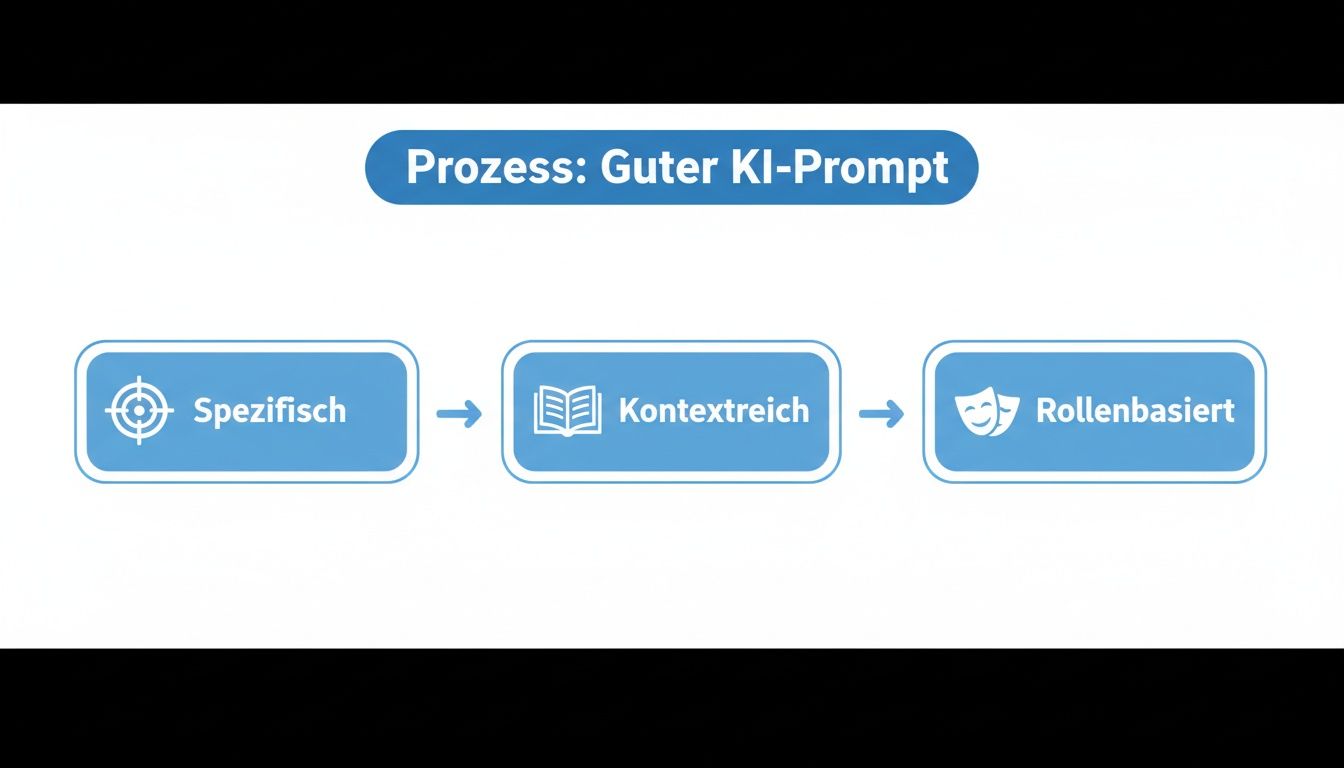
It's immediately clear: these three elements – a specific goal, plenty of context, and a clearly defined role – are the foundation you have to build on to steer the AI with precision.
Practical Example: From Vague to Valuable
Let's look at a typical business scenario. How does a weak request become a strong, usable prompt?
Before (weak prompt): Write an email to a customer.
After (strong prompt): Role: You are an experienced key account manager. Context: Our customer, "Müller GmbH," is hesitating to renew their contract for our project management software because they have concerns about the onboarding time for new employees. Task: Write a persuasive email to the managing director, Mr. Schmidt. Emphasize that our new onboarding package reduces onboarding time by 50% and reference the positive feedback from "Schulze AG." Format: The email should be professional yet personal, no longer than 150 words. Constraint: Focus on benefits and solutions, not technical features.
The difference in outcome is night and day. With the strong prompt, you get an email ready to send, while the weak prompt delivers only an unusable template. If you want to master combining these four building blocks, you'll find further advanced strategies in our guide on prompting in German.
How Data Security Makes Your Prompts Better
Data protection? For many, it first sounds like a tedious obligation. But when you want to query AI to solve real, business-relevant problems, data security becomes your most powerful strategic advantage.

Only InnoGPT's GDPR-compliant architecture makes truly great prompts possible – because you can finally include all relevant information without lying awake at night.
The Context Turbo Through Sensitive Data
The difference between a vague and a brilliant AI answer almost always lies in the context. With US providers, you'd never put customer names, internal revenue figures, or project details into a prompt. The result? You hold back the most important puzzle pieces and force the AI to grope around in the fog.
With InnoGPT, all prompts and data stay on European servers. Users can embed sensitive company information in their prompts without any data protection risks. That enables much more precise, context-rich questions.
- EU Hosting: All your data and prompts are guaranteed to stay on European servers.
- Zero-Retention Policy: Your inputs are never used to train the models.
- Strict Data Control: You retain full control at all times.
These security guarantees are the decisive ignition key for next-generation prompts.
Only when you can fully trust the platform will you feed it the context that truly counts. That's how security transforms from a roadblock into a direct catalyst for quality.
What Security Means in Practice
Imagine you want to draft a sales email to an important customer.
Without guaranteed data security (a typical prompt with US tools): "Write a follow-up email to a customer who has shown interest in our product." Result: a generic template.
With the security of InnoGPT (your new prompt): "You are a key account manager. Write a personal follow-up email to Ms. Schmidt at Meier GmbH. Reference our conversation on May 15, where she had concerns about the integration costs of our CRM tool. Explain how our new pricing model (Project 'Phoenix,' Q2 figures) relieves her budget by 15%, and reference the successful implementation at Müller AG."
This prompt is packed with sensitive data, but it's precisely those details that allow the AI to conjure a tailored, highly relevant email. If you want to dive deeper into how we ensure this, read our detailed article on technical and organizational measures at InnoGPT.
Mastering the Conversation with AI
An AI's first answer is almost never the destination – it's the starting point of a dialogue. Anyone who wants to query AI and achieve excellent results has to rethink. It's the art of iterative prompting: conducting a real conversation in which you arrive at the perfect result step by step through follow-up questions, clarifications, and corrections – much like a dialogue with a human expert.

From First Draft to Finished Solution
Let's walk through an example. You need an outline for a blog article.
Your starting prompt: Create an outline for a blog article on "Effective Project Management for Remote Teams."
The AI delivers a solid but generic draft. That's your starting point.
Your refinement: Good start. Please add a section that specifically addresses the best tools for asynchronous communication.
The result becomes more specific.
Your correction: Perfect. Now please phrase the headings as questions to make them more engaging for the reader.
Bam, the AI delivers a revised outline.
Your extension: Great. Now write the introduction based on the first heading. The tone should be motivating and direct.
Through this step-by-step dialogue, you've precisely guided the AI to a result that's worlds away from the first answer.
The Strategic Choice of the Right AI Model
One decisive lever is choosing the right "conversation partner." InnoGPT deliberately bundles several leading AI models, because picking the right model is part of your querying strategy.
- Claude models: Your first choice for analytical thinking, analyzing long texts, or creating structured reports.
- GPT models: Unbeatable at creativity, brainstorming, and producing engaging marketing copy.
- Specialized models: Ideal for niche tasks such as code generation.
The decision on which model to choose can massively influence the quality of your "conversation." Learn in the full DIHK survey how AI is changing the German economy.
Common Mistakes in AI Dialogue – and How to Avoid Them
In conversation with an AI, there are typical pitfalls that lead to frustration.
- Mistake 1: Too vague requests without context. "Write something about marketing" is an invitation to guess.
- Mistake 2: Too many tasks in one question. Break complex assignments into logical individual steps.
- Mistake 3: Missing format specifications. Always say whether you want a list, table, or email.
- Mistake 4: Expecting the AI to read minds. The AI only knows what you tell it. Give it all relevant background information.
Your Ultimate Cheat Sheet for Top Prompts
In the stressful daily grind, things can easily slip through the cracks. That's exactly what this compact checklist is for – go through it for every request. It helps you organize your thoughts and ensure the AI truly has everything it needs for a brilliant result.
The Prompt Quality Checklist to Copy
- ✅ Role clear? Have I told the AI who to be? (e.g., "You are an experienced social media manager").
- ✅ Task understandable? Is my goal unambiguous? (e.g., "Create," "Analyze," "Compare").
- ✅ Format defined? Have I specified the output format? (e.g., "bullet list," "three-column table").
- ✅ Context provided? Are all relevant background details included? (target audience, purpose, history).
- ✅ Guardrails set? Are there no-gos, a maximum length, or a specific style?
Really important: Every point on this checklist you leave out is an invitation for the AI to guess. And guessing rarely leads to perfection.
Now It's Your Turn – Into Practice!
Theory is all well and good, but now it's your turn.
Your challenge: Take a moment, open your chat history, and pick out your worst and your best AI request from the past week. Compare both against the checklist. What was the difference? This reflection anchors what you've learned and turns you from a passive user into an active shaper of your AI results.
Questions from Practice: Typical Pitfalls and How to Dodge Them
Great, you now have the most important strategies in your pocket! But tricky questions often come up in everyday use. Let's clear the most common hurdles out of the way.
"Help, the AI Won't Do What I Want!" What to Do When Instructions Are Ignored
This happens when your prompt was unintentionally too complex. The fix: make it simpler! Break your task into several small steps and feed the AI in bite-sized pieces. A small sentence like "It's very important that you pay attention to the following:" can also work wonders.
How Do I Teach the AI Our Company's Voice?
The key lies in good examples. Just drop a typical text excerpt from your company communication into the prompt with the instruction: "Write in exactly the same style as this text example: [insert your text example here]."
With InnoGPT, you can build your own AI assistants. You feed them once with your style guides or marketing copy. After that, the assistant always delivers answers in your corporate voice.
Can a Prompt Contain Too Much Information?
Yes! An overloaded prompt confuses the AI. The better strategy: start a dialogue. Begin with the core goal and refine the answer with targeted follow-ups. With InnoGPT, you can also upload entire documents and have the AI reference them – it's more elegant and gives full context.
"Du" or "Sie" – Which Is Better for the AI?
Short answer: the AI doesn't care. The choice of formal vs. informal address has no measurable impact on the quality of the answer. Pick whatever feels more natural to you.
Ready to move from prompt-guessing to targeted AI control? With InnoGPT, you not only get the best AI models at hand, but also the GDPR-compliant security to finally unleash the full potential of your company knowledge. Experience the difference yourself when you can ask without compromise. Start your free 7-day trial now at https://www.innogpt.de.
Related articles
Zive alternative: innoGPT — workplace AI from Germany
Chat, knowledge base, search and tasks in one platform — bootstrapped, EU-hosted, ISO 27001-aligned.
Developing Generative AI Use Cases: From First Prototype to Enterprise-Wide Implementation
Learn how to build effective generative AI use cases. From the initial idea through prototype to measurable value creation in your company.
ChatGPT Alternatives: The 12 Best Tools in 2025
Looking for a ChatGPT alternative? Discover the 12 top alternatives in 2025, with overviews, pros and cons, and the criteria that matter most.