Developing Generative AI Use Cases: From First Prototype to Enterprise-Wide Implementation
Learn how to build effective generative AI use cases. From the initial idea through prototype to measurable value creation in your company.
Key takeaways at a glance:
- A systematic process is critical: A 5-stage process from pain point identification to enterprise-wide rollout transforms generative AI from an experiment into a strategic advantage.
- Compliance-first as the foundation: Use case development must take place on a GDPR-compliant platform from the very first second to ensure data security and avoid shadow IT.
- Measurable value matters: The success of AI initiatives becomes tangible through concrete KPIs such as time saved, quality improvements, and employee satisfaction, justifying future investments.
Picture a marketing manager. Let's call her Sarah. Her day often begins with that dreaded look at a blank screen. The task: build out a complete campaign for a brand-new product from scratch. In the past, this meant hours of brainstorming, endless meetings, and the constant hunt for the spark of a great idea. Today? Today she opens up a dialogue with her company's secure, in-house AI platform.
Together, they refine target audience details, toss around slogan ideas, and sketch out the first blog articles. This leap from creative paralysis to genuine creative back-and-forth is no accident. It's the result of strategically designed use cases that turn generative AI from an experimental tool into an indispensable instrument.
In this guide, I'll show you how to spark that exact transformation in your own team — systematically, securely, and with results you can actually measure.
How to embed generative AI strategically in your company
A systematic approach to use cases turns generative AI from an experimental tool into a strategic corporate asset — provided that data security and compliance are front and center from day one. The key? A clear process from the very beginning and an unwavering focus on data security.
With this approach, you don't just optimize individual tasks. You build a sustainable culture of innovation. Sarah's daily work didn't change because she suddenly had access to an AI tool. It changed because her company deliberately created use cases that take repetitive work off her plate and give her the headspace she needs for what she does best: creativity and strategic thinking.
A well-defined use case doesn't answer the question "What can AI do?" but rather "Which of our real problems can AI solve?". This small shift in perspective is the first and most important step toward success.
And that's exactly what the following sections are about. We'll walk you through the entire process — from hunting down the biggest time wasters to establishing a secure, scalable AI solution like InnoGPT in your company.
Your 5-stage process for effective AI use cases
Rolling out generative AI isn't rocket science, but it's not a gamble either. It's a process you can steer deliberately. Don't think of the following steps as a rigid rulebook — think of them as your personal navigation system. It guides you safely from a vague initial idea all the way to a concrete AI use case that gets the whole company saying "Wow!".
The key to success is balancing three crucial pillars: a clear process, watertight compliance, and value that you can actually measure.

It's easy to picture: without a process, you stumble around aimlessly. Without compliance, you risk serious legal trouble. And without measurable value? Well, then it's just a nice, expensive toy. Only when all three come together does it become a true game-changer.
Stage 1: Pain point identification
The best AI use case never starts with the question "What can the technology do?" but always with "Where does the shoe pinch?". Get out there and talk to your teams! Find out where they're spending valuable time on tasks that are repetitive and uncreative. Maybe it's manually summarizing meeting minutes or endlessly rewording nearly identical customer service emails. These everyday time wasters are pure gold. And critically: think about GDPR right from the start. What data is actually being processed in these tasks?
Stage 2: Feasibility check
Okay, you've found a promising candidate. But is the idea actually doable? Now it's time to check technical and organizational feasibility. The good news: for most text-based tasks, like those of our marketing manager Sarah, the answer is almost always a clear "Yes". The decisive factor here is choosing the right tool. A secure platform like InnoGPT, hosted in Europe in a GDPR-compliant way, is essential. This way, you prevent uncontrolled US tools from spawning a dangerous shadow IT in your company right from the start.
Stage 3: Pilot project
Now it gets exciting — you put the idea into action! Pick the most promising use case and launch a small but focused pilot project. Set yourself a crystal-clear goal, for example: "With AI support, the marketing team reduces the time spent creating social media drafts by 50%." Assemble a small, motivated team and gather feedback non-stop. This step is so important because it lets you learn fast, adjust the process, and produce a first visible win that's contagious.
Stage 4: Scaling planning
Pilot project a complete success? Fantastic! Now keep the momentum going. It's time to roll out the use case to other teams or even entire departments. What worked so well on a small scale that it can be transferred? Use what you've learned to create simple guidelines and best practices. Make sure to plan training sessions and ensure that compliance requirements remain rock-solid even with broader use. A central platform is worth its weight in gold here, because it guarantees consistent standards and security policies for every user.
Stage 5: Enterprise-wide rollout
Welcome to the endgame! At the final stage, it's about firmly anchoring generative AI in your corporate culture. Tell the success stories from the early projects — loud and clear! Make the benefits tangible for every individual: more time for creativity, less mind-numbing routine work. Foster a culture where people are encouraged to just try things out. Create space where employees can come up with new ideas for AI use cases all on their own. That's how generative AI evolves from a single project into a living part of your daily work — and into a real competitive advantage.
Use cases that deliver instant impact and real value
Enough dry theory — let's talk straight! The best use cases aren't lofty concepts; they tackle real, everyday problems at the root. Remember our marketing manager Sarah? Her blank screen is the perfect symbol of a pain point that generative AI can ease in no time.
Instead of starting from zero, she simply uses AI as a creative sparring partner. Boom — she has first ideas for social media posts, punchy email subject lines, or a complete outline for the next blog article. That doesn't just save valuable hours, it blows away any creative block. And the best part? This approach works in nearly every department.
A glimpse into practice: use cases for your business
The true superpower of generative AI? It takes repetitive text work off our hands and finally creates room for the truly important, strategic tasks. Here are a few immediately actionable ideas just waiting to be discovered in many companies:
- Marketing: No more brainstorming marathons! In seconds, create drafts for social media calendars, personalized email campaigns, or SEO-optimized product descriptions. The AI delivers the solid foundation; your team adds the final, human touch.
- Sales: How about tailored proposal copy that actually convinces? Or summarize long customer emails to prepare for a call. Even memorable follow-up messages are no longer a problem.
- Human Resources (HR): Write engaging, inclusive job ads that magnetically attract top talent. Quickly develop standardized onboarding materials or drafts for internal communications.
- Customer Service: Answer frequently asked questions (FAQs) instantly, consistently, and around the clock. That way, your support team can fully focus on the tricky and emotionally important customer issues — where humans are irreplaceable.
- Product Development: Generate user stories, summarize complex technical feedback, or draft documentation and release notes. This accelerates the development cycle and improves team communication.
The game-changer is this shift in perspective: you're not looking for a problem to fit your new technology. You have a real problem and you deploy the technology as a tailored tool to solve it.
The real Return on Investment (ROI) lies in the time you reclaim — time your team can now invest in creative, strategic, truly value-creating work. To get an even better feel for the wide range of possibilities, take a look at further case studies and application examples. And if you're now eager to get started systematically, our comprehensive guide on AI Use Case has everything you need.
Why data security can't be an afterthought
Honestly: the biggest hurdle when introducing generative AI is rarely the technology itself. Far more often, it's the giant question marks around data protection. And that's precisely where a hidden but enormous risk lurks: "shadow IT". Curious employees grab freely available US tools, and suddenly sensitive company data — from customer lists to strategy papers — flows uncontrolled to servers outside the EU.

The compliance-first approach as your shield
To avoid this chaos from the outset, there's only one way: a crystal-clear "compliance-first" approach. Every single AI use case must be developed from the very first second on a secure, GDPR-compliant platform like InnoGPT. This is about nothing less than European data sovereignty. You must always have one hundred percent control over where your data sits and what happens to it.
The crux is the guarantee that the information you input will never be misused to train public AI models. Your data stays your data. Period.
This approach is more than just legal protection. It's the foundation for the trust your employees and customers place in the new technology. When everyone knows that AI use is safe, adoption and the appetite to experiment skyrocket.
How to actively protect your company data
A secure platform is the foundation. But the organization around it has to be right too. You need firm policies and crystal-clear processes that govern the safe use of AI tools. Concrete measures help here:
- Role-based access control: Make sure employees only access the AI features and data they actually need for their role.
- Zero-retention policy: Choose a provider that guarantees not to permanently store any of your data (zero retention). This is the most radical and best protection against data leaks.
- Employee training: Talk openly with your teams! Proactively educate them about the dangers of shadow IT and show them how to use the secure, internal platform properly.
This combination of technical security and clear organizational ground rules is the strongest shield for your valuable company data. You'll find many more details in our article on technical and organizational measures for AI. That's how data security goes from being a brake to becoming the turbo for your AI innovations.
ROI and measurability: how to prove the success of your AI projects
So how do you prove that your AI projects aren't just nice toys but real game-changers? Simple: you make success measurable. The biggest mistake is trying to pin success immediately to pure revenue growth. That's far too short-sighted.
Think back to our marketing manager Sarah. What we can clearly measure with her is how many hours she and her team save each week on content creation. And that's exactly what smart success measurement is about: focusing on what improves immediately.
Finding the right KPIs for generative AI
Concentrate on metrics you can almost reach out and touch. These KPIs aren't just super easy to collect — they also show direct value for your people.
- Time saved: The gold standard. Measure how long a specific task — say, drafting three social media posts — takes before and after AI is introduced.
- Quality improvement: Measure the number of revision rounds in texts before and after AI use. Fewer errors clearly mean higher quality.
- Employee satisfaction: A brutally important KPI! Ask your teams directly: "On a scale from 1 to 10, how much does AI relieve you of tedious routine tasks?"
How to gather the data without the headache
You don't need to build a massive reporting system from the ground up. Start small with simple feedback loops. A short weekly or monthly online survey with three to five punchy questions can already do wonders.
A crystal-clear Return on Investment (ROI) isn't just hard numbers. If you can show leadership that your teams reclaim 20% of their time and pour it into more creative, strategic work, that's an unbeatable argument.
With these simple KPIs, you make the success of your AI use cases watertight. You create transparency, win over even the skeptics, and along the way secure the budget for the next, even cooler AI projects.
Change management: how to get your team excited about the AI shift
Let's be honest: the best technology is worthless if the people who are supposed to use it don't come along for the ride. Introducing generative AI is, above all, a profound change management process. Resistance and fear are normal — but don't worry, you can address them proactively.
Remember Sarah? AI wasn't just dropped on her desk. She was shown how a smart assistant helps her find the creative spark faster. Position AI as a helpful colleague, not a competitor.
Easing fears through open communication
Take your team's concerns seriously. Many fear being replaced by AI. Your mission is to turn that fear into curiosity. Communicate clearly that this isn't about laying people off — it's about eliminating tedious, monotonous tasks so there's more time for exciting, strategic work. That way, a threat becomes a tangible relief.
The decisive click in people's heads happens precisely when employees understand: "AI doesn't work in my place — it works for me."
Effective training that genuinely excites
Forget dry theory lectures. Go for hands-on training that demonstrates direct value. Offer super simple "Getting Started" workshops. Nothing motivates more than the first small win. Designate a few AI champions on the team. They're the go-to people who serve as the first point of contact for questions. By putting individual benefit center stage, you create a positive atmosphere where people are eager to try things out.
Platform thinking: one platform instead of tool chaos
Picture a central platform like InnoGPT as a safe harbor — a unified, secure, GDPR-compliant environment for all employees. It saves you from the total "tool chaos" and from insecure shadow IT.
The benefits are huge:
- You can flexibly try out and use different AI models.
- You can react to new technologies in a flash, without every team starting from zero.
- It lowers costs, massively increases security, and makes scaling across the entire company a breeze.
Are you ready to anchor generative AI securely and strategically in your company? With InnoGPT, you get the GDPR-compliant platform to take your use cases from the first spark of an idea to a successful enterprise-wide rollout.
Start your free 7-day trial now and discover the potential lying dormant in your team at https://www.innogpt.de.
Related articles
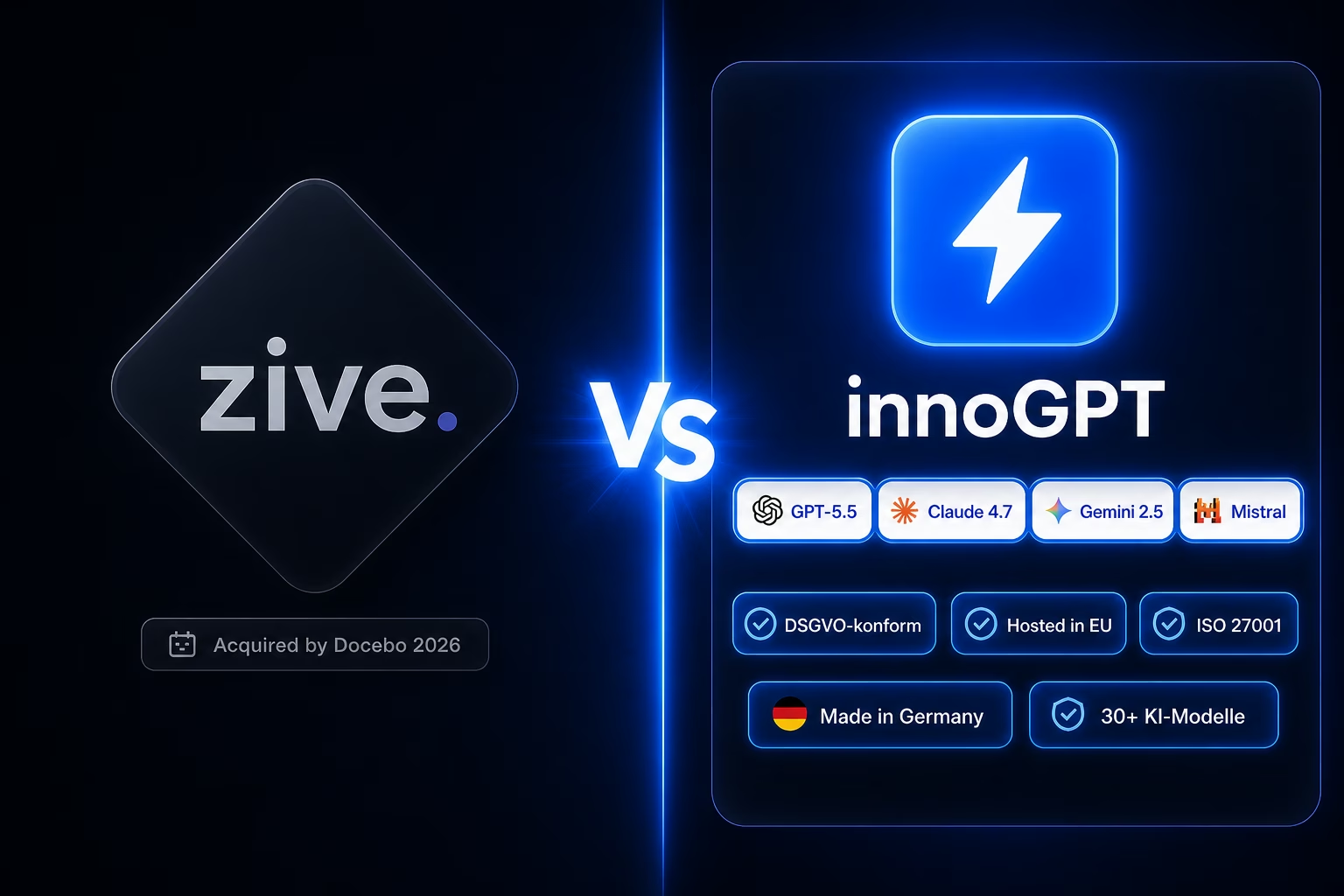
Zive alternative: innoGPT — workplace AI from Germany
Chat, knowledge base, search and tasks in one platform — bootstrapped, EU-hosted, ISO 27001-aligned.

From idea to intelligent chatbot: deploying generative AI securely in your business
Learn how to build your own chatbot and deploy generative AI securely in your business. Practical, clear, and without high barriers to entry.
Programming Your Own AI: A Beginner's Guide
Learn how to program your own AI. Discover proven step-by-step guides, tools, and real insights for your first AI project.