Generative AI in the Enterprise: The CTO Guide to Safe Rollout Without Shadow IT
Your guide to AI in business. Learn how to roll out generative AI securely, avoid shadow IT, and regain full control.

tl;dr:
- Shadow IT is the biggest security threat during AI adoption – employees use US tools because secure alternatives are missing.
- GDPR-compliant, central AI platforms give CTOs data sovereignty back and eliminate compliance risks.
- The fastest European companies rely on platforms that evolve as fast as the AI market – not on rigid solutions.
Two weeks ago, your security officer walked into your office with a CSV. 47 email addresses. 47 employees who had signed up to ChatGPT – with their company email. Among the documents they uploaded: customer lists, source code, contracts. Your first thought: "Why didn't I see this coming?" Your second: "How could I have prevented it?"
It's not bad intent. It's the opposite: your employees want to be more productive. And when IT is too slow, they reach for what works. This isn't a management problem. It's an architecture problem.
The inevitable architecture problem with AI

It's 2 pm. Your CISO walks into your office with a report: 47% of your employees use ChatGPT with production data. That's legally untenable. Every single upload is a potential data leak and a clear GDPR violation.
This scenario isn't fiction; it's the hard reality in countless European companies. Your best people – developers, marketing managers, sales reps – want to use generative AI in the enterprise to do their work better and faster. They see the enormous potential and don't want to wait for an official approval that may never come.
The problem isn't that your employees use AI. The problem is how they do it – uncontrolled, insecure, and completely under your radar.
This unchecked growth of unapproved tools – known as shadow IT – emerges for a simple reason: there's a shortage of secure, internal alternatives. Your people reach for what's available and easy. Your job is to offer them a better, safer path.
Why bans aren't the solution
The first impulse of many IT leaders? A strict ban. Block all AI tools and hope the storm passes. But this approach isn't just doomed to fail – it actively harms your company.
- You choke off innovation at the root: you slow down your most motivated people and send a signal of distrust.
- You push shadow IT deeper underground: your employees get inventive, use personal devices or VPNs – and that makes control impossible.
- You lose touch with the competition: while your competition uses generative AI to optimize processes, you're stuck on the sidelines.
The days of 5-year IT strategies are over. Anyone who doesn't iterate fast gets overtaken by the market – including in AI. The question is therefore not if, but how you enable generative AI usage safely and at scale. The answer is a central, controlled, European platform.
The CTO dilemma: between ban and innovation
As a CTO you're stuck in the middle. Management wants quick wins from AI in the enterprise. More efficiency, groundbreaking products, a lead over the competition. At the same time, your CISO rightly warns of data leakage and compliance nightmares. You're in the middle: one foot on the gas pedal of innovation, the other on the brake of security. Neither a total ban nor uncontrolled proliferation is a solution. The only viable route runs right down the middle: a strategic, controlled, and secure rollout.
Scenario 1: the unnoticed theft of your intellectual property
A top developer is puzzling over a tricky algorithm. To save time, he copies the source code into ChatGPT for optimization. He's thrilled with the result. What he isn't aware of: this code, your proprietary IP, potentially flows into the training data of a US model. A nightmare for every CTO.
How would a secure platform have prevented this? A central AI platform would have given him the same capabilities in a protected environment.
- End-to-end audit trails: every prompt would have been logged. You'd have full transparency about which data is processed where.
- Strict API control: access would run through a company-owned interface that ensures no data leaves the network for external training.
- Real data sovereignty: processing would happen on servers subject to the strict European data protection laws.
Your developer would have reached his goal without exposing your company to enormous risk.
Scenario 2: why ChatGPT Enterprise is a minefield
A sales manager asks you: "Can't we just use ChatGPT Enterprise?" A reasonable question, but for European companies this path is a minefield.
- Data location: even with enterprise versions, it's often not 100% clear where your data is processed and stored. GDPR compliance turns into a gamble.
- Missing control: you make yourself completely dependent on the security promises and policies of a single US provider. Real sovereignty? Not even close.
- Dependency: you chain your company to a single ecosystem. If prices or terms change, you're stuck.
A sustainable strategy for AI in the enterprise hands you control back instead of taking it away.
The solution: central, European AI platforms with GDPR by design
The answer to this dilemma is architectural: introducing a central, GDPR-compliant AI platform. With it, you bring control over data, processes, and innovation back to exactly where it belongs – into your hands as CTO.
Think of this platform as a company-owned, secure operating system for generative AI. It's the central gate through which every request to an AI model must pass. Instead of employees reaching for external US tools, you offer them a single, secure path.
The implementation: what CTOs need to watch technically
What makes such a platform strong from a technical perspective? Four decisive pillars that give you sovereignty over your data back:
- API control: you define which team can access which AI model. Every access is controlled and monitored through a single, central interface.
- Audit trails: every request, every prompt, every result is cleanly logged. That gives you full transparency at all times about who is using which data for what.
- Role & permission management: you can define which department is allowed to access specific data sources or AI assistants.
- Data residency: this is non-negotiable. All data and processes remain without exception on servers within the European Union.
This technical structure is your firewall against shadow IT and compliance violations.
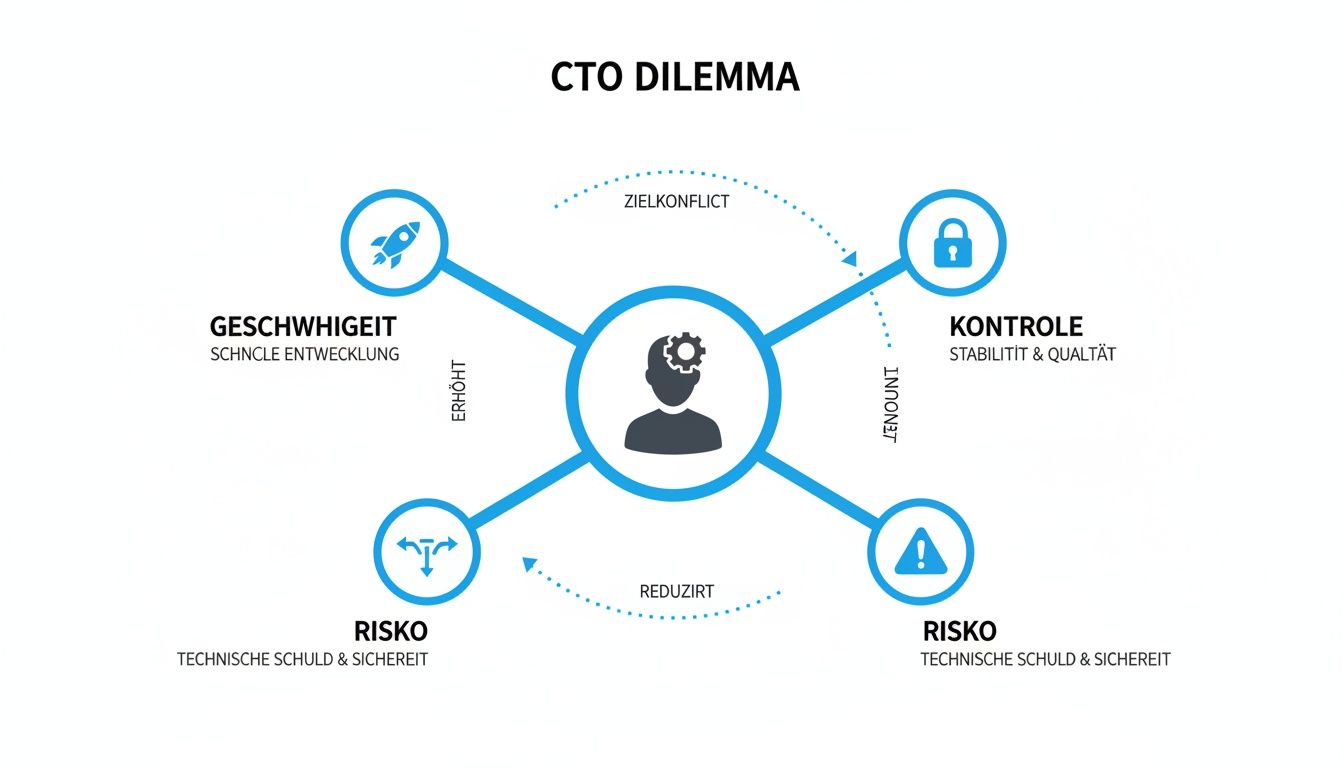
The graphic shows it clearly: a central platform is the only way to bring the three poles – speed, control, and risk – into a productive balance.
Scenario 3: the business case for the CFO
Your CFO asks about the ROI. The answer is simple: secure platforms generate ROI faster because employees aren't held back. If teams wait months for approvals, the ROI is zero. But if you give them access through a secure platform, productivity gains start from day one without having to trigger a new legal review for every tool. The ROI here comes from the enabled speed.
Comparing approaches to AI use in the enterprise
CriterionShadow IT (public US tools)Central EU AI platformData protectionUnclear data flow, risk of US access, GDPR violationsData stays guaranteed in the EU, full GDPR complianceSecurityNo control over data leakage, high riskGranular access control, end-to-end audit logsControlNo central management, sprawling toolsCentral management of users, models, and permissionsEfficiencyIsolated point solutions, no knowledge sharingSynergies through central prompts, enterprise-wide learningCostsUncontrolled costs through individual subscriptionsPredictable, centrally budgeted costsScalabilityLeads to chaosDesigned from day one for secure, enterprise-wide growthThe comparison makes it clear: the route via a central platform is the only strategically sensible choice.
A truly future-ready platform acts like an intelligent broker. Platforms that bundle multiple models while guaranteeing GDPR compliance are the answer.
This approach makes you independent of individual providers. If a better model comes onto the market tomorrow, you can simply integrate it. In our blog, you can learn more about how such an AI platform is built. You get not just security, but strategic agility.
Footnote: Generative AI and analytical AI are different threat and control paradigms.
The business case: ROI + security + speed
Anyone who thinks security slows innovation is falling for a fairy tale. A secure, centrally managed platform for AI in the enterprise is the turbo for your return on investment (ROI). It turns a risk into a measurable competitive advantage.
The biggest ROI killers aren't investments, but the months of standstill caused by legal concerns. Give your teams an approved, secure AI platform and you're not stepping on the brake – you're firing the afterburner.
Productivity immediately shoots through the roof. You create a safe harbor for innovation where your people can generate real value without triggering a compliance avalanche with every click.
More than just efficiency
The real value lies in the combination of efficiency boost and risk minimization.
- Avoid fines: a serious GDPR violation can cost you millions. A secure platform is your best insurance.
- Protect intellectual property: what is your source code worth? A central platform prevents these crown jewels from flowing into the training data of US models.
- Accelerate onboarding: instead of reviewing dozens of individual contracts, you bundle everything into one approved solution.
Investing in a secure AI platform isn't a pure security expense. It's the strategic decision for scalable, fast, and sovereign AI innovation.
Security as engine, not brake
The German economy has recognized both the potential and the risks. The deployment of AI in business is moving at a blistering pace. At the same time, concerns apply the brakes: many fear data theft and a lack of traceability. This is exactly where a secure platform resolves central blockers. Take a look at the study on AI usage in the German economy 2025 to see why now is the moment for a strategic decision.
Without such a platform, you force your people either into insecure shadow IT or into frustrating standstill. Both cost you more than any investment in a clean architecture. With a secure platform, you build trust – and this trust is the real currency for a successful AI transformation. You can read more about the meaning of ISO certification in our follow-up article.
The European security compass: GDPR as advantage
The GDPR isn't a brake – it's your strategic compass. For CTOs, it's not a hindrance but a competitive advantage.
US companies often have no choice; they're trapped in an ecosystem of US tools. European companies have the chance to do it better.
From compulsion to brand
GDPR by design is more than legal cover. It becomes a mark of quality. Customers, partners, and employees want the certainty that their data is safe. In a world full of data leaks, verifiable data security is the new premium currency.
Trust is the foundation of every business relationship. A GDPR-compliant AI strategy isn't a cost factor but a direct investment in this trust.
The opportunity of choice
The decisive difference is simple: you have the choice. You can deliberately decide on a path that puts sovereignty, security, and ethics at the center, without compromising on technological power.
The GDPR forces you to plan your IT architecture cleanly. What initially looks like a restriction turns out to be the perfect blueprint for a robust, future-proof AI infrastructure.
The logical answer
Chaining yourself to a single provider in a flood of new AI models is strategically short-sighted.
The logical answer is platforms that unite multiple leading AI models under one roof and make them available through a single, secure interface. Such platforms guarantee GDPR compliance and give you the freedom to always use the best model for each task.
This approach is your ticket to a sovereign AI future. You lock in compliance and the agility to stay at the technological top.
Frequently asked questions about secure AI rollout
Related articles
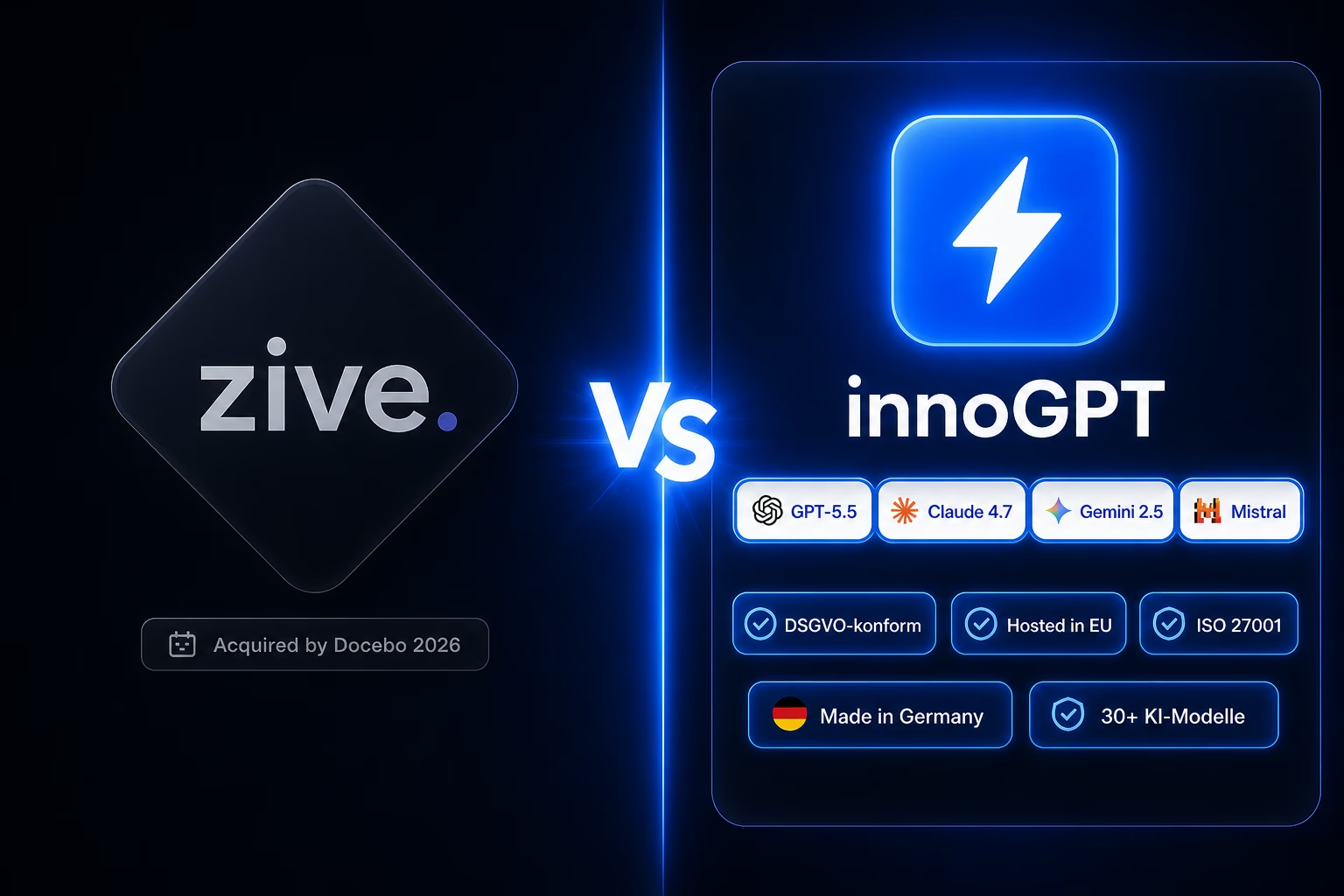
Zive alternative: innoGPT — workplace AI from Germany
Chat, knowledge base, search and tasks in one platform — bootstrapped, EU-hosted, ISO 27001-aligned.

What Does Compliant Mean: Compliance in Business – A Guide
What does compliant mean? Learn what compliance means in business – a compact guide to GDPR, AI Act & co. for legal certainty.
Developing Generative AI Use Cases: From First Prototype to Enterprise-Wide Implementation
Learn how to build effective generative AI use cases. From the initial idea through prototype to measurable value creation in your company.