AI Costs for Businesses: What Generative AI Really Costs – and What You Shouldn't Be Paying
tl;dr:
- Generative AI costs consist of visible factors (licenses) and invisible ones (implementation, training, EU AI Act compliance, data security). What you pay monthly in license fees is just the tip of the iceberg.
- US tools may appear cheap, but they carry hidden risks: data leakage, GDPR fines, EU AI Act violations, shadow IT. These hidden costs can be many times higher than the license fees themselves.
- innoGPT offers transparent flat-rate pricing with European data sovereignty – an investment in security AND efficiency. This way, you eliminate the most expensive risks upfront and make AI costs predictable.
AI costs are like an iceberg – license fees are the 10% you see. But the 90% below the surface? That's GDPR fines, EU AI Act compliance, implementation effort, and the shadow IT already running rampant in your company while you're still debating prices.
What Generative AI Really Costs Your Business
Before we dive into the numbers, let's get one thing straight: we're talking EXCLUSIVELY about the costs of generative AI here. This is not about analytical AI, data mining, or business intelligence. We're talking about tools that actively create new content for you.
Imagine:
- A ChatGPT-like assistant that searches your internal knowledge base and delivers answers at the push of a button.
- Automated content creation that supercharges your marketing campaigns.
- Intelligent customer correspondence that handles even complex inquiries in seconds.
This is exactly where the iceberg metaphor comes into full effect. The license fee for such a tool is the smallest, easiest-to-calculate line item. The real financial landmines, however, lie deep below the surface, hidden within your company.
The Tip of the Iceberg: The Obvious Costs
The line items you see on the invoice are easy to identify. They form the familiar tip of the iceberg and typically include:
- License fees: The classic model, often per user per month. A clear model that's easy to budget for.
- API usage: Billed by the volume of data processed (tokens). The good news: API prices have dropped sharply since 2024 – GPT-4-level performance now costs a fraction of what it used to. The bad news: with many users, even a cheap token price adds up quickly to four-figure monthly bills.
- Subscription models: Often a mix of both, which looks super attractive at first glance. ChatGPT Enterprise currently runs around $60 USD per user per month – that's over $700 per employee per year, before implementation, training, and compliance.
These costs are transparent and easy to compare. But they only tell a tiny part of the full story. The truly dangerous part of AI costs lies invisibly below the waterline.
Below the Surface: The Hidden but Brutal Costs
This is where the incalculable risks lurk – the ones that can turn a seemingly good deal into an existentially threatening bad investment. Be honest: have you ever actually run the numbers on these factors?
A single GDPR violation can cost you up to 4% of your global annual revenue. For a company with €10M in revenue, that's €400,000 – while innoGPT licenses cost a fraction of that per month.
As a business owner, you should be asking: "Do you really believe your employees aren't using AI? Or are they doing it in secret – with tools you can't control?" This uncontrolled usage, known as shadow IT, throws open the door to data leaks and massive compliance violations.
For the key account manager, it gets personal: "How do you explain to your client that their sensitive project data ended up on US servers?" The reputational damage that results is often priceless – and far outweighs any savings on license fees.
And for the compliance officer, there's the sleep-robbing question: "Can you sleep soundly at night when your AI tool provides no data deletion guarantee and the EU AI Act requires documentation for high-risk systems?"
This article examines both sides of the coin. We'll show you how to calculate total costs honestly and why a European solution like innoGPT doesn't just mean security – it's a strategically smart and future-proof investment.
Of course, when people think about AI costs, they usually immediately picture the big-ticket items on the invoice. Those are the license fees and API fees – the tip of the iceberg, so to speak; the expenses that show up directly in the budget. They're the logical starting point for any cost-benefit calculation, but – and this is crucial – they're far from the whole story.
We usually start with the classic per-user, per-month license fees. We all know this model from Software-as-a-Service (SaaS) providers, and it gives us a nice, predictable cost structure. But beware: prices vary enormously depending on what the AI needs to do, how many people are using it, and which models are running in the background.
What's on the Price Tag – The Common Pricing Models Examined
Looking at the market, three main pricing models for AI quickly emerge. Each has its pitfalls and advantages that you should know about.
- The classic subscription (per user/month): Perfect for getting started and for manageable teams. You have clear monthly costs, but it naturally scales with the number of users and can get expensive quickly. ChatGPT Enterprise runs around $60 USD per user – equipping 50 employees costs roughly $3,000 per month in licenses alone.
- Usage-based billing (pay-as-you-go via API): The first choice when you want to integrate AI power into your own software. You pay per "token" – essentially per processed syllable. Token prices have fallen sharply in 2025 and 2026 – but that doesn't mean API costs are no longer an issue. On the contrary: falling prices encourage higher volumes, and without cost controls, budgets can explode anyway.
- Hybrid models: Many providers entice with packages that combine a fixed base fee with a free API allowance. That sounds great at first, but as always, the devil is in the details. What happens when the allowance runs out? That's usually when it gets really expensive.
- Open-source models: Free at first glance – but the infrastructure is not. GPU hosting, DevOps capacity, security updates, and ongoing maintenance add up quickly to more than a properly managed enterprise platform. Never underestimate the total cost of ownership (TCO) of self-hosted models.
But these direct costs are only one side of the coin. The AI market is exploding, making a strategic approach all the more important. In Germany alone, the market volume was €4.8 billion in 2022, and by 2025 it had more than doubled to around €10 billion. This shows how eager German companies are to invest – but also how important smart selection is to avoid being overwhelmed by costs.
The Strategic Move: Everything on One Platform
One real game-changer for cost control is consolidation. Instead of accumulating licenses for countless specialized tools – one for text, one for code, another for images – switching to a central platform is almost always the smarter path.
Honestly: have you ever calculated what it costs when your team simultaneously uses licenses for GPT-4, Claude, and maybe Gemini too? That quickly adds up to a sum that makes you swallow hard.
A platform like innoGPT, which brings exactly these leading AI models together under one roof, eliminates this license jungle from the outset. You pay a single, transparent flat-rate fee and still have access to the best technology for any conceivable task. This not only saves real money on direct AI costs, but also makes administration a breeze and gives productivity across the entire company a real boost.
The Hidden Costs That Can Blow Your AI Budget
When people talk about the costs of artificial intelligence, they usually only think about license fees. But that's just the tip of the iceberg. The true dangers lurk below the surface – where costs hide that don't appear on the monthly invoice, but can ruin your budget and your reputation.
Be honest: have you ever honestly calculated these hidden cost factors? Most companies don't – and end up paying an incredibly high price.
GDPR Fines: The Financial Sword of Damocles
The biggest and most unpredictable cost factor? Clearly, the risk of data protection violations. A single GDPR violation can cost your company up to 4% of global annual revenue.
Just think about that: a company with €10 million in annual revenue risks a fine of up to €400,000. That's a sum that exceeds the annual license fees for a secure AI platform many times over.
Many US tools give you no legally binding guarantee that your data will be processed in an EU-compliant manner or irreversibly deleted. As the responsible party, this raises the agonizing question: can you really sleep soundly when sensitive company data is floating around uncontrolled on the internet? An investment in certified security is not an option here – it's a necessity.
Shadow IT: The Uncontrolled Data Drain
Another often criminally underestimated risk is lurking right within your teams. Do you seriously believe your employees aren't using AI just because there's no official company solution yet? The reality, unfortunately, looks different. Employees secretly resort to insecure, often free online tools to get their work done faster.
This so-called shadow IT is a ticking time bomb for your security:
- Sensitive data flying free: Internal documents, customer lists, or strategic papers are uploaded uncontrolled to random external servers.
- Chaos instead of efficiency: Every employee is cobbling together their own unofficial isolated solutions. No coordinated processes in sight.
- Loss of control: You have zero visibility into which data is leaving your company and where it's going.
As a business owner, you must ask yourself: "Are my employees doing it secretly – with tools I can't control?" The honest answer is, with high probability: yes.
Reputational Damage: The Most Valuable Loss
And now to perhaps the most painful cost factor: the loss of trust. Imagine you're a key account manager and you have to explain to your most important client that their confidential project data ended up on US servers because an employee used an unauthorized AI tool. A nightmare.
Such an incident can cause damage that cannot be offset with money. The loss of trust is often more valuable than any saved license fee. Precisely because the potential of generative AI in the German-speaking world is so enormous, secure implementation is becoming ever more important. The German market already had a volume of €1.79 billion in 2023 and is expected to grow to €7.89 billion by 2030 – partly thanks to government funding. For German companies, GDPR-compliant AI is therefore no longer optional – it's a strategic necessity.
An Honest Cost Comparison: US Tools vs. European Platforms
At first glance, the license fees for many US-based AI tools look unbeatable. But anyone looking at AI costs only at the per-user price is only seeing the tip of the iceberg. The really significant expenses are hiding below the surface. An honest comparison must take into account much more than just the monthly fee.
At its core, it's a strategic fork in the road: do you go for an apparent bargain with incalculable risks? Or do you invest in a solution that gives you security and full control over your data? The choice between a typical US tool and a European platform like innoGPT is not a pure pricing question – it's a question of total cost of ownership.
The following infographic highlights the three biggest invisible cost traps lurking below the surface of the AI iceberg that are so often criminally neglected.
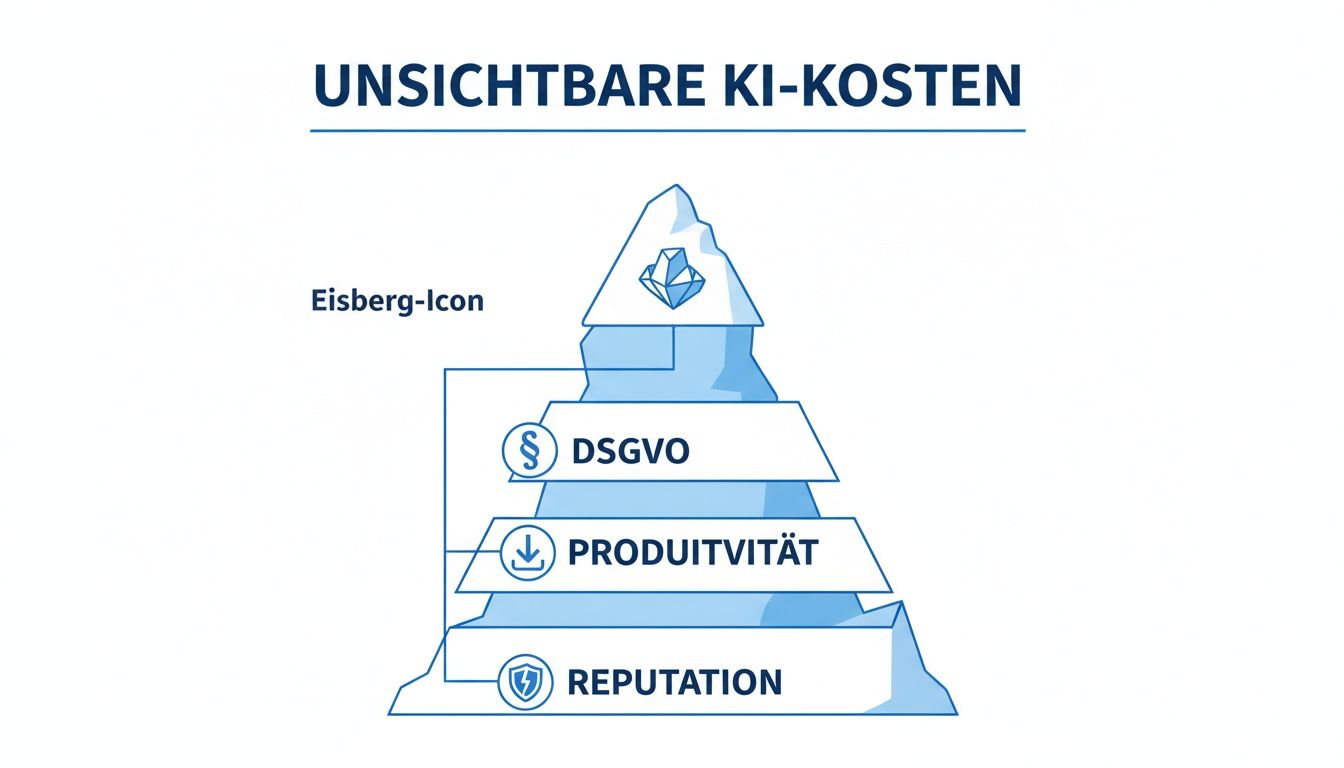
It's clear: potential GDPR penalties, productivity losses from unclear policies, and barely quantifiable reputational damage are the true cost drivers. They can make an apparently cheap solution extremely expensive in the end.
The Direct Comparison
To make the differences tangible, we've laid out the key factors side by side. This comparison helps you make an informed decision that goes well beyond the pure license price.
Comparison: US-based AI Tools vs. European AI Platforms (innoGPT)
| Factor | US-based AI Tools | European AI Platforms (innoGPT) |
|---|---|---|
| Data storage location | Often unclear or USA (CLOUD Act risk) | Guaranteed in the EU/Germany |
| GDPR guarantee | Vague assurances, no legally binding guarantee | Contractually assured compliance |
| EU AI Act | No proactive support, burden of proof on the user | Compliance-ready: documentation, governance, audit trails |
| Transparency | Data is often used to train global models | Strict zero-retention policy – your data stays yours |
| Pricing model | Per-user fee + variable API costs = difficult to plan | Flat-rate per user, all models included, predictable budgets |
| Flexibility | Usually limited to a single AI model | Bundling of leading models on one platform |
| Update speed | Slow adaptation to European needs | Fastest feature development close to the market |
The table makes it unmistakably clear: investing in a European platform is not just a decision for greater security. It's also a strategically smart choice to optimize costs in the long term.
How innoGPT Puts the Brakes on Costs and Maximizes Security
Now that we've looked together below the waterline of AI costs, one thing is crystal clear: anyone who sets off without a solid foundation risks their project capsizing. And this is exactly where innoGPT comes in. The platform is the safe harbor that transforms incalculable risks into hard, measurable advantages – and you feel that directly in your bottom line.

The masterstroke behind it? All relevant AI models are intelligently bundled on a single, rock-solid platform. What that means for you in practice is pure gold:
- No more license jungle: You no longer need separate subscriptions for GPT-4, Claude, and whatever else comes along. Everything is in one place, under a single, clear flat-rate license.
- No more tool-hopping: Your teams no longer jump wildly between different applications. That alone is a massive productivity booster!
- No uncontrolled data leaks: Every single interaction takes place in a protected, European environment. Your data stays where it belongs: with you.
- Predictable costs instead of surprise invoices: innoGPT's flat rate puts an end to variable API costs and unexpected overage fees. What you budget for is what you pay.
Zero Euros for Retroactive Compliance Nightmares
innoGPT is 100% GDPR-compliant from day one. And that's not an empty marketing claim – it's a contractually guaranteed commitment. For your company, that means: the costs for retroactive compliance patching, expensive legal hours, or looming fines simply disappear. They equal exactly zero.
Honestly: have you ever tried to calculate what it costs to "secure" a non-compliant tool after the fact? It's a nightmare of legal opinions and technical gymnastics that pulverizes any original savings.
With innoGPT, you invest in legal security from the very first minute. This is one of the strongest levers for reducing the true costs of artificial intelligence, because you eliminate the most expensive risks from the game entirely.
An Investment That Grows With You
An often underestimated cost killer is the blistering pace of technology. What's cutting-edge today may already be old news in six months. Do you then have to evaluate, budget, and implement a new, more expensive tool all over again? Not with innoGPT. Invest in a tool that grows with you, rather than buying the next one every 6 months.
A central point is the rapid and continuous further development of the platform. The newest and most powerful AI models are continuously integrated. This ensures that your investment is absolutely future-proof and grows with your company's ambitions. Instead of constantly chasing the next hype, you invest in a solution that has your back in the long term.
The True ROI Lies in Security
Briefly and directly to the point: an investment in innoGPT is so much more than just purchasing a software license. It's a strategic decision for:
- Data sovereignty: Your crown jewels – your sensitive data – stay in the EU and under your full control.
- Employee productivity: A central, intuitive tool makes your teams more efficient and puts a stop to the dreaded shadow IT.
- Legal security: The guaranteed GDPR compliance is your shield against the biggest financial dangers.
- Predictable budgets: The flat rate makes AI a calculable operating expense – no roulette with variable API costs.
These four pillars define the true return on investment (ROI) and make the difference between a simple expense and genuine value creation. So run the numbers on your AI costs honestly: add license fees, potential GDPR risks, and the time lost through inefficient processes. Then compare the result with the transparent, predictable costs of innoGPT. The difference will blow you away.
Now It Gets Concrete: Do the Math!
Enough theory – now it's your turn. We've now illuminated the iceberg of AI costs from all angles. Now it's time for an honest financial reckoning in your own company. Because the true costs of artificial intelligence are so much more than the number that appears on an invoice at the end of the month. It's about finally seeing the invisible but potentially ruinous risks in black and white.
Be honest: as a business owner, compliance officer, or sales director – please take a moment. Work through the following simple but brutally honest formula for your own company. That's the key to a decision you can still stand behind a year from now.
The Formula for Your Honest AI Cost Calculation
Anyone who wants to realistically assess total costs cannot just look at license fees. That would be fatal. Instead, use this simple but enormously powerful formula:
Your true AI costs = Visible license fees + Implementation & training + Potential GDPR risk + Productivity loss from shadow IT
Let's bring that to life:
- License fees: The amount you put on the table monthly for a tool. For ChatGPT Enterprise around $60 per user – for 50 employees that's $3,000 per month.
- Implementation & training: Often forgotten, but real. Who integrates the tool into existing systems? Who trains employees? External consultants quickly cost €10,000 to €50,000 for a medium-sized rollout – one-time, but still part of the true total bill.
- GDPR risk: Calculate with 4% of your global annual revenue. With revenue of €10 million, we're talking €400,000 for a single serious violation. A risk that is often missing from the balance sheet.
- Productivity loss: If just 20 employees lose a mere 15 minutes per day through uncoordinated, uncontrolled AI usage, that adds up to thousands of euros every month. Simply evaporated.
Add these items together. The contrast is often shocking. On one side: enormous, incalculable financial risk. On the other: the transparent, firmly budgetable flat-rate costs of innoGPT, where these gigantic risk factors simply don't arise in the first place.
Your Logical Next Step
The numbers don't lie. Investing in an apparently cheap US solution can quickly turn out to be the most expensive decision you've ever made. A secure, European platform is therefore not an expense – it's your insurance against the biggest financial and reputational dangers of the modern business world.
Calculate your AI costs honestly: add license fees + implementation costs + potential GDPR risks + time lost through shadow IT. Then compare your result with the transparent flat-rate pricing of innoGPT or request a no-obligation demo directly.
Your Most Pressing Questions About AI Costs – Plain Talk, No Jargon
To wrap up, we dive once more into the questions we encounter most frequently in practice. Here are the answers that truly help you – brief, direct, and drawn from experience with countless AI projects.
Where Do the Nastiest Cost Traps Lurk in GenAI?
Honestly? The biggest cost drivers are not the obvious license fees. That's just the tip of the iceberg. The real danger lurks below the surface, in the form of risks.
Imagine receiving a GDPR fine – that can be up to 4% of your global annual revenue! On top of that come implementation costs and training effort, which for a properly planned rollout can easily amount to €20,000 to €50,000. And then there's the uncontrolled shadow IT: employees use random free internet tools, feed them with sensitive company data, and throw open the door to data leaks. The reputational damage that can result is often impossible to quantify in monetary terms.
Why Is a European AI Solution the Smarter Investment in the Long Run?
Simply put: because it eliminates the most expensive problems from the start. A solution that is GDPR-compliant from day one, hosts in the EU, and follows a strict zero-retention policy saves you immense downstream costs.
No expensive lawyers to straighten everything out retroactively. No sleepless nights worrying about looming fines. And on top of that, a platform like innoGPT bundles the best AI models under one roof – at a single, predictable flat rate. That means: you save on buying and painstakingly managing numerous expensive individual licenses and noticeably reduce your direct expenditure.
How Do I Calculate Whether the AI Investment Is Worth It for Me?
Return on investment (ROI) is a mix of hard numbers and soft factors. The direct savings are the easiest to grasp: if every employee suddenly saves 30 to 60 minutes per day because routine tasks disappear, that's real money. Multiply that across your entire team!
But the real magic lies in the indirect gains. Think about higher quality work output, lightning-fast responses in customer service, or the strategic power to avoid costly mistakes before they even happen. Simply compare the time saved and the risk costs avoided against the clearly calculable flat-rate license fees – and you'll quickly see what enormous potential is waiting to be unlocked.
Hidden AI Costs: What You're Missing in Your Budget Approach
API prices have fallen. License fees are transparent. And yet companies regularly exceed their AI budgets. Why? Because the calculation starts in the wrong place. Anyone who only adds up license costs and token prices is calculating past reality. The real cost drivers in 2026 are elsewhere – and they are structural in nature.
Implementation and Integration: The Underestimated Budget Item
The first blind spot in almost every AI business case: the rollout itself. Buying an AI platform is not the same as using it. Between signing the contract and achieving genuine productive use, there is usually a complex process: connecting existing systems (HR, CRM, document management), building data pipelines, configuring access rights, integrating single sign-on.
What does that cost? For a typical mid-sized company with 50 to 200 employees, you should realistically budget €15,000 to €60,000 for a structured AI rollout – including external consultants, internal IT hours, and project management. Companies running open-source models themselves pay extra: GPU infrastructure, DevOps capacity, and ongoing security updates quickly add up to more than a managed enterprise platform costs.
A platform like innoGPT is designed to minimize this effort: standard integrations for common enterprise applications, no proprietary AI infrastructure required, and an onboarding process that takes weeks rather than months.
Training: The Factor Everyone Plans For – and Nobody Actually Budgets Correctly
The second major hidden cost factor is training. Not the one-time kick-off training, but ongoing enablement: improving prompt quality, learning new models, identifying meaningful use cases. Companies that underestimate this experience the same pattern in practice: the tool is introduced but barely used – because employees don't know how to apply it effectively.
Studies from 2025 show that companies with structured AI enablement achieve three times higher adoption rates than those that simply "roll out" AI without support. The ROI difference is significant: companies that truly use AI typically save between 10 and 30 percent of employee time on routine tasks per year – those that only make it theoretically available save nothing.
EU AI Act: The New Compliance Cost Driver from 2026
With the EU AI Act, binding requirements for AI systems in companies are coming into force from 2025/2026. Particularly relevant for mid-sized businesses: high-risk applications (HR decisions, credit assessments, safety systems) require documentation obligations, human oversight, and audit trails. Anyone who doesn't factor this in today will be building expensive compliance processes retroactively tomorrow.
US AI providers have a structural disadvantage here: they react to European regulation rather than being designed for it from the outset. innoGPT, as a European platform, is built with European requirements in mind – governance, documentation, and transparency are not afterthoughts, but an integral part of the architecture.
What a Budget Approach Really Costs
Anyone who views AI costs as merely a licensing line item risks a bill they didn't write themselves. Add to the license fees the implementation effort, ongoing training costs, EU AI Act compliance overhead, and the productivity loss from shadow IT – and you see why the apparently cheap option often turns out to be the most expensive in the end.
The antidote is not an expensive enterprise package with long contract periods, but a transparent flat-rate platform that minimizes all these items from the outset. That is exactly the core of the innoGPT approach: no hidden costs, no variable API surprises, no compliance roulette.
Calculating AI ROI: A Simple Framework for Decision-Makers
ROI is the word that comes up in every AI discussion – and that despite this, is rarely cleanly calculated in most business cases. This isn't due to a lack of interest, but a genuine methodological challenge: how do you measure something that primarily manifests in saved time and avoided mistakes?
The answer in 2026: you measure in FTE hours, not in features.
Step 1: Translate Time Savings into FTE Hours
FTE stands for Full-Time Equivalent – a full-time position that delivers around 1,600 productive working hours per year (based on 200 working days, 8 hours minus meetings and overhead). This is your most important calculation variable.
Start with a realistic estimate for your team. The following tasks are typically best suited for AI support and deliver the greatest time savings:
- Research and summaries: Reports, meeting minutes, market research – a well-used AI tool saves an average of 45 to 90 minutes per task here.
- Email and document creation: Proposals, standard replies, internal communications – 20 to 40 minutes per document.
- Data preparation and analysis: Evaluating spreadsheets, preparing reports, identifying patterns – 60 to 120 minutes per analysis task.
Calculation example for 50 employees: if every employee uses AI tools 3 days per week and saves an average of 30 minutes per day, that gives:
50 employees × 30 minutes × 3 days × 46 weeks (net) = 103,500 minutes = approximately 1,725 hours per year
At an average hourly rate of €50 (salary costs including overhead), that corresponds to a value of approximately €86,000 – almost an entire FTE.
Step 2: Factor in Risk Avoidance as an ROI Component
Most ROI calculations are missing a crucial factor: avoided costs. What is it worth to prevent a GDPR violation? What does a data leak cost in legal advice, notification obligations, and reputational damage?
A conservative estimate: a moderate data protection incident costs a mid-sized company between €50,000 and €250,000 – including fines, legal costs, technical remediation, and customer notification. Even if the probability of occurrence is only 5% per year, that corresponds to an expected risk cost value of €2,500 to €12,500 annually.
This value belongs in every ROI calculation – even if it's hard to pin down precisely. Companies working with a GDPR-compliant platform like innoGPT can set this risk item to virtually zero.
Step 3: The Complete ROI Formula
Based on the considerations above, the following simple framework emerges:
AI ROI = (Saved FTE hours × hourly rate) + Avoided risk costs − (License costs + Implementation + Training)
For the above example with 50 employees and innoGPT:
- Saved labor: €86,000 (1,725 hours × €50)
- Avoided risk costs: conservatively €5,000
- innoGPT costs (flat-rate, 50 users): realistically between €15,000 and €30,000 per year, all inclusive
- Implementation: one-time approximately €5,000 to €15,000 (significantly lower than for unstructured rollouts thanks to onboarding support)
- Training: approximately €3,000 to €8,000 in the first year
Result: A positive ROI already in the first year – with significantly better numbers from year two onwards, once implementation and initial training costs fall away.
What This Approach Means for Decision-Makers
The FTE hours framework has one decisive advantage: it makes AI tangible. No board approves a budget for "AI transformation." But a business case that shows innoGPT saves the equivalent of half an employee per year – while compliance and data security are fully assured – is understandable, negotiable, and approvable.
The key lies in an honest baseline: measure before the rollout how much time your teams currently spend on routine tasks that AI could take over. Then don't calculate with best-case scenarios, but with conservative 30% efficiency gains. And always add the full costs – license, implementation, training, compliance – not just the monthly subscription price.
Anyone who calculates AI ROI this way makes better decisions. And anyone who relies on a platform that brings cost transparency, flat-rate pricing, and European compliance from the start has the most solid foundation for an investment that pays off.
Weekly AI news in your inbox
New models, practical tips & expert insights — free for everyone.