tl;dr: The 3 most important takeaways for decision-makers
- The GDPR dilemma: US AI providers are subject to US laws such as the CLOUD Act, which potentially grants access to your sensitive company data — a massive compliance risk for European companies that becomes even sharper in 2026 with the EU AI Act.
- The shadow IT risk: If your company doesn't offer a secure, centralized AI solution, employees will turn to US tools without oversight, leading to data leakage and loss of control over business secrets.
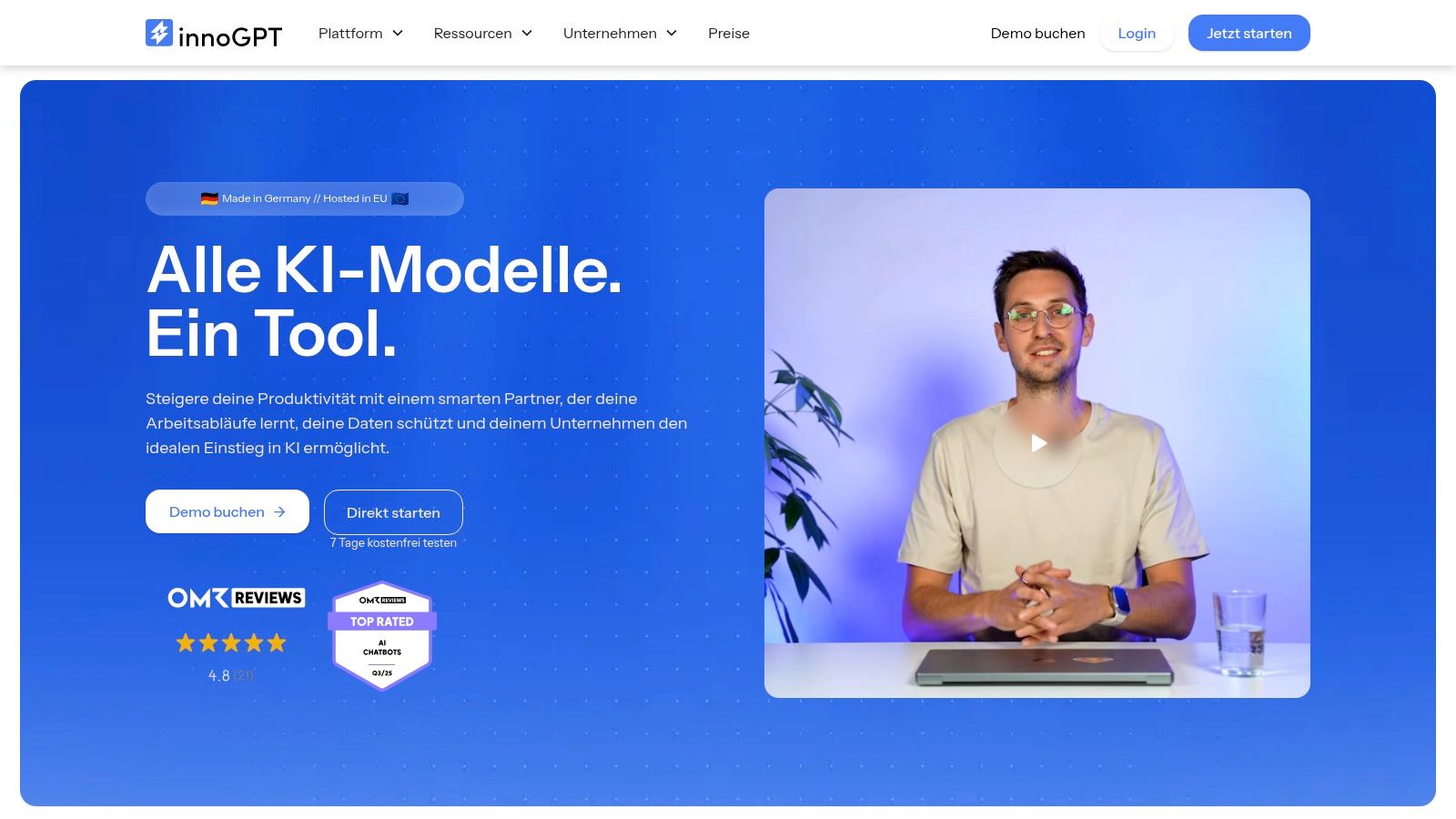
- The European solution: innoGPT is not just another AI platform — it's the rollout and governance layer for enterprise AI: a GDPR-compliant platform with EU hosting that securely consolidates all relevant AI models and increases productivity without sacrificing your data sovereignty.
Welcome to the era of generative AI! As a decision-maker, you're facing a tremendous opportunity: tools like ChatGPT and similar platforms can visibly boost efficiency and innovation in your company. By mid-2026, the pace has accelerated further — OpenAI's GPT-5 has launched, Anthropic has released Claude Sonnet 4.6 and Opus 4.8, Google offers Gemini 2.5 Pro with a context window of two million tokens, Meta has established Llama 4 as a powerful open-source option, and Mistral Large 3 positions itself as a European alternative. At the same time, API prices have dropped by up to 80% compared to 2023 — AI is cheaper than ever, but regulatory requirements have increased.
Yet while companies rush to uncover the best features in the AI gold rush, many forget to protect their data assets. Sensitive customer data, strategic plans, and internal communications all risk falling into the wrong hands if the wrong provider is chosen. That's why innoGPT combines both: innovation and security.
This comprehensive AI provider comparison 2026 shows you why popular US providers represent an incalculable GDPR risk for European companies. We highlight the pitfalls and show you how to stay not just innovative, but sovereign, with a GDPR-compliant AI as a European alternative.
We focus exclusively on generative AI — the technology you can start using immediately, without first having to laboriously prepare your own data.
This overview contains everything you need to make your decision: concise profiles of the key players from OpenAI to Aleph Alpha, clear comparisons by GDPR compliance, security, and integrations, and concrete recommendations. Each entry is supplemented with screenshots and direct links so you can find the perfect — and above all, secure — AI partner for your company without detours.
1. innoGPT: The GDPR-Compliant AI Hub for German Enterprises
innoGPT positions itself as the central nervous system for artificial intelligence in European companies and acts as a strategic, security-oriented alternative to the US giants. As one of the leading artificial intelligence providers from Germany, the platform was developed specifically for the strict requirements of the European market. It functions as an internal operating system that automates routine tasks while maintaining full control over sensitive data.
Imagine your key account management team being able to generate proposals, emails, and meeting minutes at the push of a button — all perfectly aligned with your corporate tone of voice. That's exactly what innoGPT makes possible, saving teams up to 60 minutes of pure writing work per day according to their own data. Simply upload existing documents (PDFs, Word, PowerPoint) and get summaries, key points, or data extracts generated in seconds. With the EU AI Act introducing mandatory registration for high-risk AI systems in 2026, a reliable governance layer is no longer optional — it's required. innoGPT delivers this out of the box.
The Differentiator: Enterprise Security and a Multi-Model Approach
What truly sets innoGPT apart is its unwavering focus on data protection and security. As a German solution with EU hosting in ISO-certified data centers, AES-256 encryption, and a strict zero-retention commitment (your data is never used for model training), the platform meets all GDPR criteria. Features such as SSO and role-based access controls are essential for professional enterprise use.
At the same time, the platform consolidates the most powerful AI models of 2026 — including OpenAI's GPT-5, Anthropic's Claude Opus 4.8, and Google's Gemini 2.5 Pro — under a single, secure interface. This multi-model approach means you always use the best model available for each task, without making any privacy compromises. With over 3,000 integrations into systems like SharePoint, Teams, or HubSpot, innoGPT becomes the perfect control center for your existing IT landscape. This transforms uncontrolled shadow AI into productive, measurable enterprise AI.
innoGPT is like a digital vault: it combines the most valuable AI innovations with the security European companies need to protect their data assets.
Use Cases & Verdict
From sales and marketing to HR and customer service: the range of applications is enormous. The platform delivers its full potential especially in key account management — quickly analyze customer requirements from long email threads, generate tailored proposals in seconds, or efficiently prepare for your next client conversation.
| Feature | Benefit |
|---|---|
| GDPR Compliance | EU hosting, zero retention, ISO certification — maximum legal certainty. |
| Multi-Model Access | Access to GPT-5, Claude Opus 4.8, Gemini 2.5 Pro & more via one central platform. |
| Document Analysis | Fast summaries and data extraction from PDFs, Word & PowerPoint files. |
| Integrations | Seamless connectivity to 3,000+ tools including SharePoint, Teams, and HubSpot. |
Disadvantages: Pricing is not publicly listed and must be requested individually. Additionally, optimal use — as with any powerful software — requires initial configuration.
Access: innoGPT offers a free 7-day trial — no payment details required, no cancellation needed — as well as personal demos for evaluation.
Website: https://www.innogpt.de
2. OpenAI (API, ChatGPT for Teams/Enterprise)
As the pioneer that triggered the generative AI hype with ChatGPT, OpenAI is arguably the best-known artificial intelligence provider on the market. The platform offers far more than just the well-known chatbot: via its powerful API, developers and enterprises can integrate advanced language, image, and audio models directly into their own applications and workflows. This makes OpenAI the first choice for prototyping and scalable AI projects.
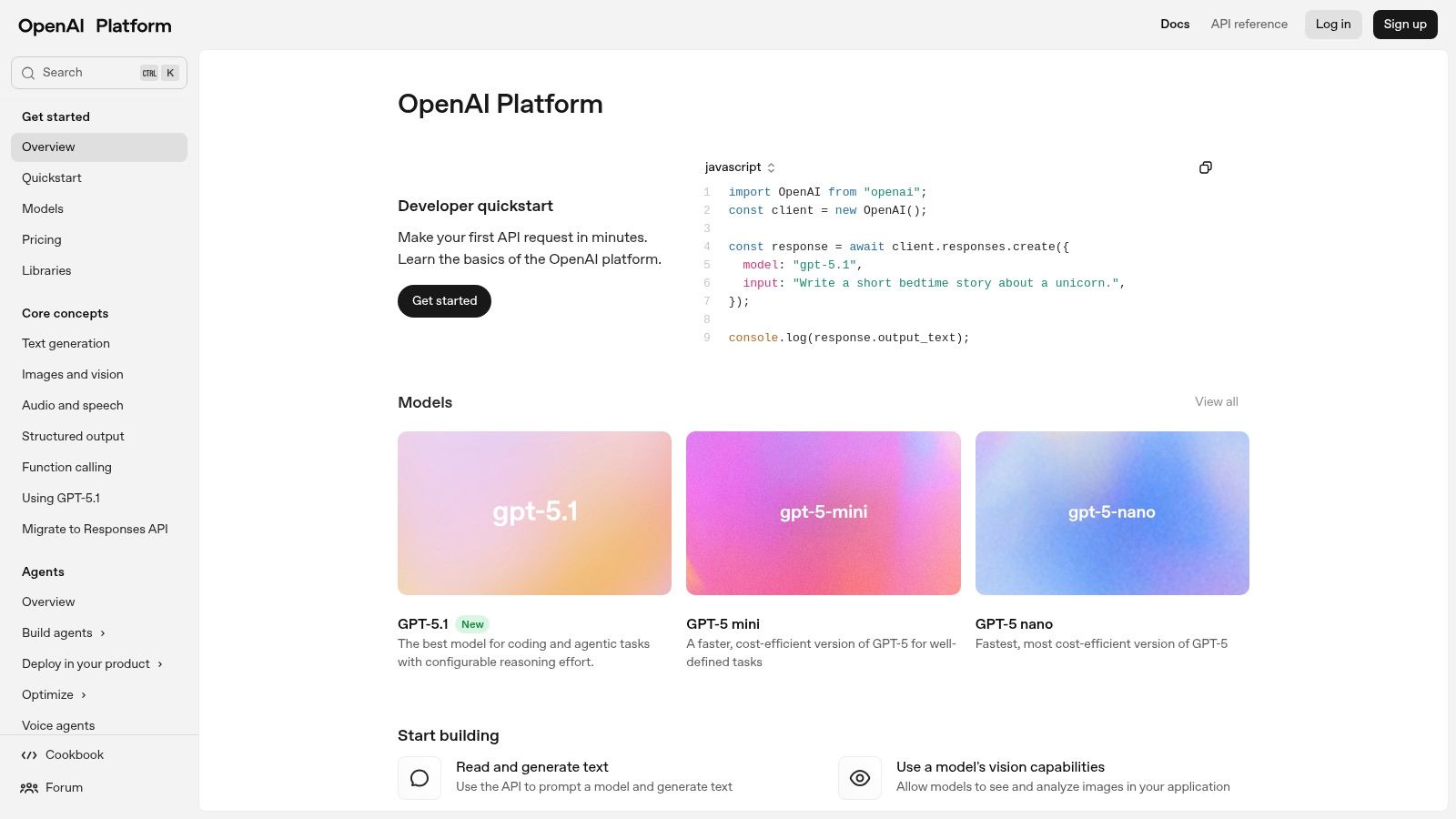
For companies looking for a ready-to-use solution, ChatGPT for Teams and the Enterprise version are ideal. These offer enhanced security features, higher usage limits, and data residency options, including in the EU — an important development, even if the fundamental GDPR challenges of a US provider remain. In June 2026, GPT-5 serves as the flagship model — demonstrating clear advances in reasoning, code generation, and multimodal tasks in benchmarks. Specialized tools for AI agents and significantly reduced API prices round out the offering, making entry more accessible for smaller companies.
Strengths and Weaknesses at a Glance
Pros:
- Innovation leader: You gain access to the latest and most powerful AI models on the market, led by GPT-5 in 2026.
- Extensive ecosystem: A large community, detailed documentation, and numerous SDKs make integration significantly easier.
- Reduced costs: API prices have dropped by up to 80% compared to 2023, making AI projects more economical for many companies.
Cons:
- Data protection (GDPR): Despite EU data residency, OpenAI remains a US company subject to laws like the CLOUD Act. For sensitive company data, this represents a significant risk, as US authorities can demand access.
- EU AI Act requirements: As a provider of general-purpose AI models, OpenAI must meet transparency obligations from 2026 onwards. For companies, this means additional due diligence tasks when using the platform.
- "Preview" status: Many new features are initially released as beta versions and may not yet be stable enough for production use.
The OpenAI platform is undoubtedly a technological giant, but European companies should proceed with caution. Use can quickly lead to unintentional shadow IT if no GDPR-compliant alternative is provided. Learn more about how a secure AI platform closes the gap between innovation and data protection — and why ChatGPT and data protection is such a pressing issue for European companies.
Website: https://platform.openai.com/
3. Microsoft Azure AI (Azure OpenAI Service and Azure AI Services)
For companies already deeply embedded in the Microsoft ecosystem, Azure AI represents the logical and strategically smartest choice. As a leading artificial intelligence provider for the enterprise sector, Microsoft wraps OpenAI's powerful models in an enterprise-grade framework. Through the Azure OpenAI Service, you gain access to GPT-5, image models, and other top models — hosted in European data centers and secured by Azure's proven security and compliance standards.

The key advantage lies in seamless integration: you can connect AI capabilities directly with Azure DevOps, Functions, or Logic Apps, and bill everything through your existing Azure account. Models are deployed within your own tenant, giving you maximum control over data access. Microsoft has expanded its EU AI Act compliance documentation in 2026 and offers companies specific guidance on registration requirements — an advantage over smaller providers who have yet to structure this process. Whether you prefer to start flexibly with pay-as-you-go or book guaranteed performance for business-critical applications via Provisioned Throughput Units (PTUs), Azure provides the right tools for a professional and scalable AI implementation.
Strengths and Weaknesses at a Glance
Pros:
- Data protection and governance: Hosting in EU regions and integration into the Azure security stack (e.g. Private Endpoints, VNETs) is a massive advantage for GDPR compliance.
- Unified billing: Costs are simply billed through your Azure account, significantly simplifying financial management for existing customers.
- Enterprise SLAs: Unlike direct OpenAI usage, you benefit from Microsoft's enterprise-grade Service Level Agreements.
Cons:
- Complexity: Managing quotas and booking PTUs can quickly become confusing and technically demanding for newcomers.
- Delayed model availability: The latest OpenAI models are often not immediately available on Azure — there's typically a lag.
- Residual GDPR risk: Although data is hosted in the EU, Microsoft as a US company is subject to the CLOUD Act, posing a residual risk for sensitive company data.
Azure AI is the top choice for established companies with Azure infrastructure that want to use OpenAI technology while adhering to strict governance policies. However, for companies seeking a faster, more flexible, and vendor-agnostic solution, the high administrative overhead can be a barrier.
Website: https://azure.microsoft.com/products/ai-services/openai-service/
4. Google Cloud Vertex AI
Google Cloud is establishing itself with Vertex AI as a comprehensive artificial intelligence provider deeply integrated into its vast cloud ecosystem. The platform is designed as an end-to-end solution covering the entire lifecycle of generative AI models — from training and fine-tuning to deployment. At the center in 2026 are the Gemini 2.5 models — most notably Gemini 2.5 Pro with a context window of two million tokens, enabling the analysis of entire document libraries or extensive code repositories in a single call. The models are available via EU data centers such as Frankfurt or Zurich.

Vertex AI offers a seamless experience especially for companies already at home in Google Cloud. The platform excels through its MLOps integrations (Machine Learning Operations), enabling professional management and scaling of AI applications. Features such as the Agent Engine for building AI agents or grounding capabilities for enriching responses with company data demonstrate the enormous potential. The extremely large context window of Gemini 2.5 Pro makes it particularly attractive for use cases involving extensive documents, long conversation histories, or code analysis. Nevertheless, the fundamental data protection challenge of a US provider subject to the CLOUD Act remains here as well.
Strengths and Weaknesses at a Glance
Pros:
- Strong MLOps integration: Perfect for companies that want to systematically develop, evaluate, and deploy AI models into production.
- Massive context window: Gemini 2.5 Pro with 2 million tokens enables analysis of entire document collections in a single call.
- EU data locations: The availability of data centers in the EU (e.g. Frankfurt) is a plus, though it doesn't resolve the fundamental GDPR dilemma.
Cons:
- Complex pricing structure: The large number of SKUs, add-ons, and billing models can quickly become confusing and requires deep technical understanding for cost optimization.
- Data protection (US CLOUD Act): As a US company, Google is subject to laws that allow US authorities to access data even when stored in the EU — a critical risk for sensitive data.
- High configuration complexity: Getting started and configuring larger setups can be demanding and requires specialized expertise.
Google Cloud Vertex AI is an extremely powerful but also complex platform for ambitious AI projects. For European companies, however, the key question remains whether the technological advantages outweigh the inherent data protection risks.
Website: https://cloud.google.com/vertex-ai
5. AWS Bedrock (plus Amazon SageMaker)
For companies already deeply embedded in the AWS ecosystem, Amazon Bedrock is a logical and extremely powerful choice as an artificial intelligence provider. The platform acts as a central hub, providing access through a single, unified API to a curated selection of foundation models from leading developers including Anthropic (Claude Sonnet 4.6 and Opus 4.8), Meta (Llama 4), Mistral, and Amazon's own Nova family. The significantly reduced API prices in 2026 have made it economically viable for mid-sized companies to use Bedrock without incurring high upfront fixed costs.
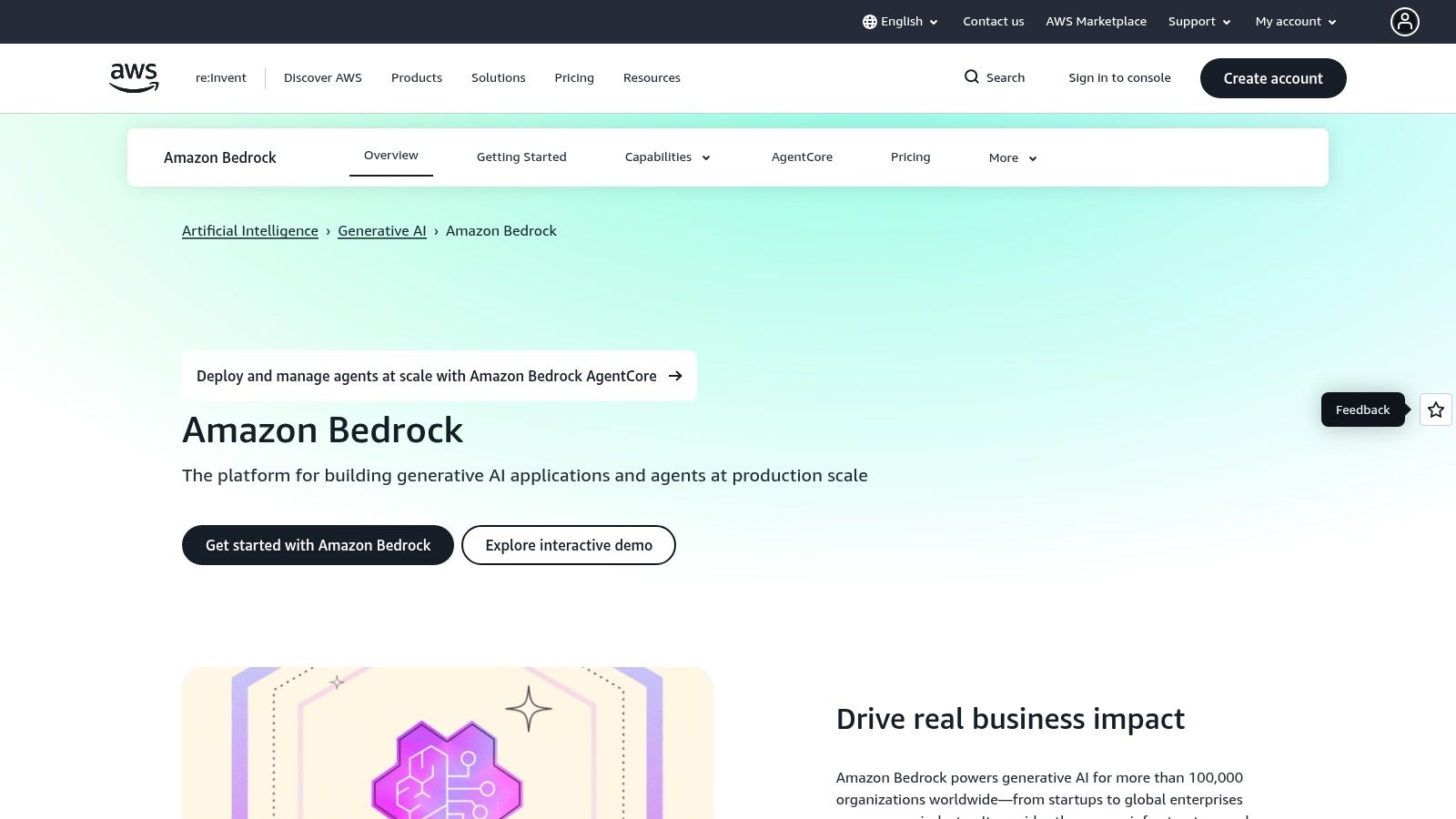
The major advantage lies in seamless integration with AWS's proven infrastructure. You can directly secure generative AI applications using familiar AWS security, governance, and compliance tools. Features like Guardrails or Knowledge Bases enable the building of production-ready, secure applications. For more traditional machine learning tasks, Amazon SageMaker complements the offering with notebooks, pipelines, and hosting options, enabling a comprehensive AI strategy from a single source. Important for European companies: AWS offers hosting regions including Frankfurt, Ireland, and Paris, ensuring data residency. However, the CLOUD Act remains as a legal residual risk here as well.
Strengths and Weaknesses at a Glance
Pros:
- Wide model selection: You're not locked into a single provider and can flexibly choose the best model for each use case — complemented in 2026 by Llama 4 as a strong open-source option.
- Integration and security: Benefit from AWS's robust security standards, governance features, and EU data hosting.
- Scalability: Options like "Provisioned Throughput" guarantee performance for critical applications and enable predictable cost structures.
Cons:
- Complex pricing structure: Costs consist of model usage, various tools, and provisioned units, which can quickly make budgeting confusing.
- High administrative overhead: Configuring quotas, access rights, and resources requires deep AWS expertise and careful planning.
- Residual GDPR risk: Although data can be hosted in the EU, AWS as a US company is subject to the CLOUD Act, posing a residual risk for sensitive data.
AWS Bedrock is an excellent choice for technically skilled teams that want full control and a broad model selection within a familiar cloud environment.
Website: https://aws.amazon.com/bedrock/
6. SAP Business AI (Joule Copilot & Joule Agents)
For companies whose business processes are deeply embedded in the SAP ecosystem, SAP Business AI is the logical step to integrate generative AI directly into daily workflows. As a native artificial intelligence provider within the SAP cloud platform, Joule — the context-aware copilot — focuses not on general queries, but on optimizing specific business processes. It draws directly on data from S/4HANA, SuccessFactors, or Signavio to accelerate processes and deliver decision-relevant insights. With the EU AI Act, SAP places increasing emphasis on traceability and documentation of AI decisions — an aspect particularly important for regulated industries.

SAP's strength lies in seamless embedding: Joule and the associated agents are not external tools but an integral part of familiar SAP interfaces. Whether analyzing financial data, creating job descriptions, or optimizing the supply chain — the AI always operates in the context of the relevant role and task. SAP places a strong focus on governance, security, and EU-compliant deployment, which is a decisive advantage for existing SAP customers and lowers the barriers to company-wide adoption.
Strengths and Weaknesses at a Glance
Pros:
- Deep process integration: The AI is natively embedded in SAP workflows and understands business context, leading to highly relevant results.
- Strong governance focus: SAP offers comprehensive security and compliance features specifically tailored to the requirements of large enterprises.
- Easy adoption: Since the AI lives within existing systems like S/4HANA or SuccessFactors, the training effort for employees is minimal.
Cons:
- Ecosystem dependency: The value is almost exclusively limited to companies that have already invested heavily in the SAP landscape.
- Opaque pricing: Costs are often tied to existing licenses or packages. A straightforward, public pricing catalog for self-service does not exist.
- Less flexibility: Compared to open platforms, the functional scope is strongly focused on predefined SAP business processes.
Website: https://www.sap.com/products/artificial-intelligence.html
7. IBM watsonx.ai
IBM, a long-established player in enterprise IT, positions itself with watsonx.ai as a strategic artificial intelligence provider for companies with the highest demands on security and control. The platform is designed as a comprehensive studio that not only enables access to IBM's own foundation models (such as the Granite family) but also integrates third-party models. This provides impressive flexibility, especially for regulated industries that require granular control and traceability of their AI usage. IBM has significantly expanded its EU AI Act compliance documentation in 2026 and positions itself as one of the best-prepared enterprise providers for regulatory requirements.

The decisive advantage of watsonx.ai lies in its hosting options: the platform can be operated not only in the cloud but also as a hybrid or on-premise solution. This gives companies full control over their data and meets the strictest data protection requirements. With capabilities such as RAG, AgentLab for creating AI agents, and tools for synthetic data, IBM clearly targets demanding use cases. The pricing structure — broken down by tokens, GPU hours, and "Machine Learning Compute Hours" — is transparent and tailored to enterprise needs.
Strengths and Weaknesses at a Glance
Pros:
- Enterprise focus: Transparent, enterprise-grade pricing and support models provide planning certainty.
- Maximum control: The strong focus on hybrid cloud and on-premise operation meets the highest data protection and sovereignty requirements.
- Open ecosystem: Integration of third-party models prevents vendor lock-in and enables use of the best model for each job.
Cons:
- High entry complexity: The feature-rich scope and enterprise focus can make getting started complex for smaller teams or simple use cases.
- Limited self-service: The focus on large customers can mean straightforward self-service use for developers is more restricted compared to pure API providers.
- Cost structure: While the structure is transparent, it can quickly become more expensive for unpredictable workloads compared to purely consumption-based models.
IBM watsonx.ai is the right choice for established enterprises that want to deeply and securely integrate generative AI into their core processes without compromising data sovereignty.
Website: https://www.ibm.com/watsonx/ai
8. Aleph Alpha (PhariaAI)
As a leading German artificial intelligence provider, Aleph Alpha from Heidelberg positions itself as the sovereign European response to US dominance. With a clear focus on data sovereignty, explainability, and GDPR compliance, the company targets public institutions and critical industries in the DACH region with the highest demands for security and transparency. The PhariaAI suite bundles the Pharia model family in 2026 with a full-stack platform for sovereign enterprise deployment. Aleph Alpha is particularly well-positioned in the context of the EU AI Act: the company aligned its compliance infrastructure to European requirements early on and offers customers specific support in meeting registration obligations.
At the heart of the offering are sovereign deployment options: Aleph Alpha enables operation of models either in a secure EU cloud or completely on-premise in the customer's own data center. This gives companies full control over their data and eliminates risks from laws like the US CLOUD Act. With a strong sales and support team in Germany, Aleph Alpha provides direct, personal support tailored to the specific needs of the European market — standing in stark contrast to the self-service models of US competitors.
Strengths and Weaknesses at a Glance
Pros:
- Maximum data sovereignty: As a German provider with on-premise options, your data receives the highest level of protection under EU law.
- EU AI Act readiness: Aleph Alpha has implemented compliance processes for the European AI regulation early and actively supports customers in meeting requirements.
- Explainability: Unique features help trace AI decisions, which is critical for compliance and trust.
Cons:
- Opaque pricing: Prices are almost exclusively available on request, making quick cost estimation and comparison difficult.
- Sales-driven access: Onboarding is not possible via self-service but requires a formal sales and onboarding process.
- Lower model awareness: The Pharia model family is less well-known compared to GPT or Claude, which can slow down the ramp-up for developer teams.
Aleph Alpha is the first choice for organizations where data security and sovereignty are non-negotiable. Learn more about how other German AI companies are positioning themselves in global competition and why European AI companies consistently prioritize data sovereignty.
Website: https://aleph-alpha.com/
9. Hugging Face (Model Hub, Inference Endpoints)
Hugging Face has established itself as the "GitHub for machine learning" and is an indispensable resource for developers and AI teams. As an artificial intelligence provider, the platform focuses less on a single flagship model and more on a massive, open hub with thousands of pre-trained models, datasets, and ready-to-use demo applications (Spaces). The real gem for enterprises are the Inference Endpoints: with just a few clicks, you can deploy any model from the hub as a dedicated, auto-scaling API for production use. In 2026, Meta's Llama 4 has enriched the open-source landscape on Hugging Face, offering a powerful alternative to proprietary models — particularly attractive for companies that want full control over their model.

This approach democratizes access to specialized open-source models and dramatically accelerates the transition from experimentation to production. Instead of building your own complex infrastructure, you simply select a model and a cloud provider (such as AWS, Azure, or GCP), and Hugging Face handles the deployment. Pricing is transparent and based on the compute power used per hour, enabling good cost control. Larger teams also benefit from organizational features such as SSO, audit logs, and choice of storage region.
Strengths and Weaknesses at a Glance
Pros:
- Enormous model variety: Access to a vast library of open-source models for diverse use cases, complemented in 2026 by Llama 4 as a strong open-source flagship.
- Fast go-live: The transition from a hub demo to a scalable, production endpoint is extremely simple and quick.
- Transparent costs: Per-hour billing for compute power makes the operating costs of a model easy to understand.
Cons:
- Complex cost management: With intensive use and heavy autoscaling, operating costs can quickly become difficult to track and require active monitoring.
- Technical expertise required: The platform primarily targets developers and requires a certain level of technical understanding for model selection and management.
- GDPR self-responsibility: Although you can choose the cloud region, responsibility for GDPR-compliant data processing within the endpoints lies entirely with your company.
Hugging Face is a paradise for technical teams seeking flexibility and control over their AI infrastructure. For business units without developer resources, however, the barrier to entry is high.
Website: https://huggingface.co/
10. DeepL (Translation, Write, Voice)
As a German showcase company from Cologne, DeepL has established itself as a leading artificial intelligence provider for language-based applications. Originally known for its outstanding neural translations that often reach human quality, the company has sensibly expanded its portfolio. With tools like DeepL Write for text optimization and the new DeepL Voice for text-to-speech applications, the platform offers a comprehensive suite for global communication. Especially for the European market, the high quality in German and European language contexts is a decisive advantage — an area where US models like GPT-5, despite their general strengths, continue to lag behind DeepL in the nuances of German.
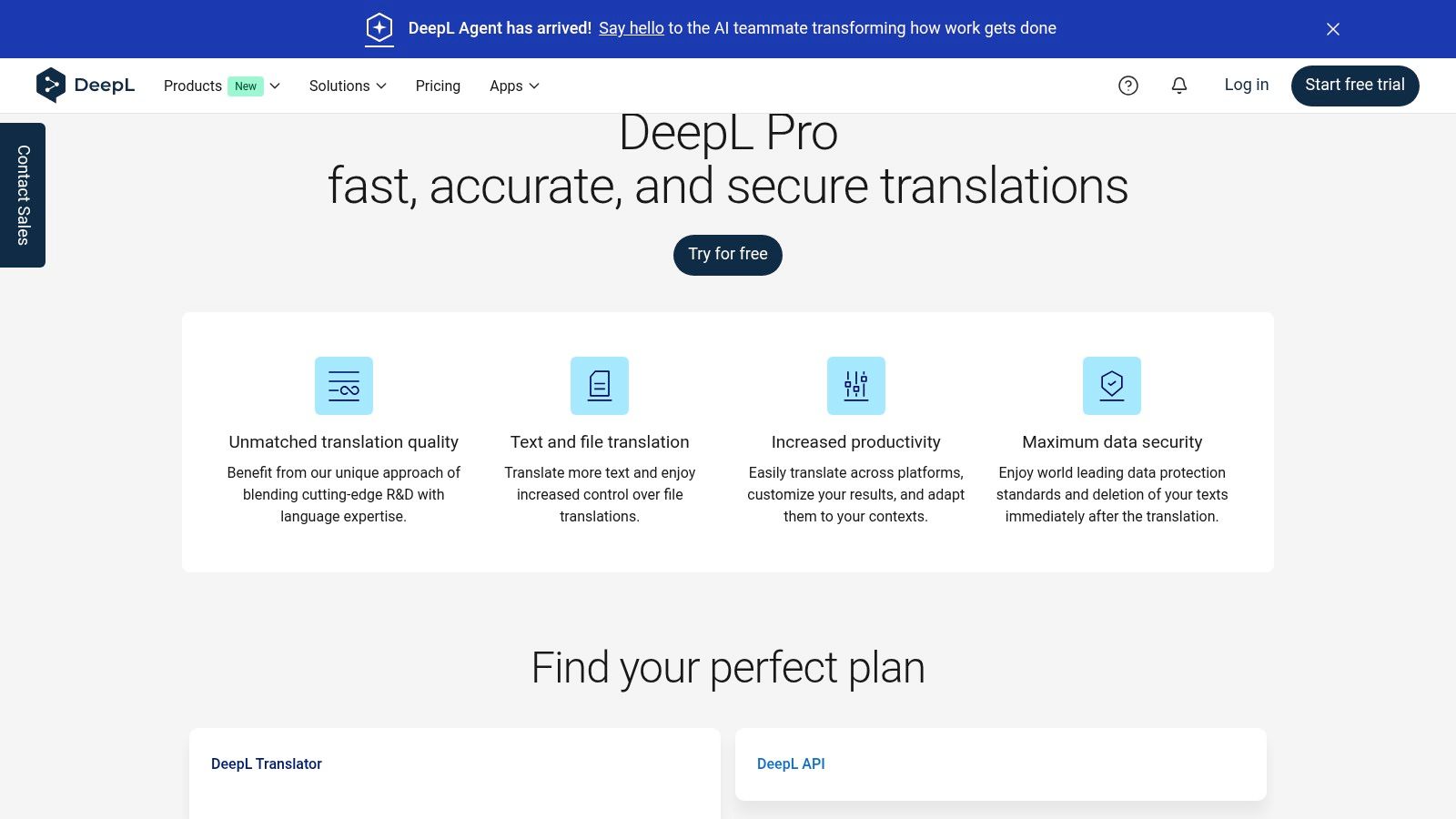
For companies, DeepL is more than just a translator. The API enables seamless integration into your own products and workflows, while ready-made integrations for Microsoft 365 or Google Workspace boost team productivity. Enterprise packages with features like Single Sign-On (SSO), centralized administration, and a dedicated Trust Center underscore the focus on security and scalability. DeepL thus positions itself as a GDPR-friendly and high-performance solution for any organization looking to overcome language barriers and perfect its written communications.
Strengths and Weaknesses at a Glance
Pros:
- Excellent language quality: Particularly in German- and European-language contexts, DeepL often delivers more nuanced and contextually appropriate results than the competition.
- Enterprise-ready: With API, SSO, team administration, and dedicated integrations, the platform is prepared for professional use.
- German provider: As a German company, DeepL offers strong credibility regarding GDPR compliance and data protection.
Cons:
- Specialized focus: Compared to all-in-one platforms, the functional scope is limited to language, text, and translation.
- Dynamic pricing: Costs vary by country and chosen package. The exact structure must be checked individually via the pricing calculator.
- Lower profile in LLM space: While DeepL is well-known for translation, it still operates in the shadow of the large US models in the general generative AI space.
DeepL is an excellent choice for companies looking for a best-in-class, secure, and specialized solution for translation and text optimization. It's a prime example of European AI excellence with a clear focus on the business user.
Website: https://www.deepl.com/pro
11. NVIDIA AI Enterprise & NGC
NVIDIA is not just the leading hardware manufacturer for AI — it's also a decisive artificial intelligence provider in the software space. With NVIDIA AI Enterprise and the NGC catalog (NVIDIA GPU Cloud), the company targets organizations that want to maintain maximum control over their AI infrastructure. Rather than relying on a public cloud, companies can build and optimize their own AI stacks on-premise or in a hybrid environment — ideal for the highest performance and security requirements. In 2026, NVIDIA has advanced its NIM Microservices platform, making it easier for companies to efficiently run external models like Llama 4 or Mistral Large 3 on their own NVIDIA hardware.
The platform is essentially the operating system for GPU-accelerated computing. NVIDIA AI Enterprise is a licensed software suite that provides certified and supported stacks for environments like VMware or Kubernetes. The NGC catalog perfectly complements this with a vast library of optimized AI models, containers, and tools that are ready to deploy immediately. This reduces complexity and dramatically accelerates the development of your own generative AI applications.
Strengths and Weaknesses at a Glance
Pros:
- Maximum control and performance: You run AI on your own infrastructure and benefit from software optimized for NVIDIA hardware.
- Enterprise support: The licensed suite comes with professional support, SLAs, and certified software stacks, which is critical for production use.
- Rich NGC catalog: The public portion of the catalog provides free access to countless models and tools, lowering the barrier to entry.
Cons:
- High total cost: In addition to AI Enterprise license fees (CapEx/OpEx), significant costs arise for the required high-end GPU hardware.
- Complexity: Building and maintaining your own AI infrastructure requires specialized IT expertise and resources.
- Partner dependency: Pricing and support contracts often run through resellers, which can complicate direct access.
NVIDIA is the top choice for companies that want to deeply integrate generative AI into their own IT infrastructure without compromising performance or data sovereignty.
12. Genspark (AI Workspace 4.0)
Genspark positions itself as an all-in-one AI workspace that bundles numerous generative tools under a single interface. Rather than being just a chatbot, the "AI Workspace 4.0" combines autonomous AI agents with a complete office suite: AI slides, AI spreadsheets, and AI documents alongside design, code, image, and video generation as well as AI meeting notes. This makes Genspark ideal for teams that want to handle as many AI tasks as possible within a single tool.

At the core are AI agents (including the "Claw" agent), which handle multi-step tasks largely autonomously — from research and presentation creation to data analysis. Genspark draws on leading models from OpenAI and Anthropic in the background and stores data on Microsoft Azure by default. Enterprise customers can arrange data residency (e.g. user profiles, project and chat history) in AWS, Azure, or GCP at additional cost.
Strengths and Weaknesses at a Glance
Pros:
- True all-in-one approach: Agents, office suite, design, code, image, and video in one interface reduce tool sprawl.
- Strong agent automation: Multi-step tasks are handled largely autonomously, noticeably reducing routine workload.
- Certified security: Genspark is SOC 2 Type II certified and guarantees GDPR-compliant processing through a data processing agreement (DPA) and EU standard contractual clauses (SCCs).
Cons:
- Residual GDPR risk (US provider): As a US company, Genspark is subject to the CLOUD Act. Since data lands in the US cloud by default and requests are forwarded to OpenAI/Anthropic, a residual risk remains for sensitive company data.
- EU data residency at additional cost: Guaranteed EU storage is only available for enterprise customers under individually negotiated terms.
- Dependency on third-party models: Genspark does not operate its own flagship models but orchestrates external APIs — with corresponding data forwarding.
Genspark is an exciting choice for teams seeking maximum functional breadth in a single tool. For European companies with high protection requirements, however — as with other US platforms — the question of data sovereignty remains decisive.
Website: https://www.genspark.ai/
AI Provider Comparison 2026: The 12 Leading Providers at a Glance
| Product | Core Features | Quality & UX (★) | USP / Highlights (✨) | Target Audience & Pricing (👥💰) |
|---|---|---|---|---|
| innoGPT | Automated text generation, doc upload, summaries, multi-model | ★★★★☆ | ✨ GDPR & EU hosting, zero retention, AES-256, 3,000+ integrations | 👥 Sales/Marketing/HR/Support/Enterprise–Startup · 💰 Contact / 7-day trial |
| OpenAI (API, ChatGPT Teams) | GPT-5, Agents, API, TTS/ASR | ★★★★☆ | ✨ Innovation leader, broad ecosystem, EU data residency | 👥 Developers/Scaleups · 💰 Token-/tool-based billing |
| Microsoft Azure AI | Azure OpenAI (GPT-5), PTUs, Security Stack, DevOps integration | ★★★★☆ | ✨ Integration into Azure governance (SSO, VNET, Private Endpoints) | 👥 Azure customers/Enterprise · 💰 Pay-as-you-go / PTU |
| Google Cloud Vertex AI | Gemini 2.5 Pro (2M tokens), Agent Engine, MLOps | ★★★★☆ | ✨ Massive context window, EU regions, MLOps tooling | 👥 ML teams/Data science · 💰 Consumption-based |
| AWS Bedrock & SageMaker | Foundation models (Claude, Llama 4, Nova), SageMaker ML lifecycle | ★★★★☆ | ✨ Wide model selection incl. Llama 4, AWS governance & EU regions | 👥 AWS customers/Enterprise · 💰 Model/throughput pricing |
| SAP Business AI (Joule) | Role-based assistants, Joule Agents, ERP integration | ★★★☆☆ | ✨ Deep SAP integration, process context, EU AI Act documentation | 👥 SAP landscapes/ERP teams · 💰 Bundles / Sales-driven |
| IBM watsonx.ai | Model studio, RAG/AgentLab, hybrid/on-prem options | ★★★★☆ | ✨ Hybrid & on-prem, transparent pricing, EU AI Act readiness | 👥 Regulated industries/Hybrid setups · 💰 Tokens/GPU hours |
| Aleph Alpha (PhariaAI) | PhariaAI Suite, Explainability, sovereign deployments | ★★★★☆ | ✨ German provider, on-prem/EU hosting, EU AI Act compliance | 👥 Public sector/Industry DACH · 💰 On request |
| Hugging Face | Model Hub (incl. Llama 4), Inference Endpoints, Spaces & Datasets | ★★★★☆ | ✨ Open models incl. Llama 4 + auto-scaling endpoints | 👥 Devs/Startups/Data teams · 💰 Compute/hourly billing |
| DeepL (Translate/Write/Voice) | Translation, writing assistance, voice, API | ★★★★★ | ✨ Best German language quality, office integrations, GDPR-compliant | 👥 Content/Localization/Teams · 💰 Subscription models (Pro/Business) |
| NVIDIA AI Enterprise & NGC | Certified AI stacks, NIM Microservices, containers/models | ★★★★☆ | ✨ GPU optimization, enterprise support, NGC catalog, Llama 4 on-prem | 👥 Infra/On-prem/GPU teams · 💰 License + HW |
| Genspark (AI Workspace 4.0) | AI agents, office suite, design/code, image/video, meeting notes | ★★★★☆ | ✨ All-in-one workspace, SOC 2 Type II, EU residency (enterprise) | 👥 Teams/All-rounders · 💰 Subscription / Enterprise on request |
Frequently Asked Questions About the AI Provider Comparison (FAQ)
EU AI Act Compliance: Which Providers Are Truly Compliant in 2026?
The EU AI Act is fully in force in 2026 and has fundamentally changed the requirements for AI providers and users alike. Since August 2, 2026, registration obligations for high-risk AI systems are binding — a milestone that has caught many companies off guard. What does this mean specifically for you as a decision-maker, and which providers are truly prepared for this new reality?
What the EU AI Act Means for Companies
The EU AI Act classifies AI systems by risk category. For most enterprise applications, the "limited risk" and "high risk" categories are relevant. High-risk systems — including AI-assisted HR decisions, credit assessments, and certain safety systems — must be registered in an EU-wide database and meet strict requirements for transparency, human oversight, and technical documentation. As the operator of such a system, you are responsible for compliance — not solely the provider. This has direct consequences: you need a provider that can deliver the necessary documentation, audit trails, and transparency about the models used.
General-purpose AI models like GPT-5, Claude Opus 4.8, or Gemini 2.5 Pro are subject to their own transparency obligations: their providers must publish technical documentation and ensure their models don't unlawfully use copyrighted training data. US providers formally meet these requirements — but whether they can deliver the underlying evidence for your internal documentation is a different question.
Who Is Truly EU AI Act-Ready?
The honest answer: the market is still developing. European providers like Aleph Alpha have invested early and offer customers structured support in meeting requirements. IBM watsonx.ai has expanded its compliance documentation and positions itself as one of the best-prepared enterprise providers. innoGPT, as a governance layer, delivers exactly the central control functions companies need to demonstrate human oversight: role-based access rights, audit logs, usage reports, and a central management interface for all AI activities across the company.
The major US providers — OpenAI, Google, Microsoft, AWS — have expanded their compliance documentation, but as the operator you ultimately bear the responsibility. With these providers, EU AI Act compliance means primarily: independent due diligence, internal documentation, and in many cases additional legal opinions. This is a significant additional effort that is often overlooked in cost calculations.
The Practical Consequence
For companies operating or planning to operate high-risk AI systems, choosing a provider with a clear EU AI Act roadmap is not a nice-to-have — it's business-critical. Fines of up to €35 million or 7% of global annual turnover for serious violations make this clear. The practical recommendation: choose providers that offer structured support for creating the required documentation, and go with platforms that have implemented governance as a core feature — not as an afterthought or compliance fig leaf. In this logic, innoGPT is not just a GDPR-compliant platform but the central governance layer that the EU AI Act effectively presupposes.
Total Cost of Ownership: What AI Providers Really Cost
API prices have dropped by up to 80% since 2023. That sounds like unambiguous good news for AI decision-makers — but it isn't. Because falling model prices obscure a truth that many purchasing decisions ignore: the raw token price is just a small part of the actual total cost of an AI solution. Those who ignore the Total Cost of Ownership (TCO) underestimate the true costs many times over.
The Hidden Cost Drivers
1. Integration effort: The technical integration of an AI API into existing systems — CRM, ERP, document management, intranet — costs developer hours. Depending on the complexity of the IT landscape, initial costs for a direct API integration alone can amount to €50,000 to €200,000. Platforms like innoGPT deliver these integrations pre-built for over 3,000 systems, dramatically reducing integration effort.
2. Training and change management: An AI platform that employees don't use delivers no ROI. Realistic training costs for a mid-sized company with 200 employees run between €20,000 and €60,000 — including project management and internal communications. Tools with an intuitive interface and readily available learning resources significantly reduce this effort.
3. IT administration and operations: Any self-hosted AI infrastructure requires ongoing administration. With cloud services like Azure AI or AWS Bedrock, regular effort is needed for quota management, access rights, monitoring, and security updates. SaaS platforms like innoGPT handle this operation — particularly relevant for companies without a dedicated AI team.
4. Compliance and legal assurance: Legal opinions on GDPR compliance, data protection impact assessments, and EU AI Act documentation cost time and money. With US providers carrying CLOUD Act residual risk, regular legal reviews are necessary — an ongoing cost item that's absent from the initial pricing comparison. European providers with a clear GDPR stance structurally reduce this effort.
5. Model switching and vendor lock-in: Anyone betting on a single proprietary model today risks expensive re-engineering tomorrow if the provider raises prices or changes features. Multi-model platforms like innoGPT decouple the user layer from the underlying models, enabling flexible switching without additional costs.
TCO Comparison: A Sample Calculation
Let's look at a mid-sized company with 100 AI users over three years:
| Cost item | Direct API usage | innoGPT |
|---|---|---|
| Model/license costs | ~€30,000 | ~€45,000 |
| Integration & development | ~€80,000 | ~€5,000 |
| Training & adoption | ~€40,000 | ~€15,000 |
| IT administration | ~€30,000 | ~€5,000 |
| Compliance & legal | ~€25,000 | ~€8,000 |
| Total (3 years) | ~€205,000 | ~€78,000 |
These figures are estimates and vary by company size and starting point — but they show the direction: the seemingly cheaper direct access to raw models is often the more expensive route in practice. The lever is not the token price but the total effort for operations, integration, and compliance.
What This Means for Your Decision
Always ask providers for a TCO model, not just a price comparison. Ask specifically: What additional integration costs arise? What compliance documentation is included in the package? What is the ongoing administrative effort? What does a model switch cost in 12 months? Providers who can answer these questions concretely have thought seriously about their own solution. Providers who only communicate the model price are shifting the real costs onto your operations. innoGPT is transparent on TCO: the platform is delivered as a fully managed service, integration effort is minimal, and compliance documentation is included in the package — so you can focus on the real question: how does AI truly advance your company?
Your Strategic Decision: Innovation With Security — No Compromises
We've reached the end of our journey through the fascinating landscape of artificial intelligence providers. You've seen how the market pulses, driven by tech giants from the US and innovative European players. The AI gold rush is in full swing — GPT-5, Claude Opus 4.8, Gemini 2.5 Pro, Llama 4, and Mistral Large 3 show how quickly possibilities are evolving. And every company wants to claim its share of the efficiency revolution. But as we've analyzed in detail, this rush carries a significant danger: while digging for the shiniest features, you might unknowingly be putting your most valuable data assets at risk — and walking into a EU AI Act compliance trap.
The Core Insight: Data Protection Is Non-Negotiable
The central message of this AI provider comparison is unambiguous: choosing an artificial intelligence provider is a fundamental strategic decision, not merely a technical one. For European companies — especially German mid-sized businesses — GDPR compliance is not just an annoying checkbox but the foundation for trust and legal certainty. With the EU AI Act, another regulatory framework was added in 2026 that reinforces these requirements — and puts companies still relying on informal AI usage under pressure to act.
US providers like OpenAI, Google, or Microsoft undoubtedly offer impressive technology. But their infrastructure and the legal framework conditions (such as the CLOUD Act) create a gray zone in which sensitive company data — from customer lists to contract details and internal strategy documents — can flow out uncontrolled. This compromise is unacceptable for forward-thinking companies. It not only endangers GDPR compliance but also your digital sovereignty and compliance with the EU AI Act.
From Knowledge to Action: Your Next Steps
Where do you go from here? Selecting the perfect partner for your AI strategy requires clear prioritization. It's not about forgoing the power of generative AI — it's about implementing it intelligently and responsibly.
- Conduct a needs analysis: Identify the concrete use cases in your departments. Where can generative AI create the most value? Is it generating proposals in sales, analyzing customer feedback in support, or drafting compliance reports in legal?
- Perform a security audit: Evaluate what data the AI will work with. Is it publicly available information or highly sensitive personal data? The more sensitive the data, the more important it is to use a European, GDPR-compliant provider.
- Check TCO, not list price: Calculate the total cost over three years — including integration, training, administration, and compliance. The cheapest model price is rarely the cheapest overall solution.
- Demand EU AI Act readiness: Ask every provider specifically: What documentation do you provide for EU AI Act compliance? Who takes responsibility for registration obligations? Clear answers are a good sign; evasive answers are a warning signal.
- Fight shadow IT: Recognize that your employees are already searching for solutions. If you don't offer a secure, company-wide alternative, they will inevitably fall back on unsanctioned US tools, creating an enormous security risk. A proactive decision for a platform like innoGPT is the best defense against shadow AI.
innoGPT: The Vault for Your AI Innovation
This comparison has shown that you don't have to compromise. Solutions like innoGPT are not just "another alternative" but the strategic answer to the challenges facing European companies. They combine the power of leading AI models with an unwavering commitment to data protection and security — and deliver the governance layer that the EU AI Act effectively presupposes.
Imagine your key account management team being able to upload confidential customer PDFs to generate personalized proposals, with all data remaining securely on European servers. This is not a future vision — it's the reality with a GDPR-compliant solution. It's the symbiosis of maximum efficiency and maximum security — the vault that protects your data assets while unleashing the innovative power of AI.
The era of artificial intelligence has only just begun. Make the right decision now to stay competitive and secure not just today, but into the future. Build your AI strategy on a foundation of trust, control, and European sovereignty.
Ready to implement generative AI securely and in a GDPR-compliant way in your company? innoGPT offers you a ready-to-use platform developed specifically for the needs of the European market. Discover at innoGPT how you can drive innovation forward without compromising your data security.
Weekly AI news in your inbox
New models, practical tips & expert insights — free for everyone.
All articles: AI Providers
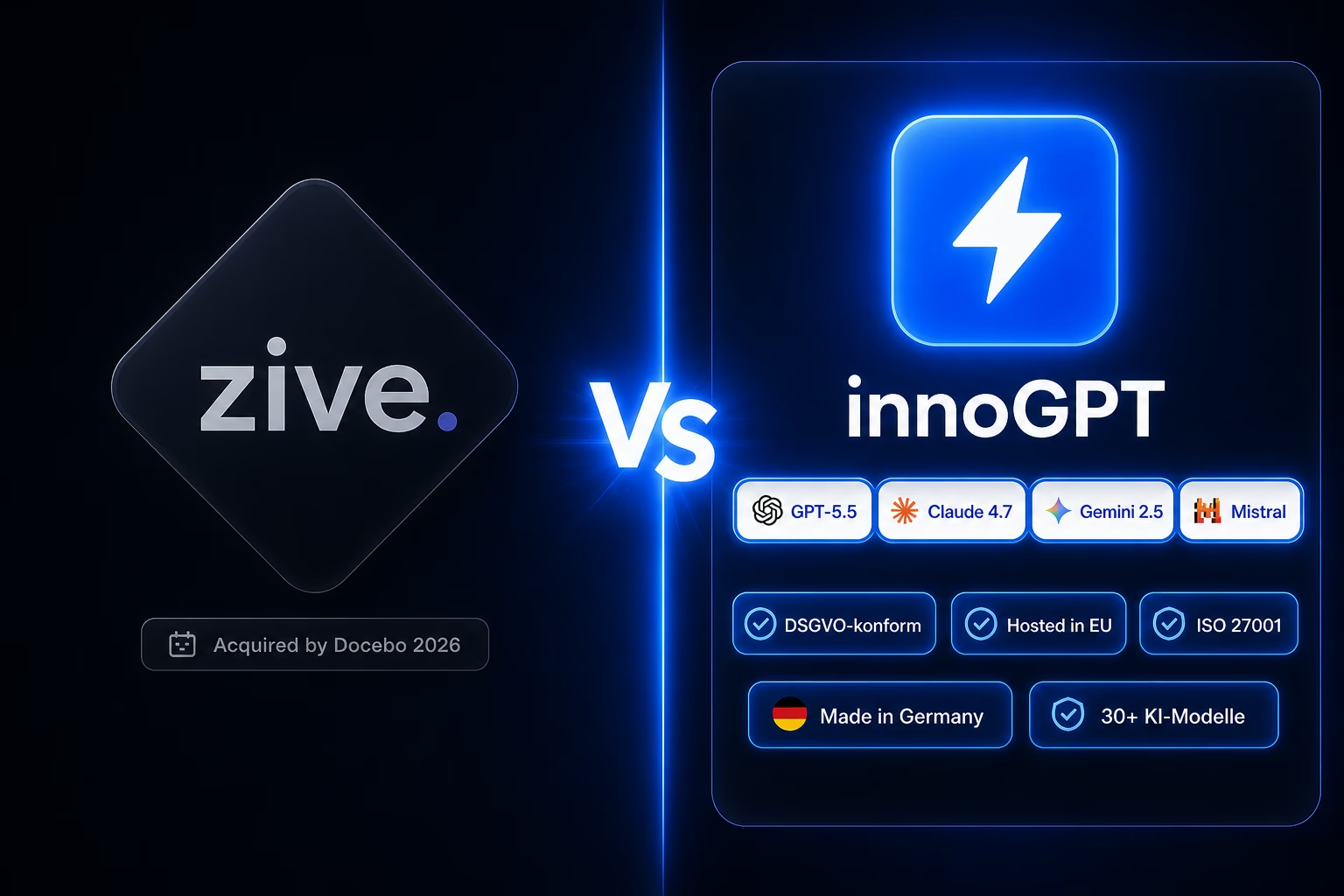
Zive alternative: innoGPT — workplace AI from Germany
Chat, knowledge base, search and tasks in one platform — bootstrapped, EU-hosted, ISO 27001-aligned.
ChatGPT Alternatives: The 12 Best Tools in 2025
Looking for a ChatGPT alternative? Discover the 12 top alternatives in 2025, with overviews, pros and cons, and the criteria that matter most.
alternative to chatgpt: The 12 best alternatives 2025
alternative to chatgpt: Discover 12 top alternatives in 2025 with an overview, advantages and purchase criteria.
Generative AI platforms for companies: The ultimate comparison 2024
Discover the best AI platform for your business. A hands-on comparison of features, privacy, security, and ROI for generative AI.
The European ChatGPT alternative: Why companies rely on German GDPR-compliant AI
Discover a chatgpt alternative that is GDPR-compliant and strengthens data sovereignty. Why German AI solutions create trust.