tl;dr:
- The self-hosting cost trap: Running your own generative AI sounds like full control, but it often turns into a financial sinkhole. High costs for specialized hardware, power, maintenance, and IT staff quickly become a showstopper — even with modern tools like Ollama v0.6.
- Shadow AI 2.0: Decentralized Ollama installations on dozens of employee laptops are the new shadow AI problem. Without governance, nobody knows which models are running, what data is being processed, or who has access.
- The smart alternative: Professional, GDPR-compliant AI platforms with European servers offer the perfect balance: you retain data sovereignty without the technical nightmare and high costs of a local installation.
- Future-proof & ready to go: With a managed platform like innoGPT, you automatically get access to the latest and best AI models — Llama 4 Scout, Qwen 3 72B, Mistral Large 3, and more. No stress with updates, no complex integrations.
Local AI Installation or Cloud Platform — the Big Decision
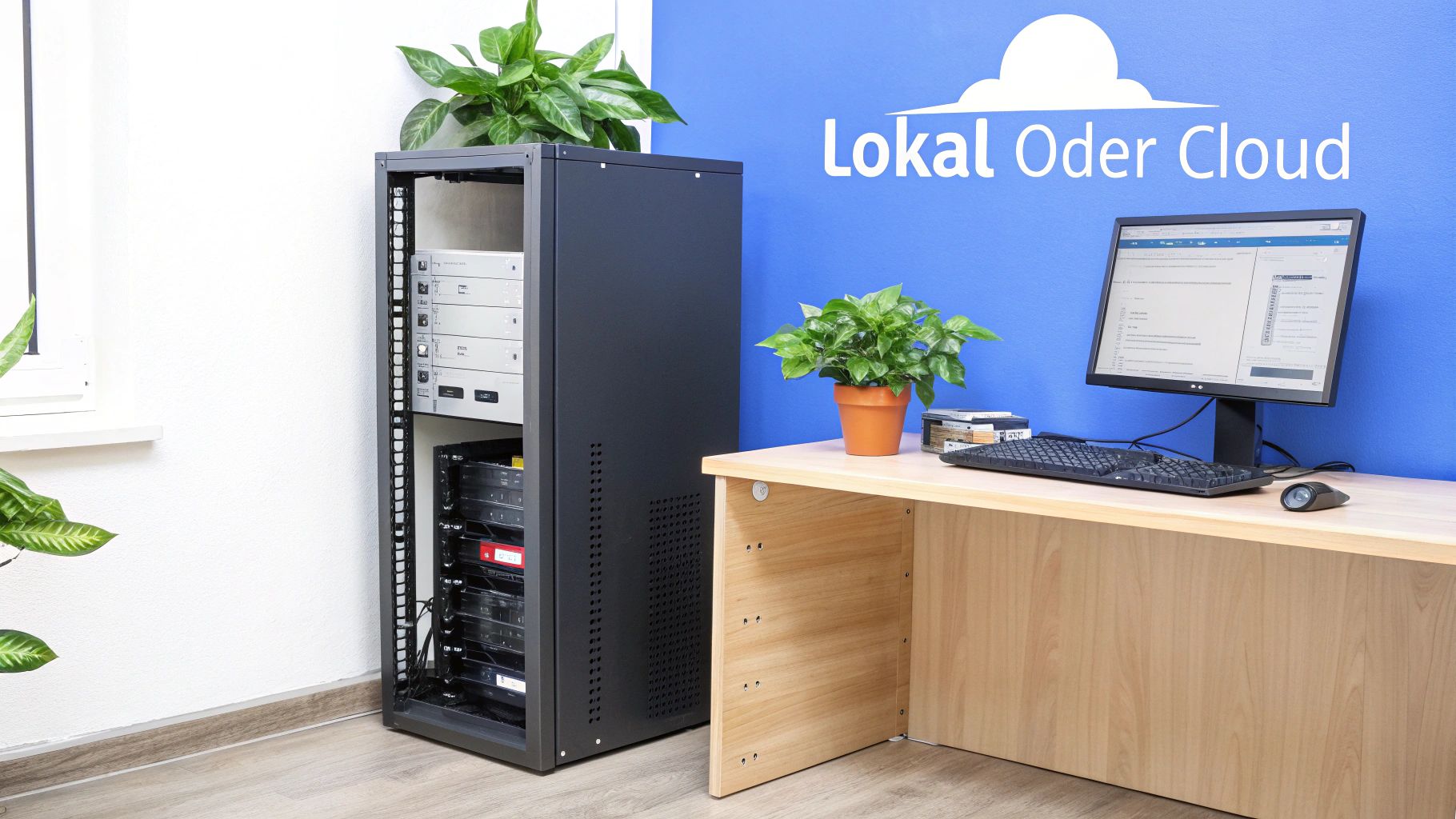
Let's be honest: you're facing a genuinely important fork in the road. Should you install a generative AI completely autonomously on your own servers or employees' laptops to retain full control over your data? Or is it smarter to rely on a professional AI platform that handles all the technical complexity for you? This question keeps many companies up at night — driven by concerns about data leaking to US providers and a desire for absolute data sovereignty.
In 2026, the situation has intensified further. Tools like Ollama v0.6 make it technically trivial to run language models like Llama 4 Scout, Qwen 3 72B, or Gemma 3 on a local machine. Apple Silicon — particularly M3 and M4 — has virtually eliminated the performance barrier for smaller models: a MacBook Pro with M4 Max runs 4-bit quantized GGUF models at impressive speed. The entry barrier has never been lower. And that's precisely the problem.
Your Own Power Plant in the Basement or Just a Power Outlet?
Think of it this way: you can set up your own power generator in the basement, or simply plug into the wall and use the public electrical grid. Both deliver power, sure. But the effort involved in maintenance, safety, and constant modernization couldn't be more different.
The generator gives you absolute independence. But you also bear the full costs of acquisition, fuel, regular maintenance, and every single repair. If it breaks down, you're in the dark. Connecting to the power grid, on the other hand, just works. It's there, it's efficient, and it's always up to date — without you lifting a finger.
Translated to the world of AI, innoGPT offers you exactly both options: the "premium generator" as an on-premises installation for companies with extremely strict compliance requirements. And the "smart grid connection" as a ready-to-use, GDPR-compliant cloud solution for everyday business.
The Typical Concerns Every Company Knows
The idea of installing AI locally often comes from completely understandable concerns. Fear that sensitive company data might end up with US providers, and the desire for total data sovereignty, are the main drivers. Nobody wants important internal information sent uncontrolled across the Atlantic.
At the same time, 2026 has brought a new phenomenon that has caught many IT managers off guard: decentralized Ollama installations on employee laptops. What starts as a clever solution — a developer installs Ollama on their MacBook, others copy the approach — quickly becomes a governance nightmare. Suddenly your company has dozens of different models running in various versions, without central control, without an audit log, without knowing which company data flows into which local models. That's Shadow AI 2.0 — and it's harder to detect than the first generation.
The great thing about generative AI? You can get started immediately, without first collecting and preparing your own training data. Instead of spending months stuck in a data jungle, you create real value from day one.
A professional AI platform like ours takes these concerns seriously and offers a smart solution. It guarantees data security through hosting on European servers and strict GDPR compliance, while simultaneously taking care of all the technical complexity for you. That's the golden middle ground that combines the benefits of local control with the simplicity of a professional platform.
In this guide, we'll take an honest and practical look at which option is the better choice for your specific requirements.
The Hard Reality: What a Local AI Installation Actually Means
The idea of running a generative AI entirely on your own servers is tempting. Maximum control, absolute data sovereignty — that sounds like every CIO's dream. But before you dive into that dream, let's take a completely honest and straightforward look at reality.
The desire to keep sensitive company data in-house and protected from the prying eyes of external providers is completely understandable. But the decision to install AI locally brings with it a whole string of tasks and costs that are easy to underestimate at first.
The Hardware Appetite is Real — and Insatiable
Let's start with the most obvious: hardware. A regular company server that may have served well for accounting or CRM is completely out of its league here. We're talking about a different category entirely.
- Specialized graphics cards (GPUs): For modern language models, you need the full arsenal. Think professional GPUs like NVIDIA's A100 or H100. These are not only hard to get, they also cost a five-figure sum — per unit.
- Massive RAM: Depending on the AI model size, 256 GB of RAM or significantly more is not unusual. Without it, you'll run into performance bottlenecks right from the start.
- Enormous storage capacity: The models themselves are gigantic. Current models like Qwen 3 72B or Llama 4 Maverick require dozens of gigabytes of storage even in 4-bit GGUF quantization. Fast NVMe SSDs are an absolute must, otherwise you'll be waiting forever.
- Power and cooling: These high-performance components are true energy guzzlers and heat up a room like an oven. The costs for power and adequate cooling can quickly bring tears to your eyes.
- Apple Silicon — the exception that proves the rule: Yes, a MacBook M4 Max runs smaller models impressively well. But for enterprise-wide use with multiple parallel users and large models, consumer devices simply aren't a scalable solution.
This trend toward local high-performance infrastructure is no niche phenomenon. The expansion of data centers in Germany for AI applications is experiencing a genuine boom. Already, around 15 percent of capacity is accounted for by AI applications. By 2030, this share is expected to rise to a full 40 percent. This clearly shows the direction of travel. More details can be found in this interesting report on AI growth in German data centers at it-daily.net.
The Invisible Iceberg: Ongoing Costs
If you think the hardware purchase is all there is to it, you're unfortunately only seeing the tip of the iceberg. The real, often hidden costs lurk in ongoing operations and permanent maintenance.
The world of generative AI evolves at a breathtaking pace. At the start of 2026, Llama 3.3 was the state of the art — a few months later, Llama 4 Scout with Mixture-of-Experts architecture is standard, Qwen 3 72B from Alibaba clearly outperforms older GPT-4 class models, and Mistral Large 3 sets new benchmarks for European open-source models. Those who host locally must track all these developments themselves, test them, and roll them out.
Who on your team has the expertise — and more importantly, the time — to constantly evaluate new AI models, test them, and then securely integrate them into your existing systems? This isn't a side project, it's a full-time job for highly specialized experts.
And what happens when systems suddenly fail? Or when an Ollama update causes unexpected incompatibilities? Without a professional support contract, your IT department suddenly stands alone in the rain, having to fix complex errors under massive time pressure. This not only ties up valuable resources, it can in the worst case bring the entire business operation to a standstill.
Even a professional on-premises platform like innoGPT On-Premises must be viewed realistically. It offers maximum control for companies with extreme compliance requirements, but is naturally also associated with high costs for hardware, maintenance, and the necessary IT personnel. This is the ultimate premium solution for very specific use cases — financial sector, critical infrastructure, government agencies.
For most companies, a cloud solution is the significantly smarter and more cost-effective path. The dream of total autonomy can quickly turn into an administrative nightmare that distracts focus from the actual goal: using AI to create real value for your own business.
The True Costs in Direct Comparison
Let's be completely honest: when it comes to costs, the dream of a fully self-hosted AI often bursts like a soap bubble. To give you a realistic picture of what it means to install AI locally, we need to look far beyond the pure hardware purchase price. In the end, it's the ongoing, often invisible costs — the Total Cost of Ownership (TCO) — that make the decisive difference.
Let's walk through three typical scenarios that companies face today. We'll compare the "do-it-yourself" (DIY) approach with open-source models against the highly secure innoGPT On-Premises installation and the flexible innoGPT Cloud.
What Does This Cost? A Reality Check in 3 Scenarios
Let's examine these three paths pragmatically. Which approach really suits which company — and what ends up on the bill?
The "Do-Everything-Yourself" Approach with Open Source
You roll up your sleeves and decide to handle everything yourself. You install Ollama v0.6, download Llama 4 Scout or Qwen 3 72B, and your IT department is supposed to keep it all running somehow — on your own servers or decentrally on employee laptops.
The initial enthusiasm usually fades pretty quickly when reality comes knocking:
- High startup capital: Hardware alone can easily cost you tens to hundreds of thousands of euros. And that's just the beginning.
- Team blocker: Your best IT people become full-time AI maintenance workers instead of working on projects that actually drive your business forward.
- The ongoing bill: Power, cooling, server room — these are significant recurring costs that come up month after month.
- Endless update marathon: Every new model, every security patch has to be applied manually. A race against time that's nearly impossible to win.
- Governance blindspot: Without a central platform, you have no idea who's using which models, what company data is being processed, and whether usage is GDPR-compliant.
This path is really only for companies with a large, highly specialized IT department that wants to make AI their absolute core competency. For everyone else, it's a bottomless pit.
innoGPT On-Premises: The Fortress for Maximum Control
For companies with extremely strict compliance requirements — such as in the financial or healthcare sector — there's a professional alternative to the pure DIY adventure. Think of innoGPT On-Premises as our "premium generator": it runs on your own infrastructure, gives you full data sovereignty, but comes with professional support, ready-made integrations, and a central governance dashboard.
This is the solution when absolutely nothing — not even metadata — may leave your network. You retain control over model selection, access rights, and audit logs. Of course, the costs here are significantly higher than the cloud solution. You're paying for the powerful hardware, specialized maintenance, and licensing.
This is a conscious, strategic decision for maximum security. But it also requires the right budget.
innoGPT Cloud: The Smart Middle Ground for Practice
For the overwhelming majority of companies, the innoGPT cloud solution is simply the best deal. You use our professionally managed infrastructure on GDPR-compliant, European servers.
This gives you the data security of a European solution, but without the gigantic costs and effort of your own installation. You save on expensive hardware investments and give your IT team invaluable time back. It's comparable to connecting to the public power grid: it just works, it's always up to date, and you only pay for what you use.
Cost Comparison: DIY vs. On-Premises vs. Cloud
To make the differences even clearer, here's a direct comparison of cost factors. This table is designed to help you grasp the financial and personnel effort of each approach at a glance.
| Cost Factor | DIY Open-Source (Local) | innoGPT On-Premises | innoGPT Cloud (SaaS) |
|---|---|---|---|
| Hardware | Very high (servers, GPUs) | High (powerful dedicated servers required) | None |
| Personnel | Extremely high (developers, admins) | Medium (internal admins + support) | Minimal |
| Maintenance & Updates | Very high (manual process) | Low (managed by innoGPT) | None (included in service) |
| Power & Cooling | Very high | High | None |
| Governance & Audit | None (flying blind) | Complete (centralized) | Complete (centralized) |
| License Costs | None (open source) | Yes (software license) | Yes (monthly/annual fee) |
| Scalability | Limited & expensive | Limited by own hardware | Virtually unlimited |
| Security | Your own responsibility | Very high (full control) | Very high (GDPR-compliant) |
| Time-to-Value | Very long | Medium | Very fast |
As you can see, the effort shifts dramatically. While the DIY approach ties up massive internal resources, the professional solutions shift the bulk of the effort to the provider.
The trend toward increasingly energy-hungry AI applications in data centers is unstoppable. This graphic illustrates how rapidly AI's share of total computing capacity will grow in the coming years.
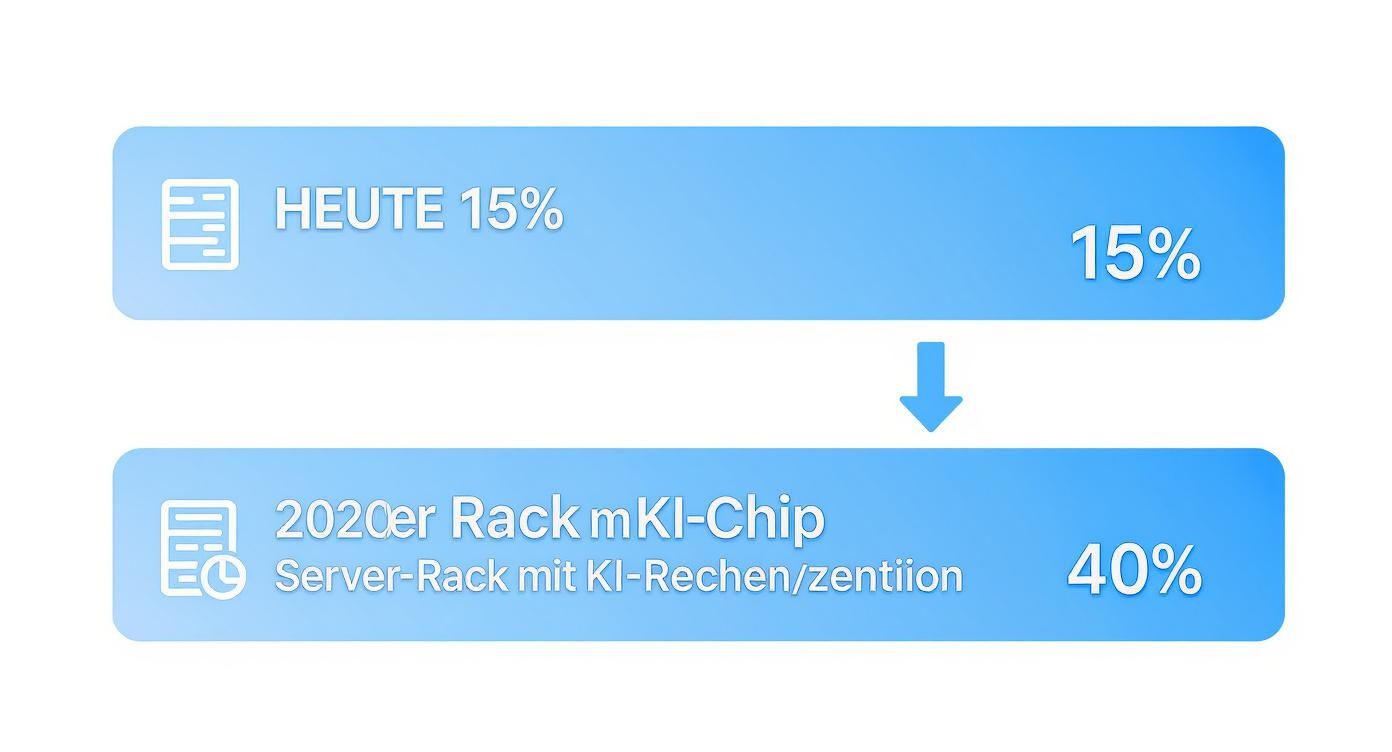
This development clearly shows why professional providers can handle these enormous infrastructure requirements through economies of scale far better than most individual companies.
The decision about how you introduce AI has massive financial and strategic consequences. If you want to dive deeper into the topic, our guide explains how to create your own AI model and what to consider in the process.
In the end, it always comes down to finding the golden balance between control, cost, and practicality. An honest analysis of total costs almost always shows: focusing on your core business and using a professional platform is the economically smartest path.
The Smart Middle Ground for Your Company
You see the hurdles that a local AI installation brings, but a generic US cloud solution is an absolute no-go for you on data protection grounds? Perfect! That's exactly the dilemma for which a clever alternative exists, combining the best of both worlds without saddling you with the downsides.
The innoGPT cloud solution is not just another platform. It was built from the ground up for the specific needs of the European market — with a clear focus on German mid-market companies.
Data Sovereignty Without the Hardware Nightmare
The real reason you're thinking about a local installation is data sovereignty, right? That's exactly where we tackle the problem at its root. Through exclusive hosting on European servers and strict GDPR compliance, you meet this core requirement effortlessly — all without the enormous effort and exploding costs of your own hardware infrastructure.
Think of it this way: you get the security and peace of mind of an on-premises solution, while simultaneously enjoying the simplicity, scalability, and cost-efficiency of a professionally managed platform. Simply brilliant.
The "Smart Grid Connection" for Your Business
Remember the generator-in-the-basement metaphor? Our innoGPT cloud solution is your "smart grid connection." It delivers AI power exactly when you need it. Always available, always up to date — and you don't have to worry about the prohibitively expensive and complex infrastructure running in the background.
Your IT department can finally focus again on projects that genuinely drive your business forward, instead of maintaining a highly complex AI server. That's not just a cost saving — it's a direct investment in your core business.
A huge advantage of generative AI is that you can get started immediately. You don't need your own data to feed the models. A platform like innoGPT makes the entry point incredibly fast and straightforward. Often you're up and running within minutes.
Full Transparency, Even with the On-Premises Option
Of course, we know there are companies with extremely high compliance requirements. For them, only a completely isolated solution works. That's exactly why we also offer innoGPT as a local installation. But let's be completely honest here: this option comes with a price.
You need not only the expensive specialized hardware, but also the personnel for maintenance and updates. We see this "premium generator" as a targeted solution for absolute edge cases. For the vast majority of companies, our "smart grid connection" — the cloud platform — is the significantly smarter and more economical choice.
This approach fits perfectly into the current trend. The AI scene in Germany is booming and massively driving the development of professional AI applications. The number of AI startups has grown by a full 36 percent compared to the previous year, with generative AI as the absolute innovation driver at around 130 percent growth. This growth is ensuring that ever more robust European platforms are emerging. Read more about the exciting developments in the German AI startup landscape at trendreport.de.
By choosing a specialized platform like this, you benefit directly from this wave of innovation, without having to bear the risks and costs of development yourself. You choose the path that optimally combines security and efficiency.
How AI Really Shakes Up Your Daily Work
Theory is all well and good, but what counts is in the field — or rather, in the office. Let's set aside the dry comparisons and jump straight into real scenarios that everyone knows. You'll quickly see where a ready-to-go professional solution makes the difference, and why local tinkering often ends in a dead end.

At the end of the day, there's only one question that matters: does this new technology solve a real problem and make my job easier, or am I just creating new, complicated headaches? The attempt to install AI locally tends to dangerously lean toward the latter.
Scenario 1: The Daily Chaos in Customer Support
Imagine your support team. Every day, hundreds of customer inquiries arrive via email and chat — many of them the same questions over and over. Sure, they're easy to answer, but they eat up an enormous amount of time and energy. The goal? Respond faster, more consistently, and still personally.
How a platform like innoGPT handles it: Your team simply logs in through the browser. There, a central knowledge base awaits, fed with your current product data, FAQs, and guides.
- Help at the push of a button: A colleague types in the customer question and — boom — the AI formulates a perfect, friendly, and technically sound answer that sounds exactly like your company.
- Consistent top quality: Everyone on the team gives the same verified answer. No more inconsistencies just because someone's having a bad day.
- No tech stress: Nothing to install, nothing to maintain. New colleagues get access, take five minutes to look around, and they're ready to go.
The nightmare of local installation: Now the same thing as a DIY project. Your IT department first has to get a suitable open-source model running via Ollama on an expensive server. But trust me, that's just the warm-up.
After that, a user interface is needed so your support team doesn't have to dig through code. This interface then has to be securely married to your ticketing systems and email clients. And what happens when Ollama releases a major update, or a new model like Llama 4 Scout is significantly better than the one currently in use? That's right — the big testing and rollout cycle begins again from scratch. What started as a small helper has quietly become a months-long IT project that constantly needs someone tending to it.
Scenario 2: The Needle in a Haystack — Internal Knowledge Search
Another classic: someone in sales urgently needs a technical specification. It's buried somewhere in thousands of documents on your company server. The normal search returns 200 hits, 199 of which are useless.
How a platform solves it: You simply connect innoGPT to your SharePoint, Google Drive, or upload the documents. The employee asks naturally: "What's the maximum operating temperature of model XZ-500 according to the latest safety data sheet?"
The AI doesn't just read file names — it understands the content of all documents. Within seconds, it delivers the exact answer and even tells you where it found it. That's not searching anymore — that's pure finding.
This power is immediately available and incredibly easy to use. The focus is 100% on the value — the lightning-fast answer.
The local DIY attempt: To replicate this, a language model alone is far from enough. You need a complex architecture in front of it (the keyword: Retrieval-Augmented Generation, or RAG). Your team would need to set up a vector database, intelligently chunk documents, convert them into numerical representations (embeddings), and connect all of that via an API to your local AI model.
This is highly complex and requires expert knowledge across multiple disciplines. The maintenance effort is gigantic, because every link in this chain can break or need updates. The time your best people sink into this is missing elsewhere — in developing your own products.
These two examples make it crystal clear: a professional platform like innoGPT lets you focus on what really matters — solving your business problems. Instead of getting lost in the technical jungle, you create real value from day one.
How to Stay Ahead in the Fast-Moving World of AI
The world of generative AI is evolving at a dizzying pace. At the start of 2025, GPT-4 was still the gold standard. Today, mid-2026, the landscape has fundamentally changed: Llama 4 Scout with Mixture-of-Experts architecture runs locally on high-end hardware, Qwen 3 72B from Alibaba outperforms many commercial models in benchmarks, Mistral Large 3 sets new standards for European open-source AI, and Gemma 3 from Google performs well even on consumer hardware. This dynamism is incredibly exciting, but it also poses a massive challenge to every company.
If you choose a local AI installation, you're consciously entering a constant race against time. Every promising new model has to be spotted by your team, then laboriously evaluated, tested in 4-bit GGUF quantization, checked for performance and quality, and painstakingly integrated into existing infrastructure.
This cycle not only eats up valuable resources — it also carries the real risk of falling behind technologically. What's celebrated as the top model today may already be yesterday's news in six months.
The Decisive Advantage of a Professional Platform
And this is precisely where a professional platform like innoGPT plays its biggest trump card. We have entire teams that do nothing but permanently scan the global AI market. They cherry-pick the best, safest, and most capable AI models and make them seamlessly available to you — whether Llama 4, Qwen 3, Mistral, Gemma, or commercial models from Anthropic and others.
You automatically benefit from the latest breakthroughs without any waiting time. Your IT department doesn't have to adapt a single line of code or dig into complex new architectures.
Think of it this way: it's like the difference between a self-assembled gaming PC and a professionally managed cloud service. With one, you're constantly tinkering, updating drivers, and swapping parts. With the other, you simply always use the latest, most powerful version — without any headaches.
Investment Protection Instead of Outdated Hardware
This approach not only guarantees you permanent access to cutting-edge technology, it also protects your investment in the long run. Instead of purchasing expensive server hardware that will be technologically obsolete and depreciated in two or three years, you remain agile and always up to date with a platform solution.
You pay for concrete value, not for a piece of metal in the server room. The responsibility for staying technically current rests with us.
The Power Grid Metaphor Hits the Mark
Remember our comparison of the "own generator in the basement" versus "connection to the power grid"? Here it becomes crystal clear. Your own generator (your local AI installation) delivers power, but you have to maintain it yourself, repair it, and eventually replace it with a more modern model.
The connection to the power grid (the innoGPT platform), on the other hand, is constantly modernized and optimized by the provider. You always get the best performance without ever having to worry about the technology behind the scenes. In the fast-moving world of AI, this future-proofing isn't a luxury — it's a decisive strategic advantage.
The Most Burning Questions About Local AI Installation — Answered Concisely
When you're thinking about running an AI in-house, some fundamental questions quickly come up. Let's clarify the most important points so you know exactly what you're getting into and can make an informed decision.
Do I Have to Feed the AI My Own Data First for It to Work?
A clear no — this is one of the biggest misconceptions! Modern generative AI models, like those used in innoGPT, are already pre-trained on gigantic volumes of data and are essentially "turnkey." You can get started immediately — generating texts, asking complex questions, or having long documents summarized. Your own data isn't needed for that.
Am I Automatically on the Safe Side with a Local Installation?
Not necessarily, and this is a critical point. Sure, the data doesn't leave your network — as long as all installations are centrally managed. But the reality in 2026 is often different: any employee with a MacBook M3 or M4 can install Ollama in five minutes and run Llama 4 locally. These decentralized installations escape any IT control. You have no idea which data flows into which models, who has access, and whether usage is GDPR-compliant. Local installation doesn't automatically mean security — it often means the opposite.
A specialized, GDPR-compliant cloud platform with server locations in Europe often offers a security level that is verifiably certified and centrally enforced. For many mid-market companies, it's hardly realistic to build a comparable level with their own resources — let alone maintain it permanently.
What Hardware Power Do I Actually Need?
Now it gets serious. For professional use of a powerful language model, we're not talking about a souped-up gaming PC, but absolute high-end server hardware. A brief overview of what you're looking at:
- Professional server GPUs: Models like the NVIDIA A100 or H100 are the gold standard here. And they quickly cost a five-figure sum — per unit!
- Massively large RAM: Depending on model size, 256 GB of RAM is the minimum. Qwen 3 72B requires around 45 GB in 4-bit quantization for the model weights alone.
- Performance across all levels: Ultra-fast NVMe SSDs are a must. So is a sophisticated server cooling system, because the GPUs produce enormous heat that must be reliably dissipated.
- Apple Silicon as the exception: M3 and M4 Pro/Max are impressively efficient for smaller models. But for enterprise-wide multi-user operation with large models, they simply don't scale.
Want to harness the power of a professional AI platform without dealing with all the technical complexity? Give innoGPT a try! See for yourself how simple and secure AI in the enterprise can be — now free for 7 days, no commitment required. Try it free now at https://www.innogpt.de
Local AI vs. SaaS: When Does Each Approach Actually Pay Off?
This question is now landing on the desk of every IT manager and executive who wants to seriously deploy AI in their company. The honest answer: it depends. But on what exactly? Let's cleanly unpack the decision matrix — without marketing speak, with real criteria from practice.
When Local or On-Premises Installation Is Genuinely the Right Choice
There are actually use cases where a local AI installation or an on-premises solution like innoGPT On-Premises is the right choice. But these cases are significantly rarer than most people initially believe.
Absolute regulatory requirements: In certain sectors — military, critical infrastructure, certain areas of healthcare, or highly regulated financial institutions — compliance mandates or regulatory requirements dictate that data may never leave the company's own network. Not even for a millisecond-long transfer to a German data center. When BSI baseline protection at the highest level or similar requirements apply, on-premises isn't an option — it's an obligation.
Air-gap environments: Research institutions or industrial companies working with strictly confidential developments or patents often operate their IT in physically isolated networks without any external connection. Here, cloud-based AI is technically impossible — and a professional on-premises solution like innoGPT On-Premises is the only viable alternative.
Extreme data volumes with latency requirements: If you need to process massive volumes of data locally in real time and any network latency is too much, a local solution can offer advantages. But this primarily applies to industrial applications, not classic business AI.
Developer sandboxing: For developers building new AI applications and wanting to experiment without incurring costs per API call, tools like Ollama with Llama 4 Scout or Qwen 3 72B on powerful developer machines make sense. But this isn't an enterprise rollout — it's a development tool.
When Cloud and SaaS Are Clearly the Better Choice
For the overwhelming majority of companies — from mid-market to larger enterprises without absolute requirements — a professional SaaS platform like innoGPT is superior for several reasons.
Speed-to-value is critical: Companies that successfully deploy AI start quickly, learn from real usage data, and optimize continuously. Those who first spend months procuring, installing, and testing hardware have already lost valuable time during which competitors are already working productively with AI. A SaaS platform gets you into productive use in days, not months.
Model variety without overhead: In 2026, the question is no longer "GPT-4 or nothing," but which of the dozens of competent models is best suited for which use case. Llama 4 Scout excels at coding tasks, Qwen 3 72B shines for multilingual texts, Mistral Large 3 performs strongly for structured analysis, Gemma 3 is efficient for short inference tasks. On a platform like innoGPT, you switch models with a click — with a local installation, every new model means another installation and testing effort.
Governance is no longer a nice-to-have: The most important aspect often overlooked in 2026: AI governance is not optional. Anyone using AI productively in a company must be able to document what data was processed how, which models are in use, who has access, and whether usage complies with internal policies. A decentralized local installation — whether DIY Ollama or several independent solutions in different departments — makes governance factually impossible. A central platform makes it a matter of course.
TCO reality after 24 months: The initial investment in local hardware often looks tempting when you only compare it to the license costs of a SaaS platform. But after 24 months, the calculation usually looks different: server refresh, GPU upgrades for new models, IT personnel dedicated exclusively to the AI infrastructure, lost productivity from downtime and update cycles — all of this adds up to a TCO that often significantly exceeds the SaaS alternative.
The Hybrid Strategy for Pragmatic Decision-Makers
The smartest companies in 2026 run a differentiated strategy: for developers and technical teams who want to experiment with new models, they allow — in a controlled manner — the use of local tools like Ollama, embedded in policies about which data may be processed. For broad enterprise use that creates real business value — knowledge management, customer service, document analysis, internal assistance — they rely on a central, governed platform like innoGPT. The best of both worlds, but with a clear line: innovation in the sandbox, governance in production.
From Local Installation to Enterprise-Wide AI Platform
Many companies go through a typical maturity curve on the topic of AI. It starts with experiments — individual employees test ChatGPT, a developer installs Ollama on their laptop, the first department runs an AI pilot. And then, at some point, the moment comes when this organically grown landscape becomes a real problem. Welcome to Shadow AI 2.0.
The Shadow AI 2.0 Problem and Why It's Becoming Acute in 2026
The first wave of shadow AI was clearly visible: employees used ChatGPT or other cloud services without the IT department knowing. This was still relatively easy to detect and address — network monitoring, clear policies, providing official alternatives.
The second wave is subtler and harder to control. Since Ollama v0.6 and the leap in Apple Silicon performance, a 70-billion-parameter model runs at an acceptable speed on a MacBook Pro with M4 Max. That means: any technically savvy employee can build a complete local AI setup in 20 minutes. No network traffic to flag. No cloud connection to block. The data doesn't leave the device — but it's also not processed, logged, or controlled according to company policy.
Concretely, it looks like this: a developer in product development uses Llama 4 locally to analyze source code — including code from proprietary systems. An HR manager uses Qwen 3 72B on their MacBook to analyze job applications — including all the personal data they contain. A sales rep uses a local model to optimize customer proposals — and feeds it sensitive contract data. All of this without an audit log, without a data protection review, without any way for the IT department to trace what's happening.
The Four Stages of the AI Maturity Curve
From conversations with hundreds of companies, at innoGPT we consistently see the same four phases:
Stage 1 — Wild Growth: Individual employees and departments use AI tools on their own initiative. A mix of cloud tools, local installations, and various services. IT has no overview. Compliance is a gamble. This phase is dangerous and costly — even if it feels like agile innovation in the moment.
Stage 2 — Awareness: An incident or a compliance audit makes the problem visible. Or leadership realizes that despite many AI experiments, no measurable business value is being created. The question gets loud: "What is everyone actually doing with AI, and is it benefiting us?" Nobody can answer cleanly.
Stage 3 — Consolidation: The company decides on a central AI platform. All AI activities run through a controlled environment — with single sign-on, role-based access, audit logs, and clear policies. The previous ad-hoc solutions are gradually replaced. At the same time, a data foundation emerges: who uses AI for what, what works, where are the gaps?
Stage 4 — Scaling and Governance: The platform is established, usage grows organically, and the company begins to systematically build AI expertise. New use cases are structured, identified, and rolled out. AI competency spreads across the entire company — because everyone uses the same tool, shares experiences, and learns from each other.
innoGPT On-Premises: When Consolidation and Data Sovereignty Come Together
For companies that want to reach stages 3 and 4 but simultaneously cannot compromise on absolute data sovereignty, innoGPT On-Premises is the answer. It's not simply a "locally installed AI model" — it's a complete enterprise AI platform that runs on your own infrastructure.
Concretely, this means: you get the same governance features as in the cloud — central user management, role-based access, audit logs, usage statistics, department dashboards — but with the guarantee that no data leaves your network. You decide which models are available: your own fine-tuned models, open-source models like Llama 4 or Qwen 3, or a mix depending on use case and security classification of the data.
That's the fundamental difference from a DIY Ollama installation: there you have a model without governance. With innoGPT On-Premises, you have a platform with a full enterprise feature set — company context, knowledge management, user permissions, measurability — but running entirely within your own infrastructure.
The Path Forward: Steps for a Clean Transition
The switch from decentralized AI experiments to a company-wide, governed platform doesn't have to be bumpy. Companies that do it right typically follow this pattern:
First, take stock: which AI tools are employees currently using? Where does data flow? Where are the biggest unregulated risks? This step takes a day but creates clarity for all subsequent decisions.
Then establish clear policies: what may be used locally (e.g., for purely technical, non-sensitive development tasks)? What must run through the central platform? Which data may under no circumstances flow into unauthorized AI systems?
In parallel, introduce the platform: innoGPT can be deployed in a few days — as a cloud solution even faster. Employees who already use AI migrate to a tool that's better than their previous solutions, but now under IT's control. This significantly reduces resistance.
Finally, scale knowledge: when everyone uses the same tool, best practices emerge automatically. Whoever develops a good prompt can share it with the entire company. Whoever has a new use case idea can easily test it in the existing infrastructure. AI competency is no longer a property of individuals — it becomes a company property.
The path from a local AI installation to a company-wide AI platform is shorter than most people think. The first step isn't a major infrastructure decision, but a strategic one: AI should move us forward as a company — measurably, in a controlled manner, and securely. Everything else follows from that.
Weekly AI news in your inbox
New models, practical tips & expert insights — free for everyone.