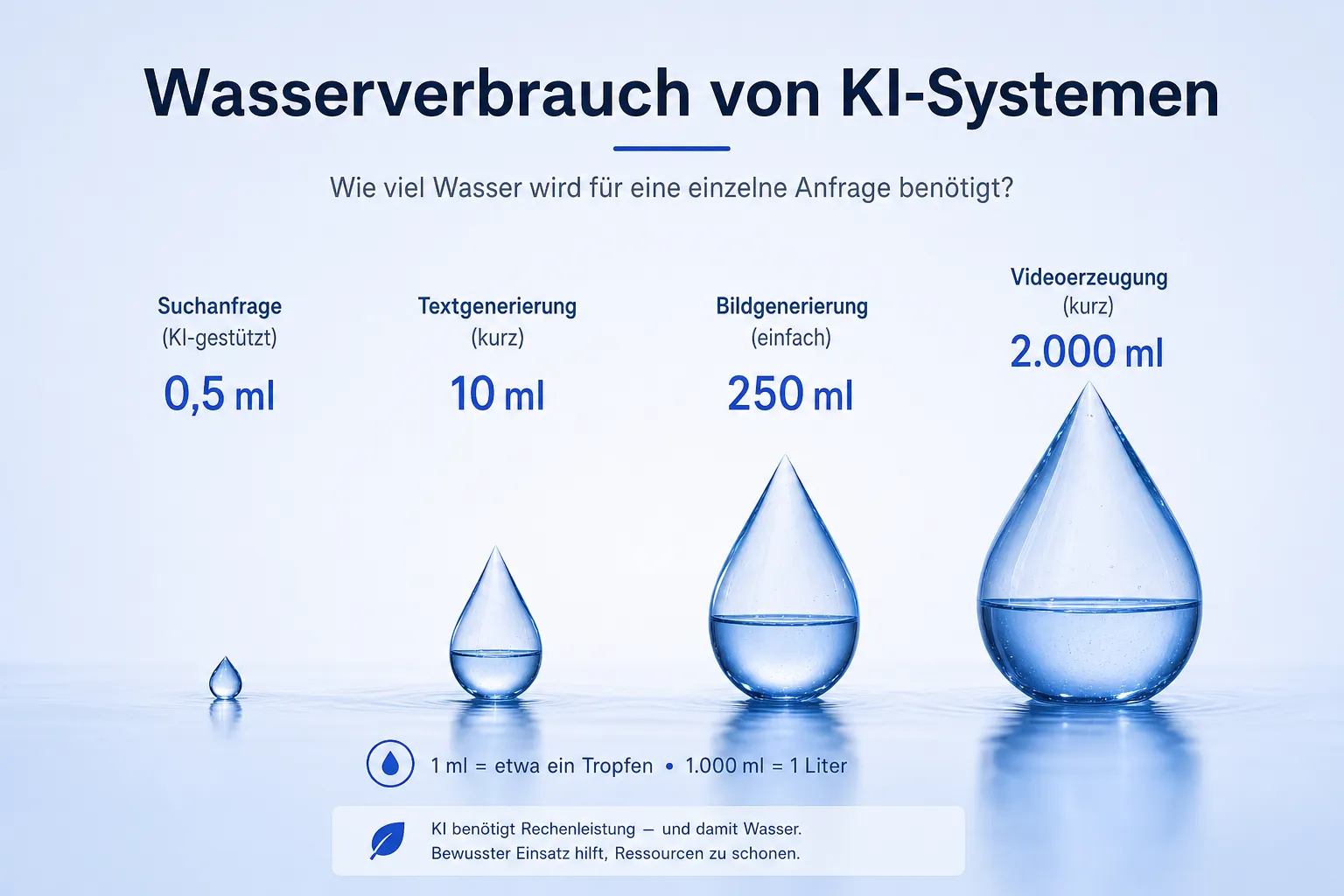
TL;DRThere's no universally verifiable water usage figure per ChatGPT query. A study estimates about 500 milliliters for 10 to 50 medium-sized responses for GPT-3. This isn't a measurement of ChatGPT. Location, timing, energy mix, and model significantly alter the value.
ChatGPT operates in data centers. Their water demand arises from cooling and power generation. Sam Altman mentioned about 0.32 milliliters per average query in 2025. OpenAI hasn't published the method or system boundaries, making the value unverifiable.
"The water usage of AI systems is often an overlooked aspect, yet it can have significant ecological impacts."
AI models require computing power, which generates heat. Data centers need to dissipate this heat. The amount of water involved depends on cooling, location, weather, and energy mix. The underlying model calculation considers cooling and water for power generation.
- A blanket annual figure per server would be unreliable, as utilization, cooling, and location vary greatly.
- High-performance AI servers generate a lot of heat. Water-based cooling systems can thus increase local water demand.
- A direct comparison with smartphones wouldn't be reliable without uniform system boundaries.
What can you do to reduce water usage? Here are some practical tips:
- Use AI services consciously and only when truly necessary.
- Opt for providers that focus on sustainable practices and make their water usage transparent.
- Educate yourself about the environmental policies of your preferred technology providers.
In my opinion, we should all develop an awareness of the resource consumption of our technologies. Only then can we make sustainable decisions that consider not just our needs, but also those of our planet.
Why AI Uses Water
AI systems like ChatGPT indirectly and sometimes directly require water. Direct water can evaporate in cooling towers. Indirect water is used in power generation. The exact amount varies greatly.
Direct comparisons between ChatGPT and Google services aren't reliable without identical measurement methods.
The Actual Water Usage of ChatGPT
ChatGPT Query Water Usage: Why There's No Blanket Figure
ChatGPT's water usage is an intriguing topic that's often overlooked. How much water is actually needed per query? And how does ChatGPT compare to other AI systems?
The 500-milliliter figure doesn't apply per ChatGPT query. It's a GPT-3 model calculation for 10 to 50 medium-sized responses.
A daily calculation for ChatGPT would be speculative without details on the model, data center, and usage volume. The frequently cited 500-milliliter figure doesn't apply per query.
- GPT-3 Model Calculation: around 500 milliliters for 10 to 50 medium-sized responses, depending on location and timing
- Other AI Systems: No reliable comparison without uniform measurement
A credible comparison between AI systems is currently hardly possible. Providers publish different metrics or none at all. Architecture, model size, hardware, cooling, and energy mix influence the value.
Environmental Impacts of AI Water Usage
Water demand is particularly critical in regions with water stress. The location and timing of AI computation are therefore relevant. High temperatures can increase cooling needs.
The water demand of data centers can be locally significant, especially in regions with water stress.
To reduce water usage in AI, sustainable practices are essential. These include:
- Optimizing cooling technologies in data centers
- Jointly evaluating energy mix and cooling technology, as water demand varies by energy source
- More efficient algorithms that require less computing power
Practical Tips for Reducing Water Usage When Using AI
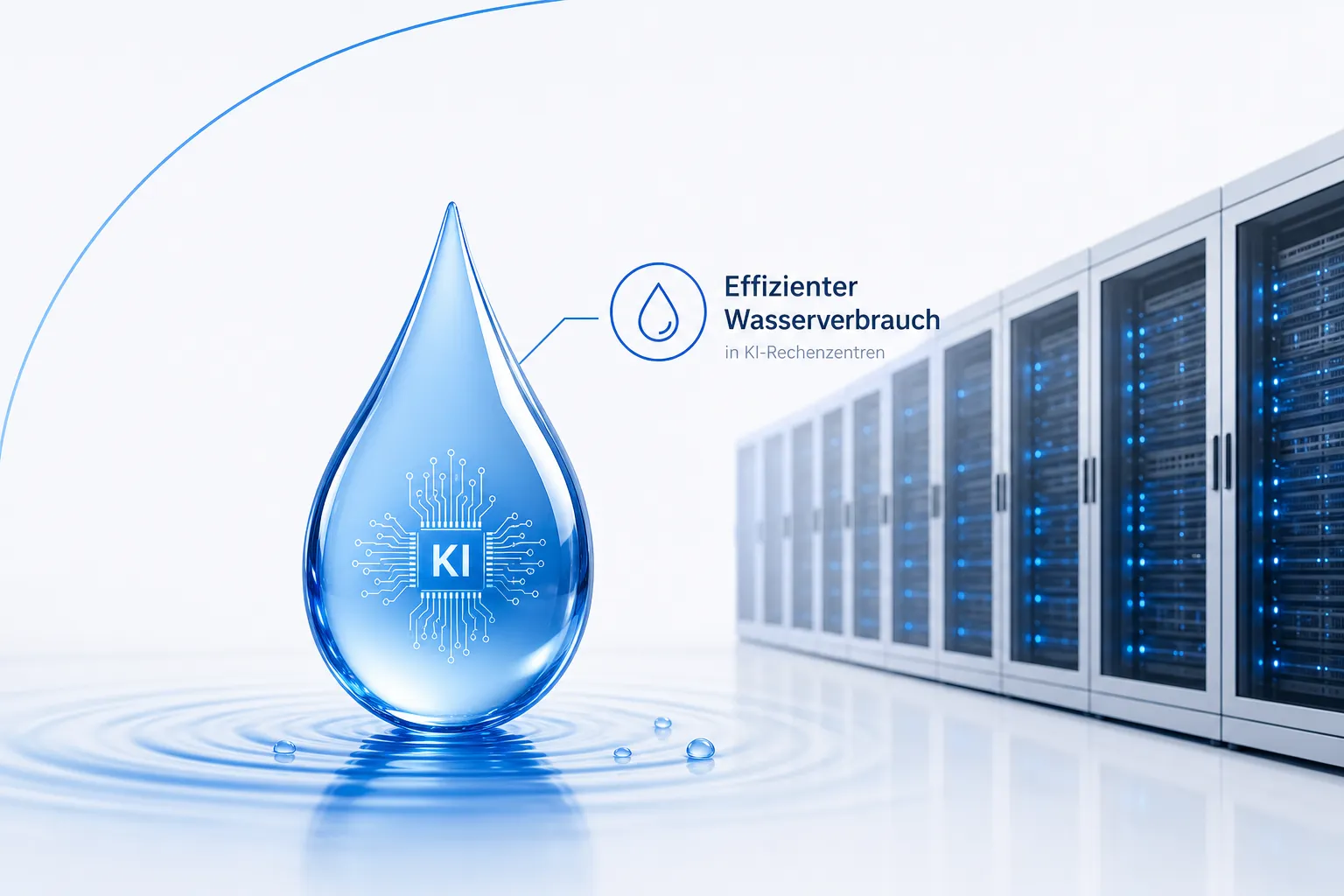
As an end-user, you can also use AI more consciously. Each individual query saves only a little. However, with many queries, especially with images or videos, the computing effort quickly adds up.
- Create images and videos only when you really need them. Trying out multiple variations increases computing effort.
- Formulate your prompt as specifically as possible. This way, you'll need fewer iterations to get the right result.
- Save good prompts and responses. This way, you can reuse proven results instead of starting the same query anew.
This doesn't replace providers' decisions about data centers and cooling. But it helps avoid unnecessary AI use in daily life.
The Impact of ChatGPT's Water Usage on Future Developments
With increasing AI use, the water issue becomes more important. Concrete forecasts for ChatGPT itself wouldn't be reliable. Reliable statements require details on model, location, cooling technology, and energy mix.
Less computing effort can reduce resource demand. Cooling technology also plays a role. Workloads should be planned consciously in terms of time and space. This way, water demand and the strain on local resources can be better considered.
ChatGPT's Water Usage Compared to Other Technologies
Comparisons with other technologies sound practical, but without the same measurement method, they're quickly misleading. The 500 milliliters are a GPT-3 model calculation for 10 to 50 medium-sized responses. They're not a measurement per ChatGPT query.
A ranking for ChatGPT can't be derived from public data. More meaningful are transparent metrics from providers and more efficient models. Without these data, any direct comparison remains a rough estimate.
FAQ
Conclusion
The water usage of AI is relevant. A blanket figure per ChatGPT query would be wrong. What's crucial are transparent data and a clear look at the measurement method; perhaps model providers can help with more precise consumption figures.
You Might Also Be Interested In
Sources
Li et al.: Making AI Less Thirsty, Preprint, Version 5 from March 2025. Model calculation for GPT-3. https://arxiv.org/html/2304.03271v5
International Energy Agency: Energy and AI. Assessment of the energy demand of AI and data centers. https://www.iea.org/reports/energy-and-ai
Sam Altman: The Gentle Singularity, June 2025. Self-reported about 0.32 milliliters per average ChatGPT query, without published method. https://blog.samaltman.com/the-gentle-singularity
About the author

Tim Geier
Tim & AIHe is a trained media manager working hands-on with AI: Tim helps companies roll out AI securely and GDPR-compliantly, turning complex AI topics into clear, actionable steps.
This article was written by Tim together with AI.
Weekly AI news in your inbox
New models, practical tips & expert insights — free for everyone.
Related articles
Zive alternative: innoGPT — workplace AI from Germany
Chat, knowledge base, search and tasks in one platform — bootstrapped, EU-hosted, ISO 27001-aligned.
AI Costs for Businesses: What Generative AI Really Costs – and What You Shouldn't Be Paying
Discover the true artificial intelligence costs for businesses. We reveal the hidden risks and show you how to save money with secure solutions.

What Is a Prompt in ChatGPT and How Do You Master It
What is a prompt in ChatGPT? Learn how to squeeze the maximum out of every AI response with clear instructions and the right techniques.