
Shadow AI might sound harmless at first. It's not. It refers to the use of AI tools without approval from IT, data protection, or compliance. This leads to AI security risks that often remain invisible in daily operations until customer data, contracts, or internal figures end up in foreign systems.
The scale is now quite clear. According to ADVISORI, 52 percent of knowledge workers use unauthorized AI tools. Only 26 percent of companies effectively enforce their rules. Frankly, this isn't a minor issue; it's a wide-open barn door.
- Sales copies customer data into a text generator.
- HR uploads resumes into an external analysis tool.
- Project teams summarize meetings with private AI accounts.
This is why the issue quickly becomes costly for companies. Data protection violations through AI, lack of traceability, and weak AI compliance controls are directly connected. Those who take AI Compliance seriously must also recognize uncontrolled AI tools, rather than just hiding bans in PDFs.
In my opinion, the biggest mistake lies elsewhere. Many companies discuss policies but not how they can monitor employees' AI usage and what safe alternatives they can offer internally. If you want to delve deeper into data protection issues, also check out GDPR-compliant AI Systems.
What is Shadow AI?
Shadow AI describes the use of AI tools in companies that are used without official approval. No vetted system, no entry in the tool directory, no clear AI compliance controls. Sounds harmless, but it's not.
Typical case: Someone uploads a contract document to a public assistant to get a summary. Or sales use customer data in a text tool for quicker offers. This is where AI security risks begin, potential data protection violations through AI, and later the uncomfortable question of why no one noticed.
- The tool wasn't vetted by IT, data protection, or legal.
- Business data ends up in an external system without approval.
- Usage occurs outside official processes and logs.
- No one can say exactly which data was processed.
In my opinion, Shadow AI isn't a tech problem; it's a management problem. According to Advisori, 52 percent of knowledge workers use unauthorized AI tools, but only 26 percent of companies effectively enforce their rules. SentinelOne aptly describes this as a blind spot in governance and security.
Shadow AI rarely arises from malicious intent. Most people just want to work faster than the approval process allows.
If you want to later recognize uncontrolled AI tools or monitor employee AI usage, you first need this definition. For the legal framework, our articles on AI Compliance and GDPR-compliant AI Systems can also help.
Why do employees use uncontrolled AI tools?
The short answer: because they want to save time and internal processes are often too slow. If a salesperson needs a quote in ten minutes, they won't wait two weeks for tool approval. Honestly, this is the core of many Shadow AI risks in companies, not malice, but shortcut logic.
Add to that frustration. Officially approved tools are often weaker, more complicated, or simply not available. According to ADVISORI, 52 percent of knowledge workers use unauthorized AI tools. At the same time, only 26 percent of companies can truly enforce their rules. This isn't a side issue; it's a wide-open barn door.
- Employees want to get rid of repetitive tasks, protocols, emails, evaluations, standard texts.
- Approval processes take too long, so private testing happens and continues quietly later.
- Many teams see the benefit immediately, but the AI compliance controls only when things go wrong.
- Private accounts seem harmless but quickly lead to data protection violations through AI.
In my opinion, the fault often doesn't lie with the people, but with the setup. Those who only prohibit will have to recognize uncontrolled AI tools instead of capturing them cleanly. That's why AI Compliance involves not just a set of rules but a usable offering. Otherwise, the work ends up in random browser tabs, and later IT debates AI security risks and whether they can monitor employee AI usage. Bad deal.
If the approved tool is slower than the workday, Shadow AI builds itself up automatically.
How quickly real problems arise from this is also shown by Deloitte and Varonis. The next step is therefore not panic, but visibility.
The 5 Biggest AI Security Risks from Shadow AI

Shadow AI risks in companies are rarely theoretical. They land directly in everyday life. An employee dumps customer data into a text tool, someone uploads contract drafts, a team quietly builds a private automation. Sounds like productivity. Often it's a blind flight.
- Data leakage: Prompts, uploads, and attachments often contain customer, personnel, or contract data.
- Data protection violations through AI: Without review, there's no legal basis, contract processing, or clear deletion rules.
- Loss of trade secrets: Source code, API keys, price lists, or internal strategies end up in foreign systems.
- Lack of traceability: No one knows which tool was used for what and which data is affected.
- Circumvention of internal rules: Without AI compliance controls, shadow processes emerge alongside IT and data protection.
I think point four is the trickiest. If you want to recognize uncontrolled AI tools, you need visibility. That's exactly what's missing with Shadow AI. According to Advisori, only 5 percent of companies have full transparency over their AI data traffic. At the same time, 54 percent have already reported confirmed AI-related security incidents.
The real problem isn't the tool. The problem is that no one knows which data landed there.
If you want to dive deeper into rules and countermeasures, check out our article on AI Compliance. For the data protection part, GDPR-compliant AI Systems are also relevant. Honestly, bans alone bring little here. Visibility, approval processes, and clean alternatives do.
Data Protection Violations through AI: What Specifically Threatens Companies?
With Shadow AI risks in companies, reactions often only occur once data is already out. That's the costly part. As soon as employees dump personal data into unauthorized tools, we're no longer talking about an IT problem, but about data protection violations through AI, reporting obligations, and liability issues.
The risk is quite tangible. According to ADVISORI, 52 percent of knowledge workers use unauthorized AI tools. Only 26 percent of companies effectively enforce their rules. If you want to recognize uncontrolled AI tools, it's not about pedantry, but about damage limitation.
- Fines, if personal data is processed without a legal basis.
- Reporting obligations if an incident poses a risk to those affected.
- Reputational damage if customers find out their data ended up in foreign AI services.
- Internal consequential costs such as forensics, legal review, and crisis communication.
In my opinion, the real damage is rarely the fine. It's the moment when sales, HR, or legal have to explain why sensitive data ended up in a foreign model.
It's particularly tricky with applicant data, customer data, contract drafts, or health-related information. Then multiple AI security risks strike simultaneously. Data leakage, lack of deletion control, and unclear contract processing. Those who want to delve deeper can find more on AI Compliance, GDPR-compliant AI Systems, and ChatGPT vs. GDPR.
Honestly, that's exactly why a ban isn't enough. You need to know where data flows. Only then can uncontrolled AI tools be recognized, risks assessed, and real data protection violations through AI avoided.
Recognizing Uncontrolled AI Tools in Companies: Here's How
Shadow AI risks in companies can't be spotted by gut feeling alone. Those who rely solely on bans only see the compliant surface. The actual usage then runs through private accounts, browser extensions, or quickly installed helpers that no one has on their radar.
How to Recognize Uncontrolled AI Tools
In my opinion, you need three perspectives at once: technology, processes, and departments. According to ADVISORI, only 5 percent of companies have full transparency over their AI data traffic. That's where the problem begins when you want to recognize uncontrolled AI tools.
- Check proxy, DNS, and firewall logs for access to known AI services.
- Search browser and SaaS inventories for extensions, plug-ins, and new web apps.
- Talk to teams from sales, HR, and marketing, where new tools usually appear first.
- Compare company accounts with private logins on the same services.
If employees solve the same task faster outside the approved tools, you don't have a control problem. You have a product problem.
Honestly, pure monitoring brings little if no one understands the context. Watch for patterns, such as uploads of customer data, contract drafts, or internal reports. This is exactly where AI security risks and data protection violations through AI arise, as described by SentinelOne and Deloitte.
Clear criteria help with classification: data type, purpose, tool origin, and approval status. If you're missing a framework for this, check out our articles on AI Compliance and GDPR-compliant AI Systems. They won't save an Excel hell, but they will bring order.
Introducing AI Compliance Controls: Step by Step
Bans alone rarely work for shadow AI risks in companies. Honestly, they just drive people to private accounts and browser tabs that no one sees. A better system guides usage, documents it, and ensures clear boundaries.
In my opinion, an AI policy only works if it can be understood in ten minutes. Not a 24-page PDF for the filing cabinet. But clear rules: What data can go into tools, what can't, who approves new applications, and how to recognize uncontrolled AI tools.
- First, establish allowed and forbidden data classes, such as customer data, contracts, source code, and HR documents.
- Introduce an approval process for new AI tools, with data protection, IT security, and departments at the table.
- Document every approved use case in the AI inventory, including purpose, data types, and responsible parties.
- Train teams with real examples from sales, HR, and legal, not with a slide graveyard.
- Regularly check logs, browser usage, and DLP alerts to spot AI security risks early.
The sequence isn't arbitrary. First rules, then approvals, then control. This is exactly what ADVISORI and SentinelOne recommend.
Practical rule: If employees wait more than a week for approval on a new AI use case, they'll create their own workaround. Then you have no governance, just avoidance.
If you want to set this up properly, read more from us on AI compliance and GDPR-compliant AI systems. That's where it’s decided whether control works in practice or just looks good on paper.
Monitoring employee AI usage: What's allowed?
Yes, you can monitor AI usage in the company. No, you can't secretly read every prompt. That's the difference between sensible oversight and a looming data protection issue.
In my opinion, many companies fail not because of technology but due to poor judgment. To identify uncontrolled AI tools, you need clear rules, a legitimate purpose, and defined boundaries. Otherwise, you're creating the next compliance problem yourself.
- It's permitted to examine company systems, access paths, and approved applications.
- It becomes critical with personal data, performance profiles, and covert continuous monitoring.
- Co-determination by the works council is often mandatory as soon as behavior or performance is assessable.
- Private use and business use must be clearly separated in the AI policy.
Practically, this means network logs, tool approvals, DLP rules, and evaluations at the team or system level are usually the right approach. This helps reduce AI security risks without putting individual employees under general suspicion. For legal guidance, check out our article on AI compliance and GDPR-compliant AI systems.
Monitor systems, not people. Once you start evaluating behavior, security control quickly turns into an employment law minefield.
If you want to identify uncontrolled AI tools, work transparently. Inform the workforce, document the purpose, and limit the data. ADVISORI and Deloitte also show that a lack of transparency in AI usage can be costly for companies. In the case of shadow AI risks, blind actionism is not a solution. Clean governance is.
Avoiding Shadow AI: Why an approved AI platform is the best answer
Bans look strict on paper, but in practice, they often lead to private accounts and new shadow IT. In my opinion, the main problem with shadow AI risks in companies isn't employee curiosity, but the lack of legal alternatives.
To identify uncontrolled AI tools, you need an alternative that doesn't disrupt everyday work. Otherwise, every guideline remains an ignored PDF. That's why an approved platform is more effective than a blanket "No."
- It consolidates access instead of everyone using their own tool.
- It enforces data rules technically, not just through a mass email.
- It provides traceability for IT, data protection, and specialist departments.
- It reduces AI security risks because sensitive content isn't distributed unchecked.
The point is simple: Employees want results, not endless approval processes. According to ADVISORI, many employees continue to use unauthorized tools despite rules. A good platform eliminates this detour. It makes the secure solution the fastest solution. This way, uncontrolled AI tools can be identified and avoided at the same time.
If the official tool is slower than the private account, the private account almost always wins. It's that simple and that annoying.
For implementation, it's worth checking out our articles on AI compliance, GDPR-compliant AI systems, andGDPR-compliant ChatGPT alternative. Honestly, that's the clean way to keep shadow AI in check without slowing down your team.
Shadow AI vs. Shadow IT: What's the difference?
Most IT departments have long been familiar with shadow IT. Shadow AI is its younger, more dangerous sibling. Here's a direct comparison.
What shadow IT and shadow AI have in common
Both arise when official channels are too slow or inconvenient. The difference: Shadow IT is often a Trello board without approval. Shadow AI can result in customer data ending up in US data centers.
Why shadow AI has significantly higher risk potential
AI models partially train on input data. What is an access problem with shadow IT becomes a data protection issue with shadow AI, with an unknown outcome.
Shadow AI by department: Where are the biggest risks lurking?
Not every department uses AI the same way. And not every use is equally risky. Here's a look at the typical hotspots.
HR: When applicant data ends up in external AI tools
Resumes, salary expectations, internal assessments. HR departments handle highly sensitive data. If a recruiter feeds this into ChatGPT, a GDPR violation has already occurred.
Sales: Customer data as AI fodder
Quotes, CRM data, meeting notes. Sales teams want to be fast. This makes them one of the most common sources of uncontrolled AI usage in the B2B sector.
Legal and compliance: Contract confidentiality at risk
Summarizing contracts, reviewing clauses, drafting letters. This is where shadow AI is most tempting and simultaneously most dangerous.
Marketing: Creativity yes, data leak no
Texts, campaigns, images. Marketing teams are AI-savvy. But as soon as internal brand data or unpublished product information flows into external tools, it gets risky.
The EU AI Act and shadow AI: What's coming for companies now
The EU AI Act has been in effect since 2024. The transition periods end in 2025 and 2026. Ignoring shadow AI risks not only GDPR fines but also AI Act sanctions.
Which AI applications are classified as high-risk
AI in HR, credit lending, or security systems is considered high-risk. Uncontrolled use without documentation is a direct compliance failure.
Transparency and documentation obligations: What companies need now
The AI Act requires logs, risk assessments, and designated responsible parties. If you don't know which AI tools your employees are using, you simply can't fulfill these obligations.
Copyright and shadow AI: Who owns AI-generated content?
A question many underestimate. If employees generate texts, images, or code with unauthorized tools, the legal situation is often unclear.
Who is liable for faulty or infringing AI outputs?
The company, not the AI provider. If an AI-generated text violates copyright or an AI analysis leads to a wrong decision, the liability rests with the employer.
Trade secrets and protection of intellectual property
If internal product plans or business strategies flow into external AI models, they could be used for training in the worst case. Protection of intellectual property is then no longer guaranteed.
Shadow AI in numbers: How widespread is the problem really?
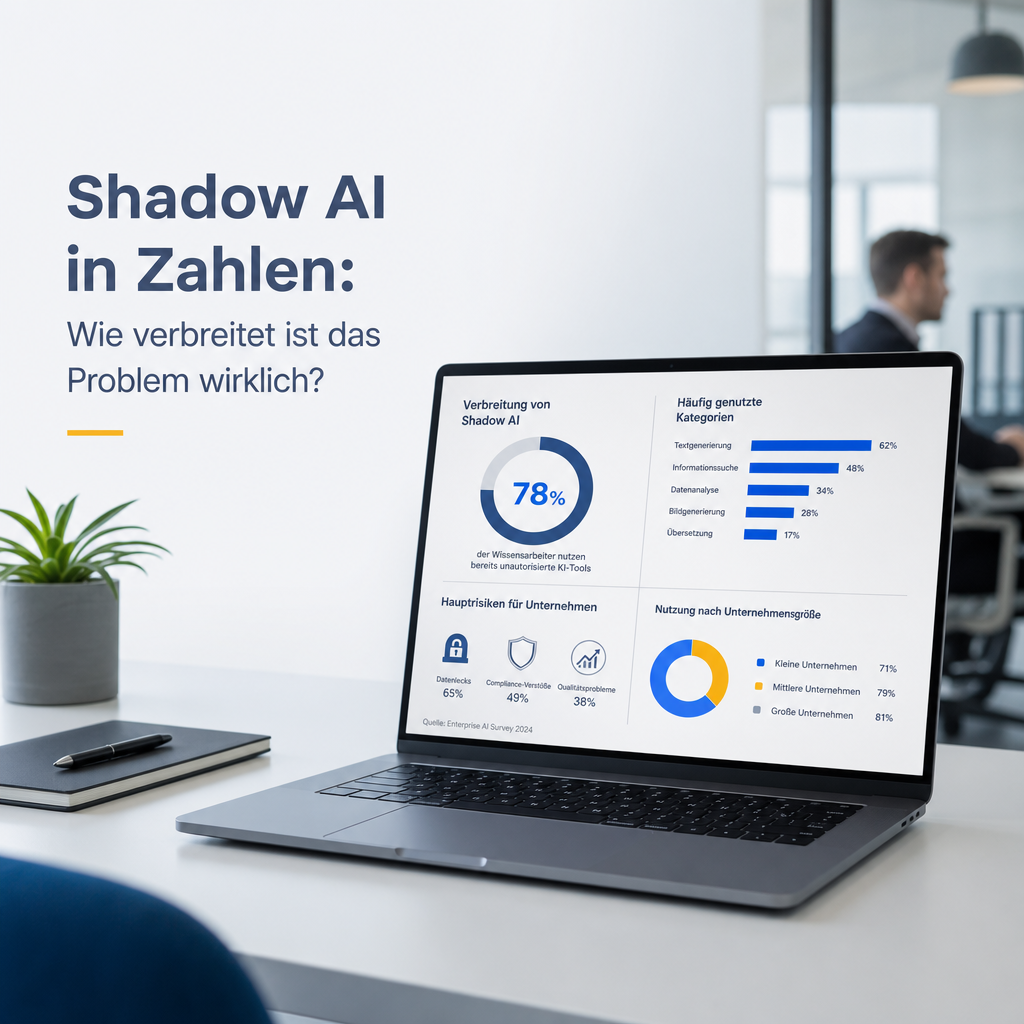
Studies show that shadow AI is not a fringe phenomenon. The numbers are sobering.
What current studies say about uncontrolled AI usage
According to various surveys, between 40 and 75 percent of knowledge workers use AI tools without the IT department's knowledge. The trend is rising, the dark figure unknown.
Which industries are particularly affected
Financial services, healthcare, and legal advice are under special scrutiny by data protection authorities. But traditional industrial companies are quickly catching up.
AI governance as a long-term strategy: More than just a ban
Shadow AI is a symptom. The real cause is a lack of AI governance. Solving this structurally provides lasting peace.
What an AI governance framework must include
Approved tools, clear usage rules, designated responsible parties, regular audits, and an update cycle for new AI applications. Not a one-time project, but an ongoing process.
How a central AI platform makes governance operational
Governance sounds like bureaucracy. But it doesn't have to be. When all employees work through a single, centrally managed AI platform, the IT department automatically has an overview: who uses what, which data flows, which models are active. innoGPT works exactly like this. Not as a control tool, but as a structural response to a structural problem.
Change management: Turning employees into AI ambassadors
The best governance is useless if the team doesn't support it. How to build AI champions in every department and turn shadow AI users into secure AI ambassadors.
Uncontrolled AI is no trivial offense
Shadow AI risks in companies are an acute problem. When employees input data into unauthorized tools, not only do AI security risks arise, but also liability, blind spots, and in the worst case, a reportable incident.
In my opinion, this is the crucial point: Bans alone achieve little. Those who only block get shadow IT with a better disguise. But those who set up AI compliance properly, can identify uncontrolled AI tools, and offer an approved alternative, remove the allure of the problem.
- Set clear rules on which data should never enter external AI systems.
- Make usage visible so teams can identify uncontrolled AI tools.
- Provide approved solutions, such as GDPR-compliant AI systems.
- Involve leadership, as shadow usage is rarely just an IT problem.
The best response to shadow AI is not panic, but control. That's where clean AI implementation separates from costly chaos.
The numbers are clear. According to ADVISORI, 52 percent of knowledge workers use unauthorized AI tools. Deloitte and SentinelOne show the same pattern: lack of control eats away at security and compliance.
If you tackle the issue properly now, you'll save yourself a lot of trouble later. For the next step, our articles on ChatGPT vs. GDPR, the GDPR-compliant ChatGPT alternative, and GDPR-compliant AI for businesses can help.
Sources
Shadow AI in Business: Harness Opportunities, Manage Risks | Deloitte Austria
What is Shadow AI? Definition, Risks & Governance Strategies
About the author

Tim Geier
Tim & AIHe is a trained media manager working hands-on with AI: Tim helps companies roll out AI securely and GDPR-compliantly, turning complex AI topics into clear, actionable steps.
This article was written by Tim together with AI.
Weekly AI news in your inbox
New models, practical tips & expert insights — free for everyone.
More on: AI Compliance & Governance
Section 203 compliant AI platform: using AI safely despite professional secrecy
What Section 203 StGB requires from an AI platform: confidentiality obligation as a contributing person, EU hosting, no model training, data processing agreement under Art. 28 GDPR. With a checklist for law firms, practices and consultancies.

What Does Compliant Mean: Compliance in Business – A Guide
What does compliant mean? Learn what compliance means in business – a compact guide to GDPR, AI Act & co. for legal certainty.

Data Protection vs. Information Security: Two Essential Pillars for Secure AI
This guide explains the difference between data protection and information security and shows how AI projects are implemented securely.

ISO certifications for AI platforms: Why true compliance is more than just a promise
Discover the meaning of ISO certification for AI. Learn why proactive compliance is key to trust and data security.