Key takeaways at a glance: Building a professional chatbot with generative AI is easier than you might think and doesn't necessarily require your own data to get started. The three core steps are: 1. Define your goal and knowledge base: Clearly establish what the chatbot should accomplish and gather the knowledge it needs (e.g. documents, FAQs). 2. Choose a platform with data sovereignty in mind: Pick a user-friendly AI platform that guarantees full control over your data (GDPR-compliant, EU hosting) to protect your company knowledge. 3. Implementation and training: Integrate the chatbot into your systems and train it with real queries to continuously improve its responses. Data sovereignty is critical here, because only when your data stays securely within your own infrastructure can you unlock the full potential without security risks.
Your path to an AI chatbot at a glance
Before we dive deep into the details, let's take the bird's-eye view for a moment. You have the chance to build a smart assistant that noticeably eases the load on your team and genuinely delights your customers. But like any good project, it all comes down to the right decisions made at the start. The goal is to anchor control, security, and efficiency firmly in your project from minute one.
Here's how to set your chatbot project up for success:
At its core, all the magic behind your AI chatbot can be boiled down to three decisive steps. They form the foundation on which your entire project either stands or falls.
-
Clarity from the start: goal and knowledge base. What exactly should your bot be able to do? Support customer service with standard questions? Speed up internal HR processes? Define the goal sharply and clearly. Then gather everything the bot needs to know: manuals, FAQs, product information — this becomes its knowledge foundation.
-
The right toolkit: choosing a platform wisely. Pick an AI platform that lets you keep full control over your data. This is non-negotiable. Look for EU hosting and GDPR compliance to protect your crown jewels — your company data — and avoid falling into a dependency trap with US-based providers.
-
Onto the slopes: implementation and training. Now the chatbot is integrated into your systems. A good, user-friendly platform makes this possible even without deep IT expertise. After that, it's all about training, testing, and optimizing. Throw real queries at the bot and watch it learn from every conversation, with its answers getting better and better.
Data sovereignty isn't a nice-to-have — it's your decisive competitive advantage. Only when you retain authority over your data and it stays securely within your infrastructure can you fully tap into the potential of your company knowledge — without even the slightest security risk. Your chatbot becomes a trustworthy digital twin of your company.
From rigid rules to genuine dialogue: the quantum leap in chatbots
Remember the chatbots of years past? You'd type a question that deviated even slightly from the expected pattern, and bam — the response was a frustrating "I'm sorry, I didn't understand that." They were essentially nothing more than interactive FAQs that stubbornly followed a predefined script. Real dialogue? Absolutely impossible.
Today, we're in the middle of a revolution fueled by generative AI. If you want to build your own chatbot today, you're stepping into a completely new world of communication. Instead of just pulling answers from a list, generative AI enables natural conversations, creativity, and genuine understanding. Your bot can truly grasp the context of a conversation, develop creative solutions, and lead conversations that feel surprisingly human.
What makes generative AI so different?
The difference is enormous. A classic, rule-based bot can only do what someone has painstakingly programmed into it. It recognizes specific keywords and spits out the corresponding stored response. As soon as a request is phrased even slightly differently, the whole system collapses.
A chatbot powered by generative AI, on the other hand, understands the intent behind a question. It learns directly from the information you give it — be it internal company documents, product descriptions, or support articles. From this knowledge base, it then independently generates fitting, individual answers. It can summarize complex topics, explain things, draw comparisons, and even develop new ideas.
Think of your AI chatbot as a "digital twin" of your entire company knowledge. It's not a parrot that simply mimics phrases. It's an intelligent representative that embodies the collective expertise of your team — yet always operates fully under your control and within the secure home of your own IT infrastructure.
Real conversations instead of stiff scripts
This new ability to understand context changes everything. Your chatbot evolves from a simple command-taker into a competent conversational partner. You can feel this across very different areas of the business:
- In customer service: Instead of just relaying the status of an order, it can proactively suggest alternative solutions when there's a delivery problem and guide the customer through the entire process.
- In HR: It doesn't just answer simple questions like "How many vacation days do I have left?" — it can also clearly explain complex parental-leave regulations by pulling information directly from the internal company wiki.
- In sales: Instead of just asking for contact details, it can engage potential customers in a real conversation, analyze their needs, and then hand them off perfectly prepared to the right contact in the team.
We see it every day: acceptance of this technology in companies is growing rapidly. The rising adoption rates of recent years speak for themselves.
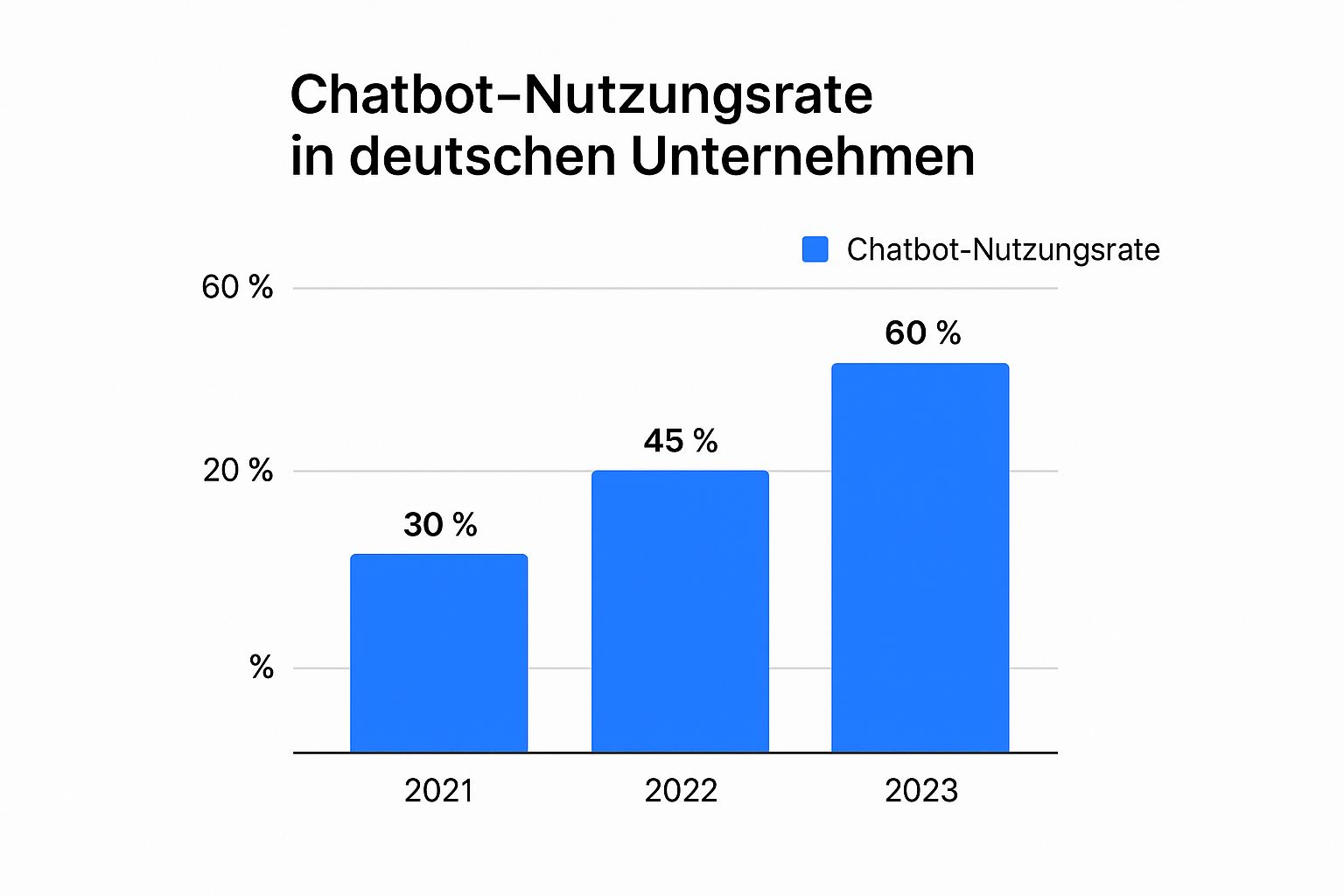
This trend clearly shows that companies have recognized the strategic value of intelligent chatbots and are willing to invest in this technology in a targeted way.
Rule-based chatbots vs. generative AI chatbots: a comparison
To make the difference even more tangible, let's look at the two technologies side by side. The following table shows the key differences in capabilities and typical use cases.
| Feature | Rule-based chatbot | Generative AI chatbot |
|---|---|---|
| Communication style | Strictly scripted, impersonal | Flexible, context-aware, human-like |
| Understanding | Recognizes only exact keywords | Understands intent, nuance, and context |
| Response generation | Selects from predefined answers | Dynamically generates new, fitting responses |
| Learning ability | None; changes require manual programming | Continuously learns from new data |
| Use cases | Simple FAQs, standard processes (e.g. appointment booking) | Complex consulting, personalized support, internal knowledge search |
| Flexibility | Low; fails on unexpected questions | Very high; can handle unforeseen requests |
It's immediately clear: while rule-based systems still have a place for simple, repetitive tasks, generative AI opens up entirely new possibilities for genuine, value-creating dialogue.
If you'd like to dig deeper into how it works, our article explains exactly what an AI chatbot is and how it differs from older technologies. Generative AI finally makes it possible to create an assistant that doesn't just react but actively thinks along with you.
Your 5-step roadmap to your own chatbot
Now we're getting down to it. Here's a concrete five-step guide that will get you safely to your goal: your own intelligent chatbot that genuinely moves your company forward. Let's roll up our sleeves and walk through the decisive milestones that will turn your project from the first spark of an idea into a fully fledged digital team member.

Step 1: Define your goals — what should the bot actually do?
Before you decide on a platform, there's one all-important question: what exactly should your chatbot achieve? Without a clear goal, the whole thing is like sailing without a compass. Sit down with the relevant departments. Where are the biggest pain points? Where are the same questions being asked over and over?
Concrete business examples of goals:
- HR department: An internal chatbot answers questions about vacation policies, travel expenses, or sick leave 24/7. Goal: reduce the HR team's load on routine inquiries by 30%.
- Sales team: An external bot on your website proactively engages visitors, clarifies their needs, and pre-qualifies valuable leads. Goal: 15% more qualified leads for the sales team.
- Customer service: The chatbot acts as the first point of contact and immediately resolves 60% of all standard inquiries (delivery status, returns). Goal: faster problem resolution and a relieved support team.
Step 2: Choose your platform — data sovereignty first
Choosing a platform is the most important technical decision. This isn't just about cool features — it's primarily about authority over your company data. Don't fall into the trap of letting US-based providers lock you in via vendor lock-in. A platform that lets you host your data in the EU and operate in a GDPR-compliant way is a strategic necessity.
A chatbot is only as good as the knowledge it can access. A platform that guarantees full data sovereignty turns your bot into a secure "digital twin" of your company — working exclusively with your knowledge in your protected environment.
Step 3: Build your knowledge base — feed the chatbot's brain
Your chatbot isn't a mind reader. Its intelligence is fed directly by the information you give it. The quality of your knowledge base determines the quality of its responses.
How to build a strong knowledge base:
- Collect: Gather all relevant documents: FAQs, product datasheets, internal guidelines, support manuals.
- Clean up: Bring order to the chaos. Group documents by topic, remove outdated information, and resolve contradictions.
- Structure: Upload the content as topically separated files. This helps the AI understand context and reliably find the right information.
Step 4: Training and testing — putting it through its paces
Now you bring the chatbot to life. During training, you feed the platform with your prepared knowledge base. After that, the crucial testing phase begins. Treat the bot like a new employee in onboarding. Challenge it with real questions, from easy to tricky.
A solid test plan covers:
- Fact checks: Are the answers correct and consistent with the documents?
- Contextual understanding: Does the bot understand follow-up questions, or does it lose track?
- Edge cases: What happens when it doesn't know an answer? Does it cleverly hand off to a human?
In German companies, AI-powered chatbots are already noticeably contributing to efficiency gains. A survey of 786 working professionals in Germany shows just how deeply these helpers are embedded in everyday work. You'll find more details in this fascinating article on the use of AI chatbots in German companies.
Step 5: Implementation and go-live — the big debut
The final step is seamless integration into your system landscape. A good chatbot isn't a lone wolf. Modern platforms make it easy to embed the bot in common tools like Microsoft Teams, Slack, or your website.
An anonymized real-world example: A mid-sized manufacturer integrated its HR chatbot directly into Microsoft Teams. New employees can now ask their onboarding questions right within the familiar chat. The bot pulls from the central company wiki and delivers immediate answers. The result: faster onboarding and a relieved HR department.
Data sovereignty as a competitive advantage
Your company data is pure gold. It's the collective knowledge of your experts, the sum of all your experiences, and the foundation of your success. So why would you hand over this digital capital? When you're thinking about building your own chatbot, the question of data control is the strategic core question, full stop.
For European companies, full control over their data — true data sovereignty — is non-negotiable. It's about retaining authority over your intellectual property and avoiding dependency on external providers.
Your knowledge, your digital vault
Picture your AI chatbot as the perfect "digital twin" of your company. It embodies the expertise of your entire team and makes that knowledge available around the clock. But honestly: would you simply hand over your most capable employee to an unknown service provider, with no idea what happens to their knowledge? Certainly not.
And that's precisely the point: a sovereign chatbot operates in a protected space — on servers in Germany or the EU. It becomes a secure digital representative working within your own shielded IT environment. That way, you can be absolutely sure that sensitive information never flows out uncontrolled.
This control isn't a brake — it's a real turbo for efficiency. Only once you have the comfort of knowing your data is safe will you genuinely tap into the full potential of your chatbot.
How to turn this into a real competitive advantage
When you keep the reins in your own hands, you can feed your chatbot truly valuable internal data without worry. The result? Significantly smarter, more precise, and more helpful answers that go far beyond what a generic bot could ever deliver.
- More trust from customers and employees: When it's crystal clear that all data stays in-house, acceptance rises enormously.
- No vendor lock-in: You stay flexible and independent. If you choose a provider that locks your data inside their ecosystem, switching later becomes complicated and expensive.
- Better automations because they're more relevant: A chatbot with access to current project data or internal manuals can automate processes that would otherwise be unthinkable.
Compliance with data sovereignty is deeply rooted in European legal thinking. To make sure your platform meets all requirements, it's essential to engage with the current data protection regulations.
A look at practice: data sovereignty in action
Let's look at how companies are putting this into practice today, concretely and successfully:
A mid-sized mechanical engineering company runs an internal chatbot that, based on construction plans and maintenance protocols, answers technical questions from service technicians directly on site. This highly sensitive data never leaves the company's own secured cloud environment in Germany. The effect? Faster repairs and a massive reduction in queries back to headquarters.
A law firm, in turn, has implemented a chatbot that supports junior lawyers in researching across thousands of anonymized case files. Thanks to hosting in an ISO-certified data center in the EU, compliance with strict professional confidentiality obligations is guaranteed at all times.
These examples show what matters: data sovereignty is the foundation for innovative and at the same time secure AI applications. If you want to dig deeper into how AI and data protection can be reconciled in practice, our article on GDPR-compliant AI usage offers plenty of valuable insights.
Elegantly overcoming typical hurdles
Deciding to introduce an AI chatbot at your company often feels like the start of a major mountain expedition. Maybe these thoughts cross your mind: is my team technically ready for this? Will the integration be complicated? And will I end up locked into a major US provider?
Don't worry — these thoughts are completely normal. The good news: if you want to build your own chatbot today, you no longer have to scale steep technical cliffs. Modern, user-friendly platforms have paved the way and cleared the biggest stumbling blocks long ago.

The fear of vendor lock-in
A real classic among the concerns is the dreaded vendor lock-in. You commit to a platform, build your entire system on it, and a few years later realize you're trapped. This scenario isn't uncommon, especially with major US providers. They often lure you in with seemingly easy entry-level solutions but bind you deeply into their own closed ecosystem.
My practical tip: From the start, choose platforms that guarantee maximum flexibility. Look for open standards and the ability to export your data at any time. A provider headquartered and hosting in the EU isn't just the safer choice from a GDPR perspective — it's usually also a guarantee of greater independence.
Taming complexity: when API integrations become a nightmare
"We just need to quickly hook up the API." That sentence has caused sleepless nights in countless IT projects. Integrating a chatbot into existing software landscapes can quickly turn into a highly complex undertaking.
This is where user-friendly solutions have made huge leaps forward. Instead of wrestling with complicated API integrations, they now offer pre-built connectors for the most common business tools. With just a few clicks, you connect your chatbot to Microsoft Teams, Slack, or your Google Drive. Integration goes from nightmare to child's play.
No tech team? No problem!
Perhaps the biggest hurdle in many companies is the worry about a lack of technical know-how. Do you really need to be able to code to set up an intelligent chatbot? The clear answer is: no, absolutely not.
The days when you had to dedicate an entire development team to such projects are definitely over. No-code and low-code platforms have completely changed the game. They enable employees from business departments to build, train, and manage professional chatbots themselves.
- Intuitive interfaces: You build dialogues via drag-and-drop and upload knowledge documents with just a few clicks.
- No code required: You don't have to write a single line of code to bring your bot to life.
- Democratization of AI: The knowledge and responsibility for the chatbot live directly in the business unit that knows it best and needs it most.
This trend toward user-friendliness is also visible in general AI usage. The Digital Index 2024/2025 from Initiative D21 shows that around 25 percent of respondents in Germany used ChatGPT. What does that tell us? AI applications take off when they're simple and accessible to everyone. More details on AI usage in Germany help in understanding current trends.
Your most pressing questions about the chatbot project
Your own AI chatbot is a really exciting project, but it's only natural that lots of questions come up at the start. So you can launch with full clarity and a great feeling, we've gathered the answers to the most frequently asked questions here.
Do I really have to laboriously collect my own data first?
That's one of the most stubborn myths — and it long since evaporated in the world of generative AI. The clear answer is: no. You can get started immediately with generative AI without having any data of your own.
The approach today is much smarter: you start with an extremely powerful, already pre-trained language model. Your only job is to give that model your specific company knowledge — ideally in the form of documents you already have. The bot doesn't memorize the content rote; instead, it learns how to find the right information within it lightning-fast and craft crystal-clear answers from it.
Getting started is a walk in the park: you immediately tap into the full power of AI and gradually feed it with your own knowledge. No endless data collection, no complex training processes. Just get going.
How much will a corporate chatbot cost me?
Naming a flat figure would be unprofessional, because costs depend on a few things. Most modern platforms today rely on transparent subscription models tied to your actual usage.
The biggest line items on the bill are typically:
- The platform license: A monthly or annual fee so you can use the software.
- Usage volume: Often you're billed by the number of requests to the AI model. The more the bot is used, the higher these variable costs.
- Implementation effort: That is, the time you invest at the start. With a good platform, this effort is reassuringly small.
What matters is keeping an eye on the total cost. A seemingly cheap platform that leaves you stranded during integration and ongoing operation will end up costing you more in the end.
How long does it really take to get the bot running?
Forget the horror stories of IT projects that drag on forever. If you want to build your own chatbot and rely on a modern no-code platform, you'll be amazed at how quickly you see initial results.
A realistic timeline: for a first working prototype with a clearly defined topic — say, an internal HR bot for vacation questions — you should plan for a few days up to a maximum of two weeks. In that time you'll set the goals, gather the right documents, and click your bot together on the platform.
Can I get the chatbot integrated into my existing tools?
Yes, absolutely — and you should! A chatbot only unfolds its true magic when it shows up exactly where your people are already working. Modern AI platforms come with the necessary interfaces for the most important business applications out of the box.
A connection to tools like Microsoft Teams, Slack, or SharePoint is often just a matter of a few clicks. That way the chatbot becomes a natural part of the workday. No one has to learn a new program — they can simply ask their questions in the familiar chat. This drives huge acceptance from day one.
Are you ready to leap from theory into practice and bring your own smart assistant to life? With innoGPT, your team gets a GDPR-compliant AI operating system built on your very own knowledge. Start your free 7-day trial now and see for yourself how easy it is to automate processes and send productivity through the roof. Learn more at https://www.innogpt.de.
Weekly AI news in your inbox
New models, practical tips & expert insights — free for everyone.