
Texts that don't sound like a robot.
Draft proposals, minutes or emails automatically — in the right tone and style.
SalesHRAdminAssistantsLaw firmsProject management
Free trial on request, no payment details
Doctors, lawyers, tax advisors and other professions bound by secrecy may use AI, if the provider meets the requirements of Section 203 of the German Criminal Code. innoGPT is built exactly for that: EU hosting, no model training and contracts that protect your duty of confidentiality.

The catalogue in Section 203 (1) of the German Criminal Code covers far more professions than just doctors and lawyers. Anyone listed here commits a criminal offence when disclosing entrusted secrets without authorisation.
Physicians, dentists, pharmacists, psychotherapists and members of other state-regulated health professions.
Attorneys, patent attorneys, notaries and defence counsel. The duty of secrecy extends to office staff.
Tax advisors, tax agents, auditors and sworn accountants.
Professional psychologists as well as recognised marriage, family, parenting, youth and addiction counsellors.
State-recognised social workers and social pedagogues.
Members of private health, accident and life insurance companies and private medical billing services.
Four points every professional bound by secrecy should know before deploying an AI tool.
Third-party secrets entrusted or made known in a professional context: patient data, client matters, tax records, insurance data.
Unauthorised disclosure is punishable by up to one year of imprisonment or a fine. Up to two years when acting for payment or with intent to enrich.
Since the 2017 reform, "other contributing persons", such as IT, cloud and AI service providers, may be involved insofar as necessary for their services.
The professional must bind the contributing person to confidentiality. Failing to do so, if a secret is then disclosed, is itself a criminal offence.
Beyond Section 203, additional rules apply depending on the profession: Section 43e of the Federal Lawyers' Act (BRAO), Section 62a of the Tax Consultancy Act (StBerG) and medical professional law. At their core they demand the same things: careful selection of the service provider, a confidentiality commitment and a clear contractual basis.
Your team is already using AI. The only question is whether it happens in a controlled way or not.
Employees paste client or patient data into private AI accounts. Protected secrets end up on servers entirely outside your responsibility.
Simply entering protected data into an unsecured AI tool can constitute unauthorised disclosure, punishable by up to one year of imprisonment or a fine.
If you only ban AI, you lose twice: usage moves into the shadows, and the productivity gains pass your practice, firm or company by.
Since the 2017 reform, professionals bound by secrecy may involve external service providers as "contributing persons" (Section 203 (3)), if the involvement is necessary and the provider is bound to confidentiality. With the Section 203 licence, innoGPT provides the confidentiality commitment and the DPA.
With the Section 203 licence: hosted in Berlin, ISO 27001 certified. Platform and data stay in the EU, and you control which models are enabled.
Neither we nor our technology partners use your inputs to train AI models.
As a contributing person we contractually commit to confidentiality, exactly as Section 203 (4) requires.
Data processing agreement, technical and organisational measures and configurable retention periods included.
SAML SSO and role-based permissions: you decide who may use which data and models.
Encryption at rest, TLS in transit, standard for everything that happens in innoGPT.









Rollout & Support
AI rollouts rarely fail on the tech — almost always on the human side. That's why you get real people with us: demo, premium support and AI experts who work on your use cases with your team, on-site and remote.



15 minutes with an AI expert — no sales theatre, just a screen share on your real data and use cases. You ask the questions, we show solutions.
Your Customer Success Manager knows you by name. Response within 2 hours — via email, phone or Teams. No ticket queues, no bot replies.
90-day pilot programme with a dedicated AI expert: workshops, use-case development, data integration and premium support directly in Microsoft Teams. We guide you from strategy to rollout — not just until the contract is signed.
Use cases
Write emails, summarise podcasts, analyse documents, take meeting minutes, generate code — all in one platform.
Draft proposals, minutes or emails automatically — in the right tone and style.
Upload PDFs, Word or PowerPoint files and extract what matters instantly.
Connect SharePoint, Outlook or your own vector databases — use company knowledge as AI context.
Turn PDFs, emails or documents into ready-made podcast episodes — auto-voiced.
Modernes Produktfoto: minimalistisches Smartphone, weißer Hintergrund, weiches Licht.
Generate images, edit photos, create video content — with the latest image and video models.
Meeting over, minutes done. Automatic summary with action items and owners.

Proposals, quarterly reports, concepts — write directly in the AI editor. Excel tables, PowerPoint presentations and PDF exports included.
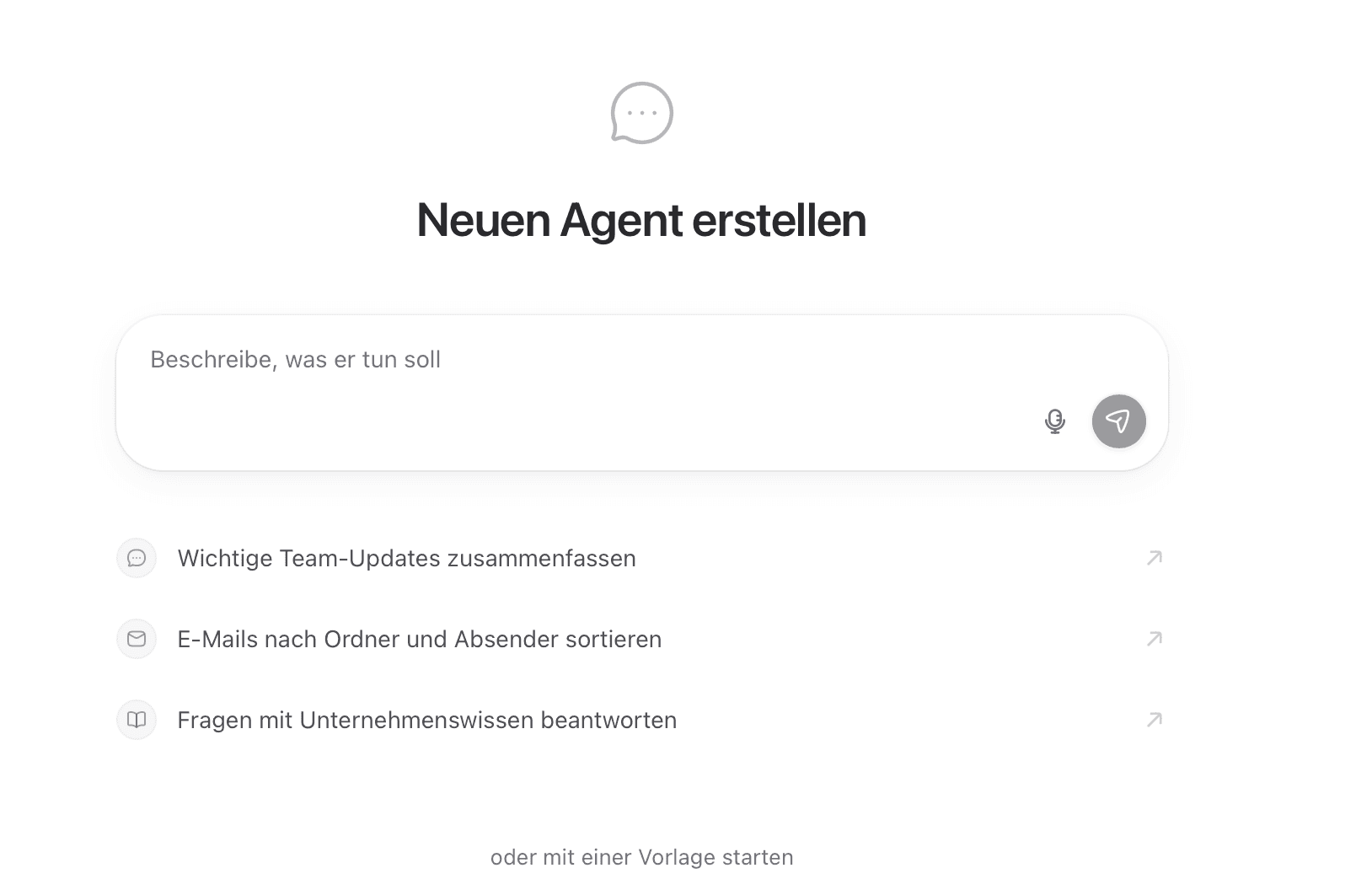
Ready-made or custom AI assistants for emails, contracts, HR, support — install and start right away.
Und viele weitere Funktionen
Trust & Security
Built in Vechta. More potato field charm than Silicon Valley hubris.
Our software and (most) AI models are hosted in Europe.
Encrypted to standards that are even too complicated for us to explain here.
Independently audited information security management. Reviewed by people who do nothing else.
Questions about data privacy? We're happy to help.
Few professions benefit from AI as much as those bound by secrecy, and few carry a higher risk when choosing the wrong tool. Medical letters, legal briefs, tax filings and expert reports consist of exactly the data Section 203 of the German Criminal Code protects. The answer is not to avoid AI, but to pick a platform built for confidential professions from the ground up.
The duty of secrecy has coexisted with external service providers for decades, from document shredding to practice management systems. The legislator settled this explicitly in 2017: Section 203 (3) allows involving "other contributing persons" if their services are necessary and they are bound to confidentiality. The same standard applies to AI platforms. What matters is not whether you use AI, but which provider you choose and what the contract says.
Four questions separate suitable providers from unsuitable ones: Where is the data processed: does it stay in the EU? Are inputs used to train AI models? Is there a genuine confidentiality agreement under Section 203 (4) in addition to the DPA under Art. 28 GDPR? And can you control who in your organisation accesses which data and models? With the Section 203 licence, innoGPT answers all four with yes: EU hosting in Berlin, a contractual commitment not to train on your data, a confidentiality commitment as contributing person, and role-based access control.
In many practices, firms and consultancies AI is already in use, just privately and without control. The secure path is a structured rollout: one approved platform for everyone, clear rules, short trainings and measurable results. That is exactly what innoGPT supports, with personal guidance from introduction to daily use. Shadow AI becomes enterprise AI that respects professional secrecy.
Note: this page provides general information on AI usage and professional secrecy. It does not replace legal advice for your individual case.
Send us your question: on GDPR, our confidentiality commitment and contracts, on features and pricing, or on the rollout in your team. We reply within 24 hours. Note: we currently enable the Section 203 mode on request only. Drop us a line and we will arrange activation for your team.
Rather see the platform live?