
tl;dr:
- Generative AI is unavoidable in the classroom: students are already using AI tools massively on their personal devices – schools need to shape the use, not ban it.
- US tools are a data protection risk: when using ChatGPT & Co., sensitive student data ends up unprotected on US servers, creating a legal gray zone for schools.
- InnoGPT is the GDPR-compliant solution: as a European alternative, InnoGPT enables the safe, controlled use of AI, with all data staying in Europe.
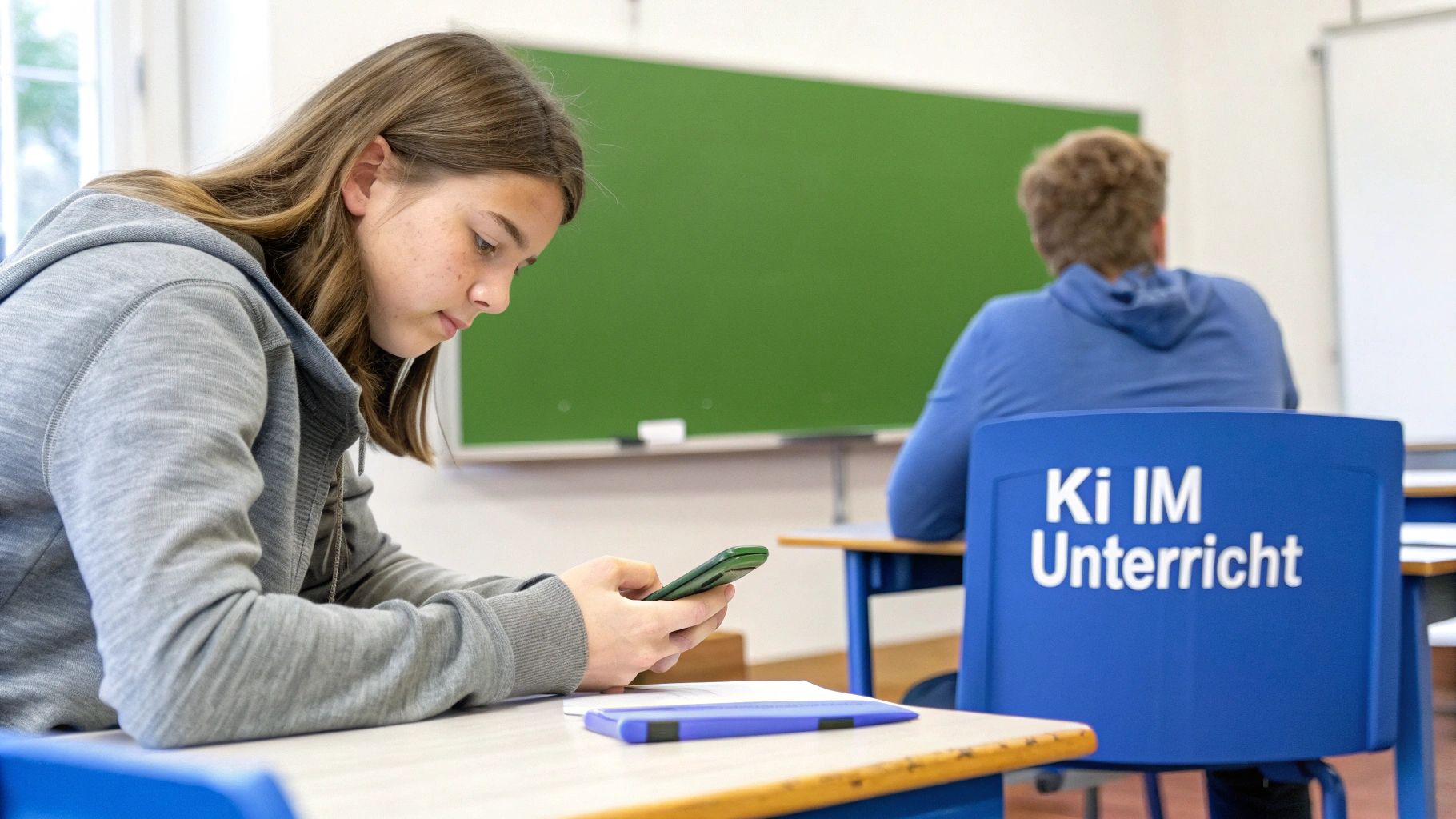
Class 9B, Monday morning, third period. Lena types her question into her smartphone: "ChatGPT, write me an interpretation of Kafka's Metamorphosis." 30 seconds later, she has her text – and her data is in the US.
This scenario is long since everyday school life. AI in school is no longer a distant vision of the future – it's a reality already sitting in the backpacks of your students. That opens up fantastic possibilities for creative, personalized instruction. But for you as a teacher or school leader, it primarily means one thing: a huge dilemma. How are you supposed to foster innovation without putting the highly sensitive data of minors at stake?
That's where your responsibility begins. In this guide I'll show you a practical way to use the power of generative AI for your classroom without throwing your legal and ethical responsibilities overboard.
The Tightrope Walk Between Innovation and Data Protection
The use of generative AI tools in the classroom often moves in a legal gray zone. When students use freely accessible US applications, something happens in the background that should rob every responsible adult of sleep: sensitive student data – names, complete pieces of work, personal information in prompts – ends up on US servers.
With that, this data completely slips out from under the protection of the General Data Protection Regulation (GDPR). You have zero control over what happens to this information, how it's stored, and what the AI is trained on with it. As a school, you have the responsibility to prevent exactly that.
The Invisible Danger: Shadow IT
Experts call this uncontrolled use of apps on personal devices "shadow IT." That may sound harmless, but it not only massively undermines data protection, it can also become a real liability risk for the school.
A strict ban, however, accomplishes nothing. It's like trying to hold back water with your hands. The use just shifts to the kids' rooms at home, and you miss the huge chance to teach young people how to use these powerful tools competently and critically.
AI literacy will be the next major cultural skill. Alongside reading, writing, and arithmetic, the confident handling of artificial intelligence will soon be one of them. Anyone using AI must understand it – and above all be able to critically question it.
The only real solution is therefore a safe, controlled framework. A platform that opens the pedagogical doors to the AI world while data sovereignty stays with you and the school at every moment. With centrally managed licenses and the guarantee that all data stays in Europe, you build a stable bridge between progress and responsibility. What technical and organizational measures for data protection look like exactly is a key building block for any future-proof school strategy.
To implement AI in school not only safely but really well, you of course also need the right technical equipment. Alongside a secure software platform, it's therefore worth a look at the best gadgets for school, which really round out modern teaching.
Why Generative AI Will Change Your Classroom Forever

You know the feeling: grading 30 essays with no time for individual feedback. This is exactly where generative AI in school steps in – not as a replacement for your pedagogical skill, but as your new, tireless assistant.
Imagine having a personal learning partner who helps you make instruction more personal and impactful for every single student. It's about creating creative, interactive learning moments. Generative AI is the tool that immediately – without any data of your own – gives you back valuable time you can put directly into what really counts: your pedagogical work.
Your New Classroom Assistant
Enough theory, let's get real. The real strength of AI tools like InnoGPT lies in taking over routine tasks so you can focus on what matters.
Here are three concrete examples of how generative AI can shake up your school day immediately:
- Conjure up individualized writing exercises: your class is a colorful bunch with different levels? No problem! With a secure AI tool, you conjure writing prompts for everyone in minutes. Weaker students get sentence starters, while you challenge the high-flyers with complex chains of argument.
- Create differentiated worksheets in minutes: need material on the fly for a substitute lesson? Give the AI the topic and the desired levels – and zip, you have tailor-made worksheets instead of hunting online for copy templates.
- Language classes with AI dialogue partners: imagine an AI dialogue partner with infinite patience. Your students can simply start talking without fear of mistakes, simulate realistic dialogues, and immediately get feedback on pronunciation and grammar.
You have to understand generative AI as a kind of "thinking tutor," not a "text factory." It should stimulate critical thinking and act like a catalyst for genuine learning processes – instead of spitting out ready-made answers that make your own thinking superfluous.
So the central question is no longer whether you use generative AI but how you integrate it into your classroom safely and pedagogically wisely. Instead of fearing the technology, you can see it as a powerful partner. And with a secure solution like InnoGPT, you retain full control at all times.
The Data Protection Trap: When Student Data Becomes a Commodity
Let's be honest: your students are already at home in the AI world. The question is no longer whether but how AI in school is used – and that often happens in an uncontrolled way, essentially under the radar. This "shadow IT" is a ticking time bomb for you and your school leadership.
When your class uses freely accessible AI tools like ChatGPT for homework, highly sensitive data leaves the safe harbor of the school. Personal thoughts in an essay, names, concerns formulated in a prompt – all of it ends up straight on servers in the US. And there? There, it's entirely withdrawn from the protection of our European General Data Protection Regulation (GDPR).
The Invisible Data Highway to the US
This is exactly where the huge gray zone begins. As a teacher, you have the duty to protect your students' data. The uncontrolled use of US tools makes that practically impossible and carries an enormous liability risk. You lose all control over what happens to the content, how it's stored, or possibly even what it's eventually used for – for example, to train the next generation of AI. We've covered this sensitive topic in much greater detail in our article on ChatGPT and data protection risks.
Issuing a complete ban is also not a solution. It doesn't stop anyone from using it privately and robs you of the valuable opportunity to teach real future-ready skills in class. The numbers paint a very clear picture here.
In German schools, AI is already an everyday part of kids' lives. A survey shows: a staggering 91% of 12- to 19-year-olds state that they use at least one AI application. At the same time, 76% of 14- to 20-year-olds report that there are no consistent rules for this at their school. You can discover more amazing statistics on AI in education here.
This enormous gap between what happens privately and what the school regulates cries out for a solution.
The Way Out of the Gray Zone
The solution can't be to close your eyes or issue bans. What you and your colleagues really need is a safe, controllable alternative. A platform that lets you use the pedagogical superpowers of AI without throwing data protection overboard.
Imagine an environment in which your students can creatively and curiously experiment with AI while you have the one hundred percent certainty that all data stays in Europe and the GDPR is upheld. Such a system puts an end to uncontrolled shadow IT. It replaces a culture of banning with a culture of enabling.
How InnoGPT Becomes the Safe Harbor for Your Digital Classroom
The good news is: you don't have to choose between innovation and data protection! The key is to create a protected space in which the fantastic possibilities of AI can be fully used while data sovereignty stays with your school at all times.
This is exactly where InnoGPT comes in. Picture our platform as a digital shield for your school – a secure firewall that fuels your students' spirit of exploration and at the same time guarantees strict European data protection rules. With InnoGPT, you and your school leadership take back control and end shadow IT caused by uncontrolled ChatGPT use.
Four Pillars for Your Digital Sovereignty
InnoGPT was built from the ground up for the specific requirements of the education sector. The platform rests on four decisive pillars that address the problem of shadow IT at the root:
- Central license management: your school manages all licenses in one place. You decide who gets access and always have full oversight.
- Controlled AI tools: as a teacher, you only enable the AI applications that are truly sensible for your class. That way, you ensure the technology serves the learning goal.
- Guaranteed GDPR compliance: all data stays in Europe. No data transfer to the US takes place, so student data never leaves the protected zone of the GDPR.
- The end of shadow IT: by offering an official, secure, and powerful alternative, you make the uncontrolled use of US tools superfluous and create legal certainty for the faculty.
This graphic captures the typical data protection trap with the uncontrolled use of US tools.
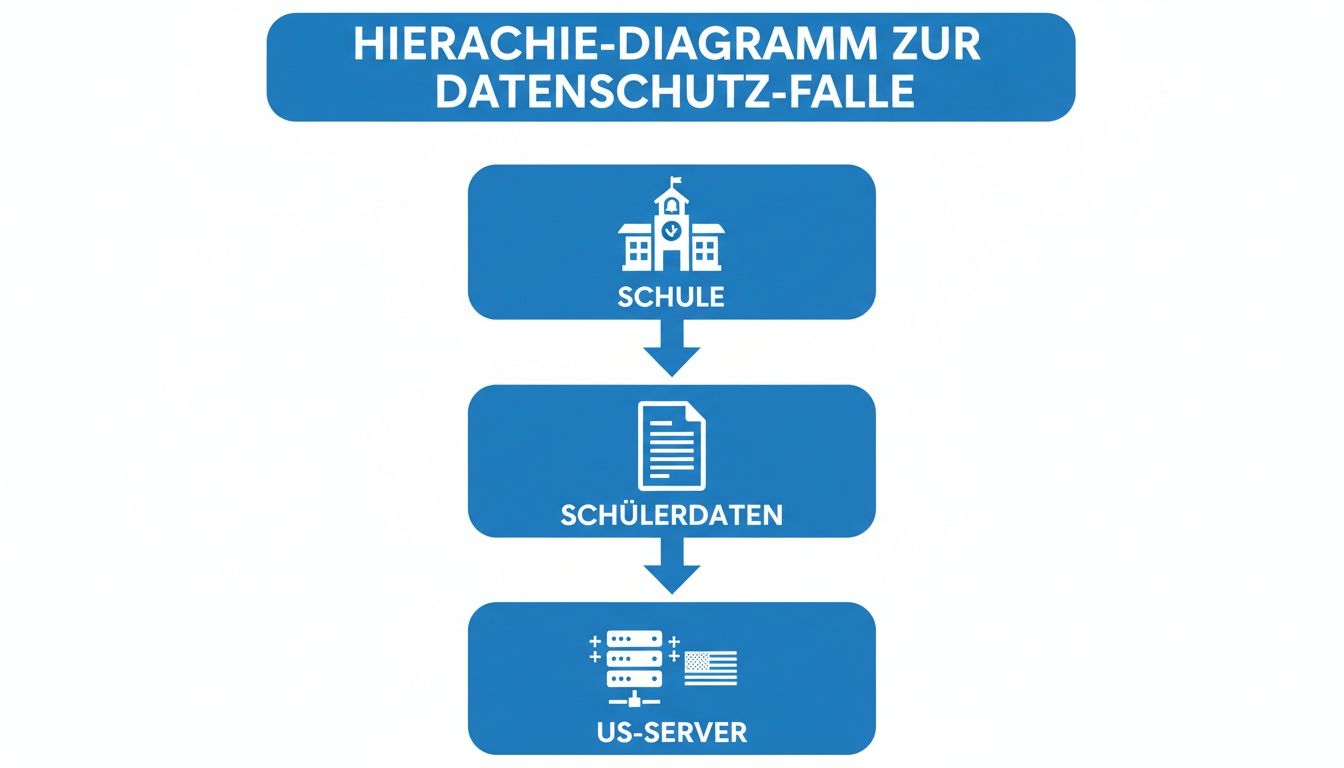
You can see the direct, unprotected data flow clearly: from the school, student data goes straight to servers in the US and is thus withdrawn from European law.
Comparison Between Standard AI Tools and InnoGPT for Schools
To make the differences even clearer, we've prepared a small comparison. This table shows why a targeted school solution is vastly superior to the freely available tools.
| Feature | Standard US AI Tools (e.g., ChatGPT) | InnoGPT (The European School Solution) |
|---|---|---|
| Data storage | Unclear, mostly on US servers | Guaranteed on European servers |
| GDPR compliance | Not given; data is subject to US laws (e.g., CLOUD Act) | Fully given; no data transfer to third countries |
| License management | Decentralized by individual users (shadow IT) | Centrally managed by the school |
| Control & filters | No pedagogical steering; content often uncontrolled | Teachers enable specific tools & content |
| Legal certainty | Large legal gray zone for teachers and school leadership | Full legal certainty for the faculty |
| Data usage | Data is often used to train AI models | No use of student data for model training |
It quickly becomes clear: the difference isn't just in the detail, it's in the entire approach.
Shape Proactively Instead of Just Reacting
With a solution like InnoGPT, you finally switch from a reactive stance of bans to the proactive shaping of digital classrooms. You empower your school to safely use the enormous opportunities of AI and teach your students exactly the skills they'll need for their future.
Instead of racking your brains over legal gray zones, you can focus fully on what really counts again: designing engaging and impactful lessons.
Away with Gray Theory: Here's How AI Sparks in Your Classroom!
Theory is all well and good, but what can generative AI in the classroom really do? Let's look at a few concrete scenarios from the school day in which a secure tool like InnoGPT can make your teaching not only easier but pedagogically more valuable.
German Teacher Uses InnoGPT for Individualized Writing Exercises
You know the scene: your class is a colorful bunch with completely different strengths. A German teacher wants to prepare a writing prompt for his heterogeneous class. With InnoGPT, he cracks that nut in minutes:
- For those who need a jump start, the AI generates matching sentence starters and a clear outline.
- For the high-flyers, the tool drafts complex questions that stimulate critical inquiry. The result? Everyone gets the right challenge, and you no longer have to work nights to create worksheets in triplicate.
Language Classes with AI-Powered Dialogue Partners
In language classes, the fear of mistakes paralyzes many students when speaking. Here, InnoGPT becomes the world's most patient language partner. In a protected environment, learners can chat away completely freely. Whether they order in a restaurant or chat about their hobbies – the AI not only answers, it also gives immediate, constructive feedback on grammar or pronunciation.
Teachers Create Differentiated Worksheets with InnoGPT in Minutes
The classic: you have to spontaneously cover a class in a subject outside your expertise. Instead of frantically fishing for copy templates, you pull out InnoGPT. You type in the topic and grade level – and in no time, you have a topically fitting, didactically sensible worksheet in your hand.
The students themselves, by the way, are eagerly waiting for such digital helpers. A representative youth survey showed that 73% of young people see the use of AI in school as a huge opportunity. The catch? Only 38% felt well prepared for it by their school. If you want to dive deeper, you'll find further insights into the students' perspective on the bidt website.
Why AI Literacy Today Is as Important as Reading and Writing
The world out there is spinning faster than ever. Safe, critical, and creative handling of generative AI is becoming a genuine basic skill. Schools that simply ban AI in school instead of integrating it responsibly don't prepare students for the digital world. They leave young people on their own and exposed to the opaque algorithms of the big tech giants.
The only sensible path doesn't go through bans, it goes through active shaping in a secure, pedagogical framework. Schools that bet on secure solutions now responsibly prepare students for the digital world.
From Passive User to Active Designer
AI literacy is more than knowing how to type a command into a chat window. It's about turning students into autonomous digital citizens.
They need to learn:
- To grasp technology as a tool: where does AI really help, and where are its limits?
- To critically examine results: just because an AI spits something out doesn't make it correct or objective.
- To take responsibility: they need to develop a sense for the ethical implications of AI use.
Schools that now commit to secure and pedagogically well-thought-out solutions like InnoGPT take exactly this educational mandate seriously. They create a protected space for trying things out and learning – without the risk that personal data will be misused.
But this is where a huge gap yawns: an incredible 72% of teachers state they've had no specific training on the subject of AI so far. You can read more about the background in the study on the challenges of anchoring AI in the education system. When you bring a secure platform like InnoGPT into your classroom, you kill two birds with one stone: you protect your class's data and at the same time make them fit for the future.
And Now? Take the First Step Toward an AI-Literate School!
The path to a digitally sovereign school starts right here. Don't wait until the uncontrolled use of AI tools becomes a challenge. Rather shape the future of your school yourself – actively, safely, and with a clear pedagogical compass. Introducing AI in school doesn't have to be a leap into the unknown.
We've deliberately made the start simple and risk-free. You can get going right away and set the course for innovative, GDPR-compliant teaching.
Here are three concrete ways to start right away:
- Test InnoGPT risk-free: convince yourself and try our platform at your own pace with a few colleagues.
- Schedule a demo for the faculty: experience live how the platform can make your daily school life easier, and put all your questions directly to our experts.
- Request teacher training: we offer tailored training sessions that get to the point of how to "safely use generative AI in the classroom."
Actively shape your school's digital future now with InnoGPT. Take the first step and learn more at https://www.innogpt.de.
Weekly AI news in your inbox
New models, practical tips & expert insights — free for everyone.
Related articles
Use ChatGPT – Safely: The GDPR-Compliant Alternative for Businesses
Learn how to use ChatGPT safely and avoid GDPR risks. Discover innoGPT as the GDPR-compliant alternative that protects your data.
AI Text Rewriting: How to Reformulate Content GDPR-Compliant Without Endangering Your Data
Learn how to rewrite text with AI while staying GDPR-compliant. Practical tips for secure, efficient, and privacy-compliant content.

What Does Compliant Mean: Compliance in Business – A Guide
What does compliant mean? Learn what compliance means in business – a compact guide to GDPR, AI Act & co. for legal certainty.