
tl;dr:
- Massive time savings: Generative AI lightens the load for law firms when drafting contracts, briefs, and research summaries – saving valuable hours.
- Acute GDPR risk: Public AI tools like ChatGPT & Co. are a no-go, since sensitive client data ends up on US servers and violates attorney-client privilege.
- Secure alternative: InnoGPT offers the same AI capability as US providers but guarantees full client protection and data sovereignty through EU hosting and a zero-retention policy.
"I've been writing contracts for 30 years. This AI does in 3 minutes what my legal trainee needed half a day for – and no one can see the data. That changes everything." – Fictional senior partner at a corporate law firm
It's 10 p.m. and the light in your office is still on. You're polishing a brief while the stack of unfinished files keeps growing. Or you're manually adapting a standard lease agreement for the third time – a monotonous but necessary task that eats up hours. Time you could better invest in strategically advising your clients.
It's precisely this pressure from routine tasks that is the biggest productivity killer in daily law firm life. But that's exactly where the revolution starts. With generative artificial intelligence (AI), lawyers can hand these time-consuming tasks off to an indefatigable assistant.
But here's the decisive point: for legally secure use, the AI solution must be fully GDPR-compliant. Specialized platforms like InnoGPT bridge exactly this gap – they combine maximum efficiency with uncompromising data sovereignty.
AI Is No Longer a Dream of the Future – It's Your New Ally in Daily Law Firm Life
Forget classic legal tech tools for pure data analysis. Here we're talking about generative AI that actively creates texts for you: contract drafts, briefs, client responses, or the outline for an opinion. Think of the AI as your new, brilliant junior associate who delivers initial drafts – not a simple database searcher. You set the strategic direction, and the AI takes over the time-consuming grunt work.
Digital transformation has the legal industry firmly in its grip. A current study shows that the technology has not only arrived but is already firmly anchored. Nearly 70 percent of German lawyers already use AI tools for their daily work – a number that impressively demonstrates the rapid change.
More precisely, according to the ninth Future-Law Legal Tech Barometer of 2025, exactly 68.48 percent of the surveyed lawyers use AI-powered solutions. And here's what's truly exciting: in an impressive 68.82 percent of cases, they do so for substantive legal work – for research or drafting briefs. A full analysis of how AI is taking the legal industry from vision to reality can be read here.
This guide shows you, in a very practical way, how to fully exploit the enormous potential of artificial intelligence for lawyers – without violating the strict requirements of professional law and data protection by even a millimeter.
How AI Becomes the Productive Junior Associate of Your Law Firm
The term "efficiency gain" only becomes tangible when measured in hard numbers. Let's look at four typical scenarios from daily legal work and compare the time involved – traditional manual work versus the support of a secure AI like InnoGPT.
Efficiency Gains Through Generative AI in the Law Firm
A comparison of time spent on typical legal tasks with and without generative AI support.
| Task | Time Manual | Time with AI | Time Saved |
|---|---|---|---|
| Adapting a commercial lease | approx. 45 minutes | approx. 8 minutes | 82% |
| First draft of a brief | approx. 2 hours | approx. 20 minutes | 83% |
| Complex client email | approx. 15 minutes | approx. 2 minutes | 87% |
| "Translating" legal text | approx. 20 minutes | under 1 minute | >95% |
These numbers clearly show: AI doesn't take away your work – it takes away the time-consuming parts of the work.
-
**Scenario 1: Adapting a Lease Agreement.**Before (45 min.): A lawyer manually adapts clauses on subletting, cosmetic repairs, and operating costs in a standard contract.After (8 min.): With AI, the lawyer instructs: "Adapt this commercial lease for an IT service provider. Integrate a flexible home-office clause and limit subletting to companies in similar industries." The draft is ready for review in minutes.
-
**Scenario 2: First Draft of a Brief.**Before (2 hrs.): Creating the first draft of a reply to a complaint, including the facts and initial legal arguments, easily takes two hours manually.After (20 min.): With AI, the lawyer uploads the complaint and commands: "Create a draft reply to the complaint based on these facts. Argue based on §XYZ of the German Civil Code." The structured draft is the ideal working basis, which the lawyer then refines.
These numbers come as no surprise when you consider how widespread AI usage already is in law firms – especially for substantive work.
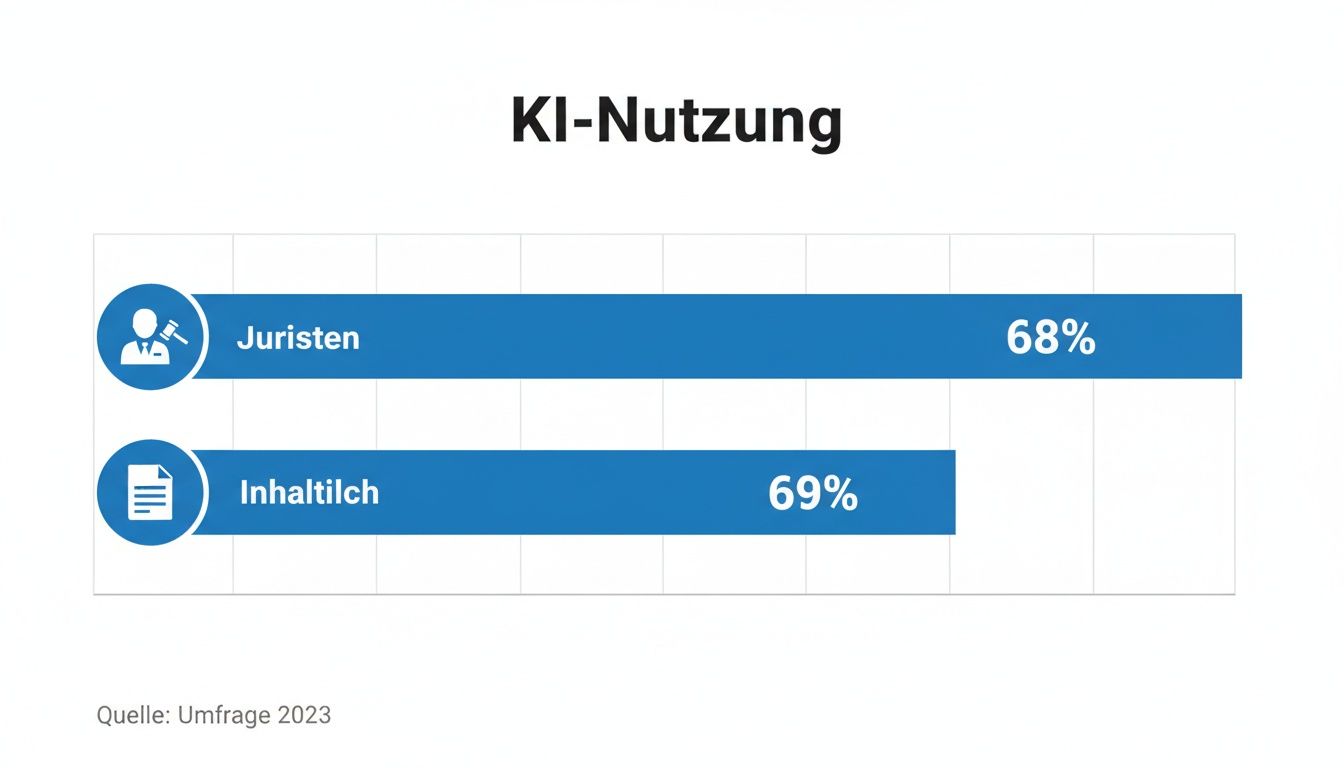
The data shows: the vast majority of lawyers don't just have the technology on their radar – they're actively integrating it into their core tasks to become faster and better.
-
**Scenario 3: Drafting a Client Email.**Before (15 min.): A complex follow-up from a client on the status of proceedings requires a careful manual summary.After (2 min.): With AI, the instruction is: "Summarize the key points from brief XYZ for the client and draft an email that clearly explains the next three steps. Keep the tone professional but reassuring."
-
**Scenario 4: Translating Legal Text for Clients.**Before (20 min.): Preparing a comprehensible version of a paragraph from "legalese" for a layperson takes time.After (< 1 min.): With AI, you paste in the text and ask: "Explain this paragraph in simple, clear language for a layperson without legal background."
The time gained is your greatest asset. Instead of getting lost in routine, you can focus on strategic advice, negotiations, and personal care of your clients. For an "AI junior associate" to unfold its full impact, the environment has to be right, too. After all, how you set up your home office workspace for more productivity has a massive impact on your daily concentration.
The GDPR Dilemma: A Red Line for Lawyers
ChatGPT, Claude & Gemini are brilliant – but every single input containing client data flows directly to US servers. For attorneys, that's a clear violation of professional rules and the GDPR.
Let's make it concrete: what happens when a lawyer, under time pressure, accidentally types names, facts, or contract details into the public version of ChatGPT? In that moment, a violation of attorney-client privilege (Section 203 of the German Criminal Code) and the GDPR has been committed. The data is out of the safe firm environment and is no longer under your control.

This uncontrolled data outflow can have serious consequences:
- Professional trouble: a breach of the duty of confidentiality can lead to sanctions from the bar association.
- Heavy GDPR fines: data protection violations are punishable by fines of up to 4% of global annual revenue.
- Enormous reputational damage: the loss of trust with clients is huge and hard to repair.
The temptation to simply use these efficient tools has led to the emergence of dangerous "shadow IT" in many law firms. Employees use freely available AI tools on their own, without firm leadership knowing about it or having control over it.
For lawyers, the rule is: the use of artificial intelligence is not primarily a technical issue – it's a data protection and professional rules issue. The question is not what the AI can do, but where and how it does it.
A seemingly unsolvable conflict arises: on one side, the desire for maximum efficiency; on the other, the unshakable duty to protect client confidentiality. That's precisely why it's essential that artificial intelligence for lawyers runs in a shielded, secure, and GDPR-compliant environment. Read our detailed article on this, clarifying whether ChatGPT is actually GDPR-compliant and which criteria a secure solution must meet. The good news: there are solutions that enable exactly that.
InnoGPT: The Bridge Between AI Power and Client Protection
You don't have to choose between efficiency and security. InnoGPT positions itself as a bridge-builder that takes nothing away but enables everything: you use the same leading AI models (Claude, GPT-4, Gemini) but GDPR-compliant hosting. Client data stays in Europe, and lawyers retain full control.
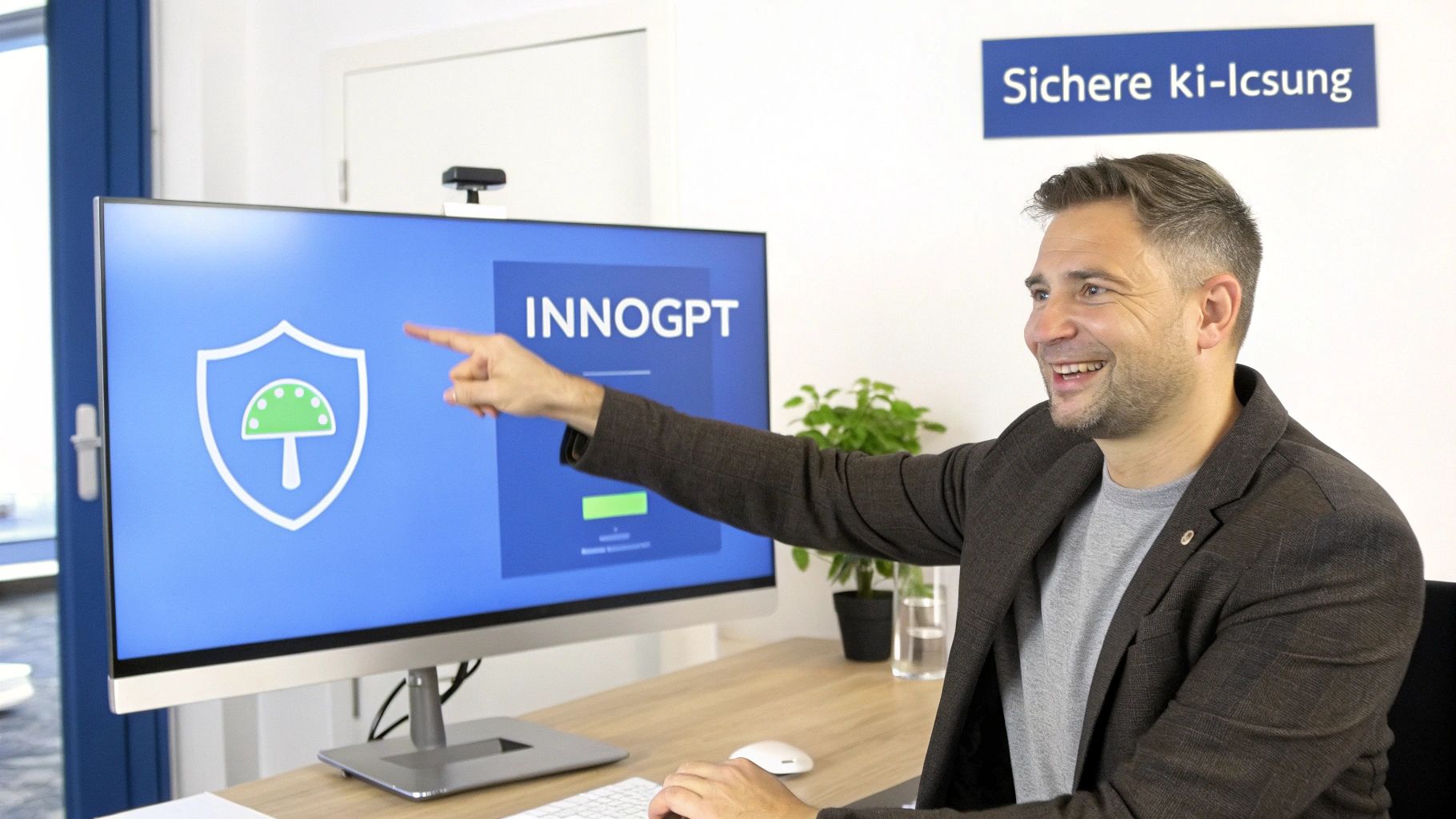
The decisive difference lies in the principle of complete data sovereignty. Your data always stays your data. Period.
The central pillars for protecting your client data are crystal clear:
- Hosting exclusively in the EU: all data processing takes place in high-security, ISO-certified data centers within the European Union.
- Strict zero-retention policy: every one of your inputs and the outputs generated from them are never stored or used to train the AI models. After processing, the data is immediately deleted.
- End-to-end encryption: all communication is encrypted to the most modern standards (AES-256/TLS).
No more shadow IT needed – firm leadership can rest easy. By offering an official, secure solution, you stop the uncontrolled use of insecure tools and ensure compliant AI use across the entire firm.
If you'd like to dive deeper into the security architecture, we recommend our article on technical and organizational measures at InnoGPT.
The Typical Concerns of Lawyers? Let's Clear Them Up!
Skepticism toward new technologies is a sign of professional diligence. Let's directly defuse the three biggest reservations lawyers have.
"Won't AI Replace the Lawyer?"
No, it's an assistant, not a replacement. An AI delivers brilliant drafts, summarizes briefs, and accelerates research. But strategic finesse, empathy, and the final legal review remain firmly in your hands. The AI serves the ball, but you put it away.
"How Confidential Is It Really?"
With a professional solution like InnoGPT, the answer is crystal clear and technically underpinned. Through EU hosting, a guaranteed zero-retention policy, and bank-grade end-to-end encryption, your data is 100% secure. Client confidentiality is uncompromisingly preserved.
"Isn't It Expensive?"
At first glance, it may seem like an investment. But the ROI calculation is simple: time saved × hourly rate. If AI saves you just a single hour of routine work per day, the investment often pays for itself within a few weeks. It's not an expense – it's an investment in your most valuable resource: your time.
A glance at the future makes it clear there's no way around AI anyway. As current analyses of AI in the legal sector emphasize, it's now time for lawyers to familiarize themselves with secure AI applications so as not to fall behind.
Why Early Action on AI Decides Your Firm's Success
The market for artificial intelligence for lawyers is developing rapidly. Your competitors are already using AI – the only question is whether GDPR-compliant or in the shadows. Anyone who doesn't start today will lose mandates tomorrow to faster firms.
Speed Is Everything
In this dynamic environment, flexible platforms like InnoGPT have an invaluable advantage. While classic legal tech providers need months to integrate new models, it happens within days with us. That way, firms stay on the pulse of innovation.
This speed advantage catapults you straight to the top of innovation. You're not working with yesterday's technology – you're always working with the strongest, most current AI models on the market.
This ensures your firm stays technologically on the cutting edge. You capture efficiency gains immediately while others are still waiting for the next big update.
Whoever Doesn't Start Today Will Lose Mandates Tomorrow
Clients no longer expect only brilliant legal work – they also expect lightning-fast, efficient processes. A firm that drafts briefs in a fraction of the time with AI support is simply superior and more attractive to clients. Whoever sleeps through the start today risks losing important mandates tomorrow to more agile competitors.
So the question is not whether you can afford the change – but whether you can afford to miss it.
Your Questions About AI in the Firm – Our Answers
The thought of bringing AI into daily firm life naturally raises questions. That's a good thing! Here, we address the three most important concerns lawyers repeatedly bring to us. This gives you the clarity you need to make a well-founded decision.
How Safe Is My Client Data Really?
That's the make-or-break question, and there's only one answer: security isn't a feature, it's the foundation. With a professional solution tailored for holders of professional secrecy like InnoGPT, nothing is left to chance.
Your data is protected by a multi-layered security architecture developed specifically for you:
- Hosting exclusively in the EU: all data processing takes place in ISO-certified data centers within the European Union. A data outflow to the US or other insecure third countries? Technically impossible and contractually excluded.
- Guaranteed zero-retention policy: this is your most important shield. Neither your inputs nor the AI's outputs are ever stored or misused to train the models. After each request, everything is irrevocably deleted. It's that simple.
- Bank-grade encryption: the entire communication between your computer and our servers is seamlessly encrypted according to the AES-256/TLS standard. No one gets in.
Does Generative AI Make Legal Mistakes?
Yes, and it's crucial to address this openly. An AI is an incredibly strong assistant, but it doesn't replace your legal expertise. It can miss nuances, misinterpret context, or in the worst case even "hallucinate" facts – simply make them up.
That's exactly why your role as a lawyer remains absolutely central. Think of the AI as a highly qualified trainee: it delivers the first draft, the summary, or the research basis. The final review, strategic evaluation, and sign-off – that always remains your sovereign duty. Artificial intelligence for lawyers serves the ball, but you put it away.
How Complicated Is Implementation in My Firm?
Don't worry – the days of months-long, grueling IT projects are over. Modern AI platforms are designed as plug-and-play solutions. The idea is that they integrate seamlessly into your established workflows instead of turning everything upside down.
Onboarding usually takes just a few hours and requires no specialized IT knowledge. Thanks to ready-made integrations – for example with Microsoft Teams or SharePoint – your team simply keeps working in the familiar environment, just much, much faster. You can essentially start immediately and feel the efficiency gains.
Your competitors are already using AI – the only question is whether GDPR-compliant or in the shadows. Whoever doesn't start today will lose mandates tomorrow to faster firms. Start your transformation now with InnoGPT.
➡️ Start your free test now and experience the future of legal consulting.
Weekly AI news in your inbox
New models, practical tips & expert insights — free for everyone.
Related articles
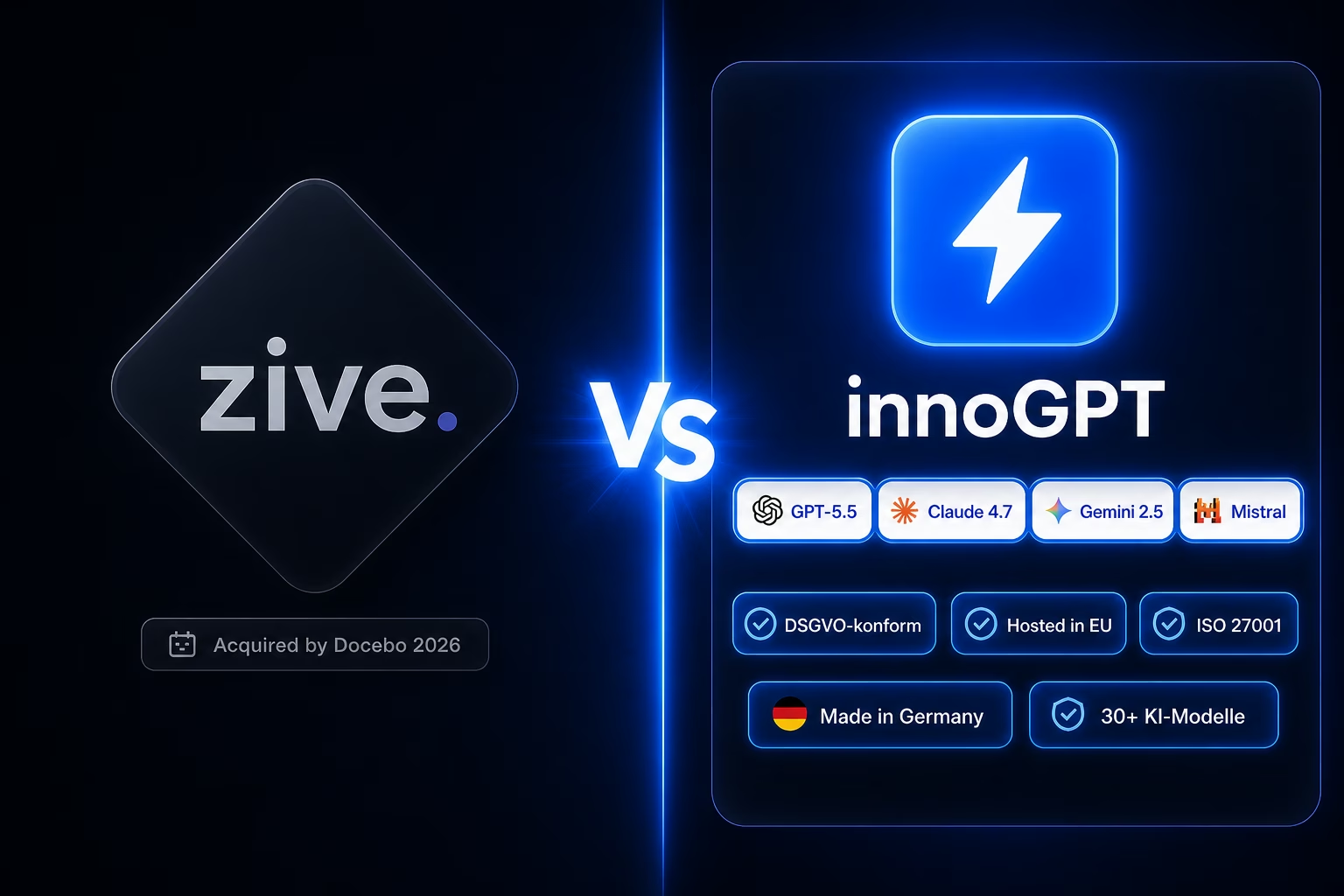
Zive alternative: innoGPT — workplace AI from Germany
Chat, knowledge base, search and tasks in one platform — bootstrapped, EU-hosted, ISO 27001-aligned.
ChatGPT for Companies? Why European Businesses Need a GDPR-Compliant Alternative
Discover the risks of ChatGPT for companies and how InnoGPT, as a secure GDPR-compliant alternative, makes generative AI power usable for your business.
Use ChatGPT – Safely: The GDPR-Compliant Alternative for Businesses
Learn how to use ChatGPT safely and avoid GDPR risks. Discover innoGPT as the GDPR-compliant alternative that protects your data.