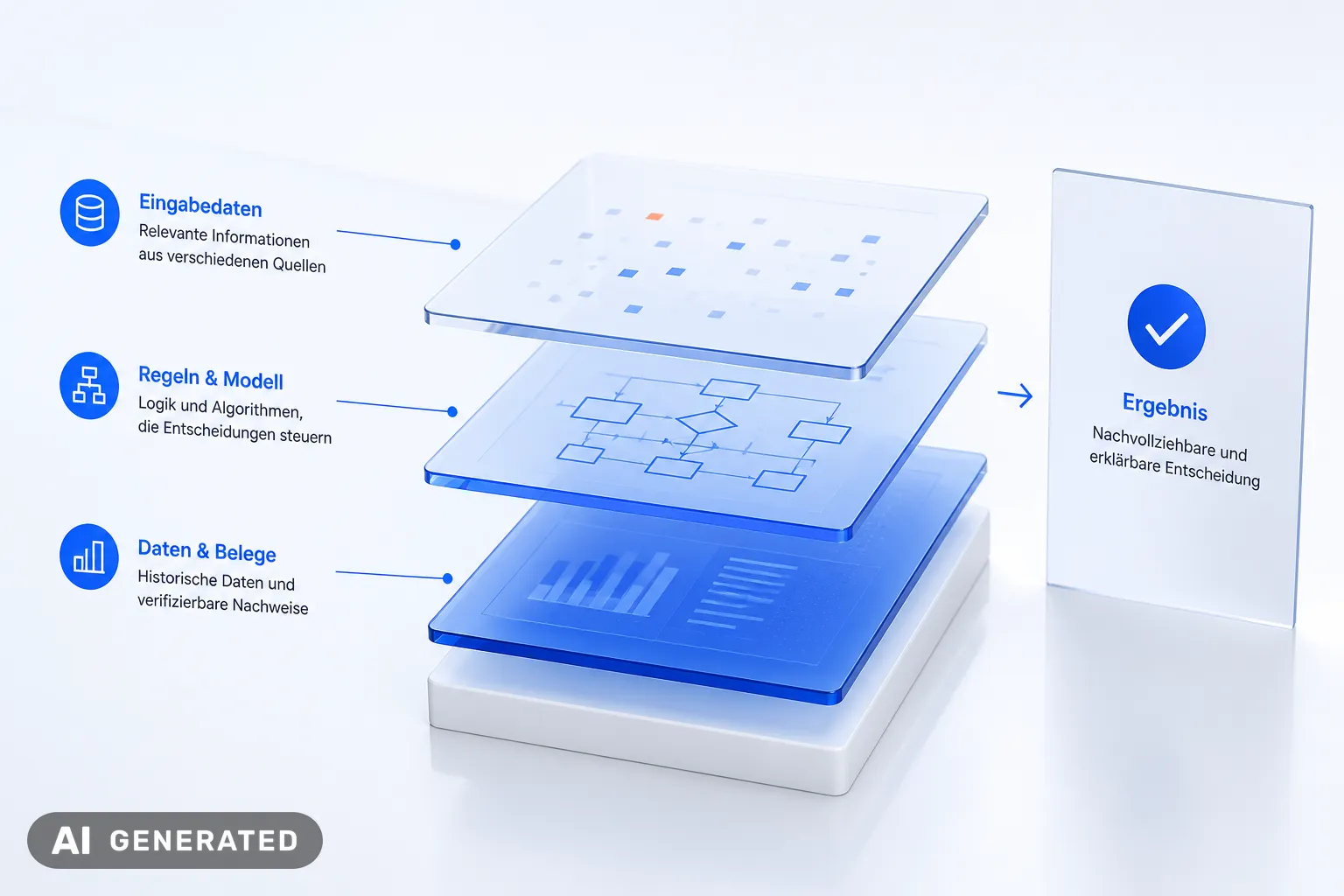
TL;DRExplainable AI reveals why a model reaches a particular outcome. It prevents blind trust, speeds up audits, and lays the groundwork for transparent decisions.
Explainable AIis not just a nice slide feature. It answers a specific question: What inputs, rules, or data led to this outcome?
An everyday example: An AI flags an invoice as suspicious. The specialist needs more than a red warning symbol. They need to see if the amount, supplier, payment terms, or an unusual account connection triggered the alert.
**Explainable AI,**often abbreviated as XAI, describes methods that make such reasons readable for humans. The result must fit the role. A data scientist checks model versions and features. A sales manager needs a clear explanation for a lead evaluation.
- Understanding AI Decisionsmeans documenting input, model version, and outcome together.
- AI Transparencyshows users where AI was involved and the limitations of the outcome.
- AI Governancedetermines who reviews, approves, or corrects an outcome.
An explanation without stored inputs and model version is about as useful in an audit as a screenshot of a printer error.
From August 2, 2026, new EU transparency rules apply to certain AI-generated or manipulated content. Companies must also indicate when users are interacting with an AI system instead of a person. The European Commission mentions fines of up to 15 million euros or 3% of global annual turnover for violations.
Trustworthy AIdoesn't come from a pretty explanation after the fact. It requires auditable data paths, clear responsibilities, and an explanation that the responsible person truly understands. Frankly, a model whose judgment can't be explained shouldn't be solely responsible for a critical decision.
Explainable AI
Explainable AIdoesn't provide a retrospective explanation. It shows which features influenced an outcome and how strongly they did.
With simple rule sets, this is manageable. An invoice is flagged because the amount and bank details don't match. With neural networks or large language models, it gets trickier. Here, technical methods are needed to translate model behavior into verifiable clues.
The right explanation depends on the model
- SHAP and TreeSHAPare ideal for tree-based methods when departments need to examine feature contributions per case.
- Integrated Gradients and Captumare suitable for neural networks, such as in image or text classifications.
- LIMEis helpful for quick prototyping but doesn't replace repeatable audits in operation.
A concrete case from sales: A model rates a lead with 82 out of 100 points. The explanation shouldn't just output "high potential." It should show that factors like industry, company size, visited product page, and a recently requested appointment influenced the rating.
A useful XAI explanation answers the professional question. It doesn't just explain which mathematical method was running in the background.
For forecasts, speed also matters. Helmholtz AI describes SHAPformer, an approach that generates explanations for energy forecasts in under a second. This is relevant when teams need to check results during an ongoing process, rather than reading a report days later.
AI Transparencystarts with the right level of detail. An analyst needs feature values and thresholds. An executive needs the business reason for the recommendation. Combining explanations for both roles in the same report usually causes confusion with extra clicks.
Explainable AI alone doesn't make an outcome correct. It uncovers errors, such as when a model suddenly reacts to an irrelevant field. This is where Explainable AI, AI Governanceand trustworthy AI intersect: Results must remain verifiable before they influence decisions.
Understanding AI Decisions
Understanding AI Decisionsmeans storing input, model version, threshold, and justification together for each case. Without these four pieces of information, only an outcome remains. That's not enough if a department needs to review or correct the decision.
A procurement team has suppliers checked for risks. The AI flags a supplier as critical. The specialist then needs the dataset, the risk threshold used, the model version, and the specific triggers. "Critical" alone is as helpful as an error message saying "Computer says no."
- Store the original input, including data source and any data transformations made.
- Log model version, prompt, knowledge sources used, and any set threshold.
- Record who reviewed the outcome and what follow-up decision they made.
An explanation is only verifiable if the same case can be reconstructed later with the same information.
Test the process on real cases. Take ten flagged supplier cases and have two buyers trace why the AI issued a warning. Do both find the same triggers? If a data source is missing or a threshold is unclear, the process is not yet audit-proof.
AI Transparencydoesn't come from a dashboard. It comes from complete decision logs. AI Governancedetermines who can access these logs, how long they are stored, and who intervenes in case of errors. innoGPT can integrate company knowledge and AI outputs into controlled workflows instead of letting decisions disappear in individual chats.
Honestly, not every AI response needs a forensic log. For text drafts, a source reference often suffices. For personnel, credit, or risk cases, however, you need a complete trail.
AI Transparency
AI Transparencyhighlights what an AI system does, what limitations exist, and who must intervene. A log alone is not enough. The explanation must reach the person making the professional decision.
From August 2, 2026, additional EU transparency rules apply to certain AI-generated or manipulated content. Users must be able to recognize when they are interacting with an AI system instead of a person. This affects many customer-facing processes. A service chatbot therefore needs a clear notice, not a game of hide-and-seek in the fine print.
Transparency needs clear levels
Explainable AI answers the question about the specific outcome. AI Transparency describes the bigger picture: data origin, system purpose, limitations, and human oversight. Both topics belong together but serve different purposes.
- **Department:**Show the trigger, the data used, and the next sensible check.
- **IT Team:**Document model version, interfaces, permissions, and error cases.
- **Affected Individuals:**Clearly name the AI usage and enable human contact.
Transparency doesn't mean handing over the source code. Transparency means that every involved person receives the information necessary for their decision.
A concrete case from HR shows the difference. A system summarizes application documents and highlights missing qualifications. Recruiters need the text passages from the documents and the hint of uncertain hits. Applicants, on the other hand, need clear information that AI processed their documents, not the internal weighting of each feature.
The most common mistake is: Teams build a pretty dashboard and call it transparency. A diagram without sources, timestamps, and responsibility is just decorated ambiguity. Therefore, check five real cases monthly: Is the purpose, data origin, AI output, reviewer, and correction visible for each case?
Platforms like innoGPThelp keep knowledge sources and AI outputs traceable in the business context. AI Governance then sets binding rules on who reviews this information and what the consequences of errors are.
AI Governance
AI Governancedetermines who approves, monitors, and stops an AI system in case of errors. Without clear responsibilities, explainability remains a report that no one reads in an emergency.
For companies, AI Governance means: Rules are defined before going live and checked during operation. This concerns data access, model changes, human approvals, and the storage of decision logs. Violations of EU regulations can result in fines of up to 15 million euros or three percent of global annual turnover.
A Governance Process in Five Steps
An effective process doesn't need endless coordination rounds. It requires five clear decisions documented for each relevant AI system.
- **Define Purpose:**Describe the specific task, such as pre-sorting incoming invoices.
- **Assign Responsibility:**An expert decides on outcomes that impact customers or employees.
- **Limit data access:**Only grant access to roles that need to review, modify, or approve data.
- **Log changes:**Record model version, prompt, data source, and approval with each adjustment.
- **Define error path:**Determine who reviews unusual results and when the system should be paused.
If no one can challenge or stop an AI result, it's not a missing feature. It's a lack of accountability.
An example from sales: An AI system evaluates leads and prioritizes contacts for the sales team. Sales management sets the threshold. An admin documents changes. Employees flag incorrect prioritizations. This way,AI decisions can be traced, instead of debating an inexplicable order later.
AI transparencyis part of this process, but it doesn't replace it. A note on AI usage doesn't explain permissions or approvals. Frankly, many projects fail right there: The tool runs, but no one owns the process. innoGPT helps companies bring together roles, company knowledge, and approvals for AI applications in a controlled manner.
For simple text drafts, a streamlined review by the department often suffices. Once AI prioritizes, evaluates, or manages external communication, the process needs documented responsibilities and regular checks.
Trustworthy AI
Trustworthy AIdoesn't come from a green checkmark on the dashboard. Trust is built when experts can review, correct, and discard a result if necessary.
This is especially true for decisions with human consequences. If an HR system pre-sorts applications, a recruiter shouldn't work through an unexplained ranking. The recruiter must see which professional criteria influenced the evaluation.
Trust is built through verifiable control
Teams must be able totrace AI decisionswithout having to read a model's source code. For daily work, clear answers to three questions suffice:
- What data did the system use for this specific result?
- What criteria led to the recommendation or marking?
- Who reviews the case if the expert disagrees?
A practical case from administration: An AI marks an application as incomplete. The processing staff checks the missing fields directly in the result. They either complete the document or correct the marking. This way, the decision remains with the responsible person, not a black box with an important expression.
Trust doesn't mean accepting every AI result. Trust means quickly identifying errors and correcting them with justification.
AI transparencymust therefore match the respective role. An administrator needs logs of model versions and data access. An expert needs a brief explanation of the individual process. Management and data protection require evidence of compliance with established rules.
Explainable AI doesn't create error-free results. A clearly explained outcome remains wrong if the input data is flawed or the rules are unsuitable. Frankly, that's the test: Does your team find errors faster because the reasoning is visible?
innoGPT supports this work style by integrating company knowledge in a controlled manner and reviewing results in the professional context.AI transparencydoesn't start with a review. It begins with clear data sources, roles, and approvals in the work process.
FAQ
Conclusion
Explainable AIis crucial for whether experts review results or blindly adopt them. Trust only arises when a professional justification stands alongside the result.
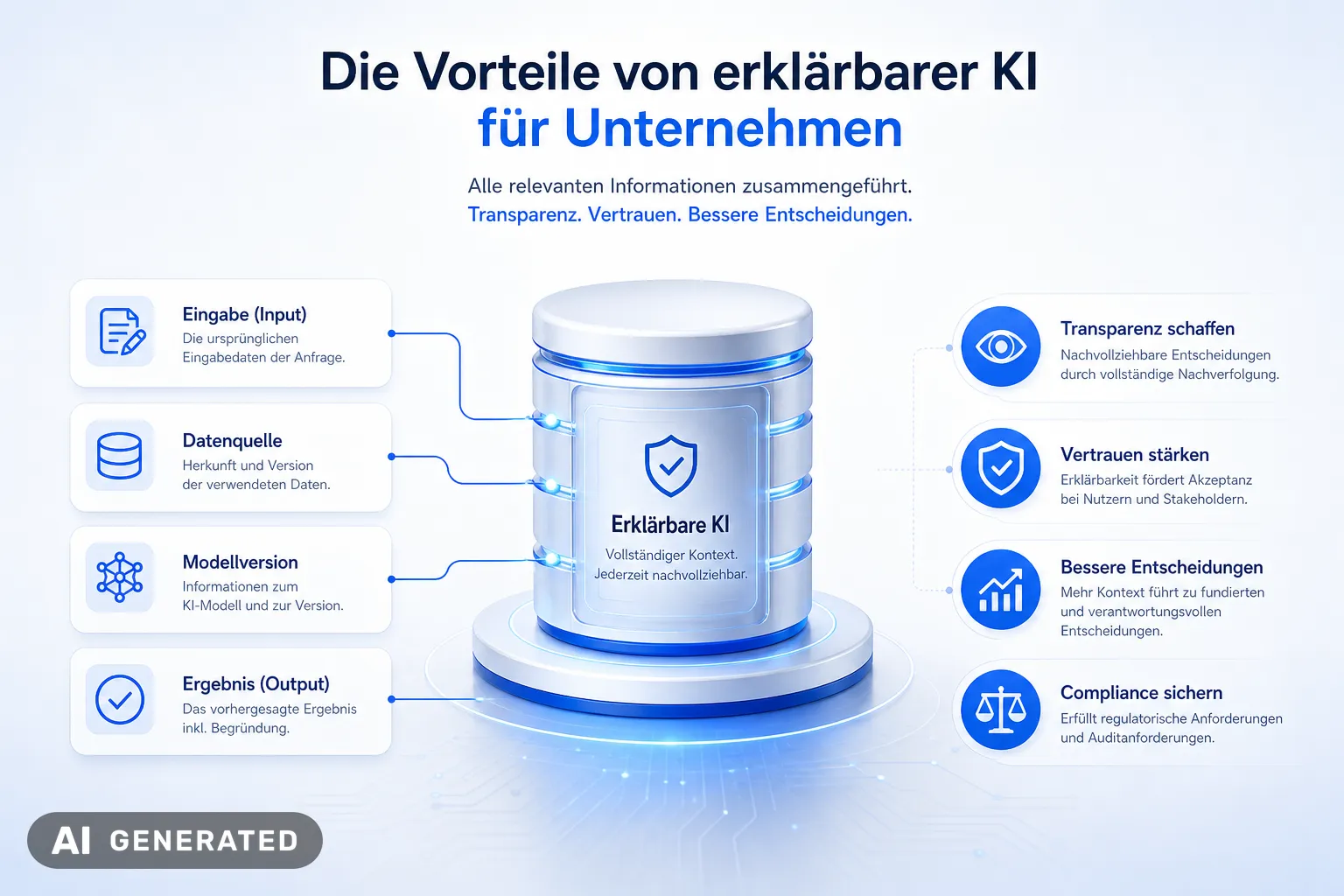
AI transparencymust be part of the workflow, not just a PDF in the project folder. The demand to trace AI decisions affects every single suggestion, marking, and automated response.
- Store input, data source, model version, and result together.
- Show experts the reasons directly where they approve or correct.
- Review conspicuous errors based on a documented individual case.
An explanation is only useful if the responsible expert can derive a concrete review from it.
A practical starting point is a process with real consequences, such as reviewing incoming invoices. Document the amount, supplier, applied threshold, and model version used for each marking. If an accountant reports an error, the cause can be narrowed down. Without these traces, only guesswork remains. That's about as helpful as a printer error without an error code.
At innoGPT, this question is addressed early in the introduction of company knowledge and AI-supported workflows. Teams should determine before rollout who reviews explanations, where logs are stored, and when a human decides. A good model without documented control is worth less for critical processes than a slightly less accurate model whose outcome can be reviewed.
Explainable AI doesn't create error-free results. But it ensures that errors become visible, responsible parties can act, and decisions don't disappear into a black box.
Labeling for AI-generated images
The article**"When is labeling required for AI images"**clarifies when image content needs a visible notice. This particularly affects marketing departments directly.
An example: Your team creates a product image with an image generator and publishes it on LinkedIn. It's not enough to know internally that AI was involved. The publication requires a clear process for review, labeling, and approval.
A traceable decision not only documents the result. It also shows how this result is communicated externally.
Translating the AI regulation into workflows
The articles**"Labeling requirement AI regulation"and"Labeling requirement AI VO"** help you break down legal requirements into actionable steps. This is much more useful than a guideline that gathers dust in SharePoint, unread.
The connection to explainable AI is obvious. Anyone who wants to understand AI decisions needs information about data, models, and approvals. To create AI transparency, you also need to determine what cues users will see.
I wouldn't treat these topics separately. For each AI workflow, decide who reviews the output, where the review evidence is stored, and what labeling is required. For AI-generated texts, images, or automated responses, this prevents later disputes with compliance, data protection, or customer service.
innoGPT helps teams introduce company knowledge and AI-driven workflows with clear responsibilities. The technical part is rarely the biggest issue. Usually, there's a lack of a clear rule on who makes the final call when a result is questionable.
You might also be interested in
- GDPR-compliant AI
- Organizational data protection measures
- ISO certification for AI systems
- Data protection vs. information security
Sources
About the author

Tim Geier
Tim & AIHe is a trained media manager working hands-on with AI: Tim helps companies roll out AI securely and GDPR-compliantly, turning complex AI topics into clear, actionable steps.
This article was written by Tim together with AI.
Weekly AI news in your inbox
New models, practical tips & expert insights — free for everyone.
Related articles
ChatGPT for Companies? Why European Businesses Need a GDPR-Compliant Alternative
Discover the risks of ChatGPT for companies and how InnoGPT, as a secure GDPR-compliant alternative, makes generative AI power usable for your business.

The European ChatGPT alternative: Why companies rely on German GDPR-compliant AI
Discover a chatgpt alternative that is GDPR-compliant and strengthens data sovereignty. Why German AI solutions create trust.
AI Hyper-Personalization Marketing Real-Time: Benefits & Strategies
AI Hyper-Personalization Marketing Real-Time Revolutionizes Customer Engagement. Discover Benefits and Technologies! ➨ Read Now!