TL;DR: An AI policy for businesses outlines which tools your team can use, which data is off-limits, and who is responsible for decisions. Without these rules, shadow IT can quickly emerge.
A AI policy is not just a legal formality. It provides employees with clear guidelines to prevent customer data from ending up in a public chatbot or an unchecked AI-generated text being sent out.
For a business AI policy, vague statements like "Please use AI responsibly" aren't enough. Employees need practical answers for their day-to-day work. The University of Freiburg's policy, as of May 2026, demonstrates the necessity of specific rules for generative AI.
These Questions Must Be Answered Immediately by the Policy
- Which AI tools are approved for use?
- Which personal, confidential, or business-critical data should remain outside AI tools?
- Who reviews results before publication, sending, or decision-making?
- Where do employees report faulty, discriminatory, or fabricated AI outputs?
A good AI usage policy addresses specific work situations, not just abstract risks.
An AI policy template saves time at the start but doesn't replace customization. Sales, HR, and legal departments work with different data. An AI policy generator can help draft the initial version. However, the final AI compliance policy must be reviewed by IT, data protection, and relevant departments together.
Honestly: Three clear AI rules in a company prevent more chaos than a 20-page PDF filled with legal jargon.
Introduction to the AI Policy
An AI policy for businesses translates abstract requirements into practical work rules. It clarifies not only which tools are allowed but also when employees need to consult with others.
The University of Freiburg's policy, as of May 2026, shows the right approach: Generative AI can assist, but results must be reviewed. An AI output is not proof but a draft that may contain errors, invented sources, or distorted statements.
- Permission Framework: Which AI systems the team uses for which tasks.
- Data Rule: Which content should never be entered into external AI services.
- Review Rule: Who checks texts, analyses, or decisions before use.
- Reporting Path: Where problematic outputs and rule violations are documented.
A good AI usage policy clearly shows what is allowed, where the boundaries are, and who decides in case of uncertainty.
An AI compliance policy must fit actual work practices. HR needs different rules than sales or research. An AI policy template is just the starting point. The AI policy generator from KIT shows how a structured draft can be created. Honestly: Without expert review, such a generator only produces well-formatted nonsense.
A company's AI rules should be short enough to be read. Three pages with clear examples are better than a 30-page PDF gathering dust in the downloads folder.
Opportunities and Risks of AI
AI saves time, but it doesn't take responsibility. This is where useful support separates from costly mistakes.
Generative AI can turn bullet points into a proposal draft, summarize long protocols, or sort information for research. This speeds up routines. However, if a sales team copies contract clauses into a public chatbot, the time savings become secondary.
- Opportunity: Employees can create initial text drafts faster, leaving more time for review and customer interaction.
- Risk: AI can invent facts, sources, or numbers and sound surprisingly convincing.
- Risk: Inputs with personal, customer, or contract data can violate data protection and confidentiality obligations.
- Opportunity: Teams can find patterns in large document volumes that are easily overlooked in manual searches.
Use AI for drafts and structure. Don't use it as the final authority for facts, law, or personnel decisions.
The University of Freiburg's policy, as of May 2026, addresses the opportunities and risks of generative systems together. This makes sense. An AI policy for businesses should neither just restrict nor blindly allow.
A practical test helps: Would you show the prompt and result to a customer or the data protection team? If not, the task doesn't belong in an external tool. Such clear AI rules in the company prevent employees from improvising under stress.
A good AI usage policy therefore specifies allowed use cases and red lines. Without this distinction, helpful technology quickly becomes shadow IT with a friendly chat interface.
Responsibility and Transparency
Without clear responsibilities, many things fall by the wayside. Responsibility turns an AI policy from a document into a practical work instruction.
For each use case, three roles should be defined. This takes only a few minutes per application and prevents chaos later.
- Subject Matter Experts review content, facts, and professional implications before use.
- IT approves tools and documents interfaces, access, and technical changes.
- Data protection or legal decides on personal, contract data, and particularly sensitive processes.
An example from sales: An employee creates a proposal draft with generative AI. The sales manager checks prices and service scope. IT is responsible for the approved tool. Customer data may only be used if the AI usage policy explicitly allows this use.
Whoever uses an AI result remains responsible for its consequences.
Transparency doesn't mean archiving every prompt. Instead, relevant results should document the tool, purpose, data types used, reviewing person, and approval decision. For an automated pre-selection of applications, a note like "AI checked" is not enough.
The University of Freiburg requires in its policy, as of May 2026, a review of generated content. I find this rule sensible. AI rules should not stop at operation but clearly define who corrects errors and explains decisions.
Legal Framework for AI Use
An AI policy in the company needs a legal check, not just good intentions. Otherwise, a helpful text assistant quickly becomes a case for data protection, the works council, or the legal department.
Since August 2, 2026, the EU AI Act largely applies. Prohibited AI practices have been in effect since February 2, 2025. For high-risk AI systems, some deadlines are later, especially for products with safety regulations.
- GDPR: Personal data may only be used in an AI tool with a legal basis and clarified order processing.
- EU AI Act: The AI usage policy must exclude prohibited applications and document high-risk uses.
- Copyright: AI outputs may not be published as one's own, legally secure content without review.
- Labor Law: For AI used in performance or behavior monitoring, the works council must be involved early.
When a tool sorts applications, evaluates loan requests, or monitors employees, a general approval isn't enough.
A tangible example: HR wants to summarize application documents using generative AI. The company's AI rules should specify whether names are anonymized, which tool processes the data, and who reviews each pre-selection. An automatic rejection without human oversight is not a smart shortcut.
I believe every AI policy should include a stop rule: If data protection checks, tool approval, or human final decisions are missing, the deployment must not start. This doesn't protect against every mistake, but it prevents avoidable ones.
Recommendations for implementing AI policies
An AI policy in companies rarely fails because of the document itself. It fails because no one finds or understands it in daily work life.
Don't start with a comprehensive rulebook for all possible cases. Take three real applications from sales, HR, and administration. From these, develop an AI usage guideline that employees can actually use.
- Identify existing AI tools and ask what data is processed there.
- Assign each use case to a responsible specialist and IT.
- Test the rules with real tasks, such as a proposal draft or an application summary.
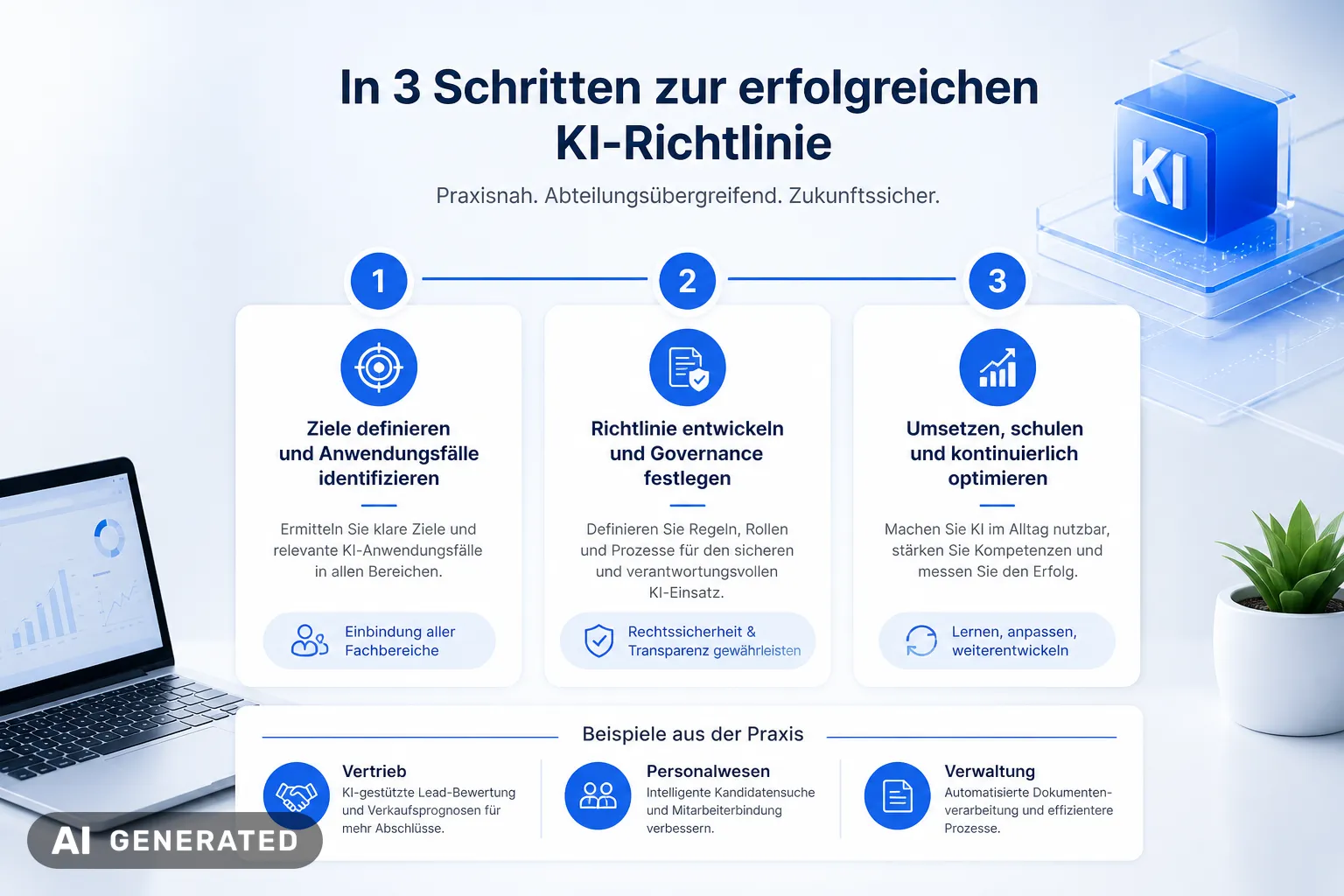
A practical case: Marketing wants to use generative AI for product texts. The AI rules should specify which tool is allowed, which inputs are off-limits, and who approves the results. If any of these answers are missing, the deployment remains blocked.
A policy must answer a specific work question. "Can I enter customer data?" beats ten pages of general guidelines.
Training is essential during the introduction. Show a short exercise with an allowed request and then one with personal data. That sticks. A PDF in the intranet is of little use if it gathers dust among travel expense forms.
Review the guidelines after each new tool or process change. The University of Freiburg last updated its policy in May 2026. This discipline is also needed for your AI policy.
AI policy generator for companies
A generator saves time on the first draft but does not replace data protection checks or clear operational decisions.
For a company AI policy it offers structure instead of blank pages. KIT refers to a policy generator from the University of Bamberg and a form generator. Such templates are particularly helpful when teams need to document rules for teaching, research, or administration for the first time.
How to use a generator effectively
- Choose specific use cases, such as text drafts in sales or protocols in administration.
- Answer each query with your actual guidelines on data, approvals, and allowed tools.
- Review the draft with IT, data protection, and the departments before publication.
The most common mistake: A team adopts the generated text unchanged. Then it might say "no sensitive data," but no one knows if customer numbers or application documents are included.
A generator creates the framework. Your actual workflows turn it into a usable AI usage guideline.
In my opinion, every template should clearly answer three questions: Which system is allowed? What content is excluded? Who approves results? Those searching for "company AI rules" don't need a text desert. Three clear answers help more than twelve general prohibitions.
With generative artificial intelligence, especially: The draft is just the beginning. Adapt the policy to your usage and update it as soon as new systems or processes are added.
FAQ
Conclusion
An AI policy doesn't magically prevent mistakes. However, it ensures that your team knows the boundaries and who makes decisions before deployment.
A good guideline answers three questions: Which tool is allowed, what data is excluded, and who reviews critical results?
The most common mistake is a PDF that disappears after publication. Honestly: Then the best wording helps no one. The rules must appear where work happens, such as in onboarding, the intranet, and tool approval.
- Appoint a responsible person to consolidate changes from IT, data protection, and departments.
- Review your AI usage guideline after each new application purpose, not just after an incident.
- Test rules with a real case, such as a sales proposal with customer data or an application overview.
I think a policy can be short. Ten understandable rules beat 30 pages of legalese. For applications affecting applications, loans, or customer decisions, however, it alone is not enough. Documented reviews and human oversight are needed there.
Start with the tools actually used. Add clear prohibitions and approvals. Then train the team on it. This turns a document into a rule that holds up in everyday life, even when the next chatbot is "just being tried out" again.
Choosing AI tools without buying new risks
If public chatbots are off-limits for you, ChatGPT alternatives can help find suitable tools. Check three points:
- Data processing
- Access rights
- Location of storage
A good range of functions doesn't save an application that mishandles customer data.
AI competence for schools, teaching, and further education
The page on AI for Teachers shows why clear rules are necessary in educational institutions too. Teaching and research have different requirements compared to sales. Especially with generative AI, sources, individual contributions, and handling of results must remain transparent.
Further questions that arise after the policy
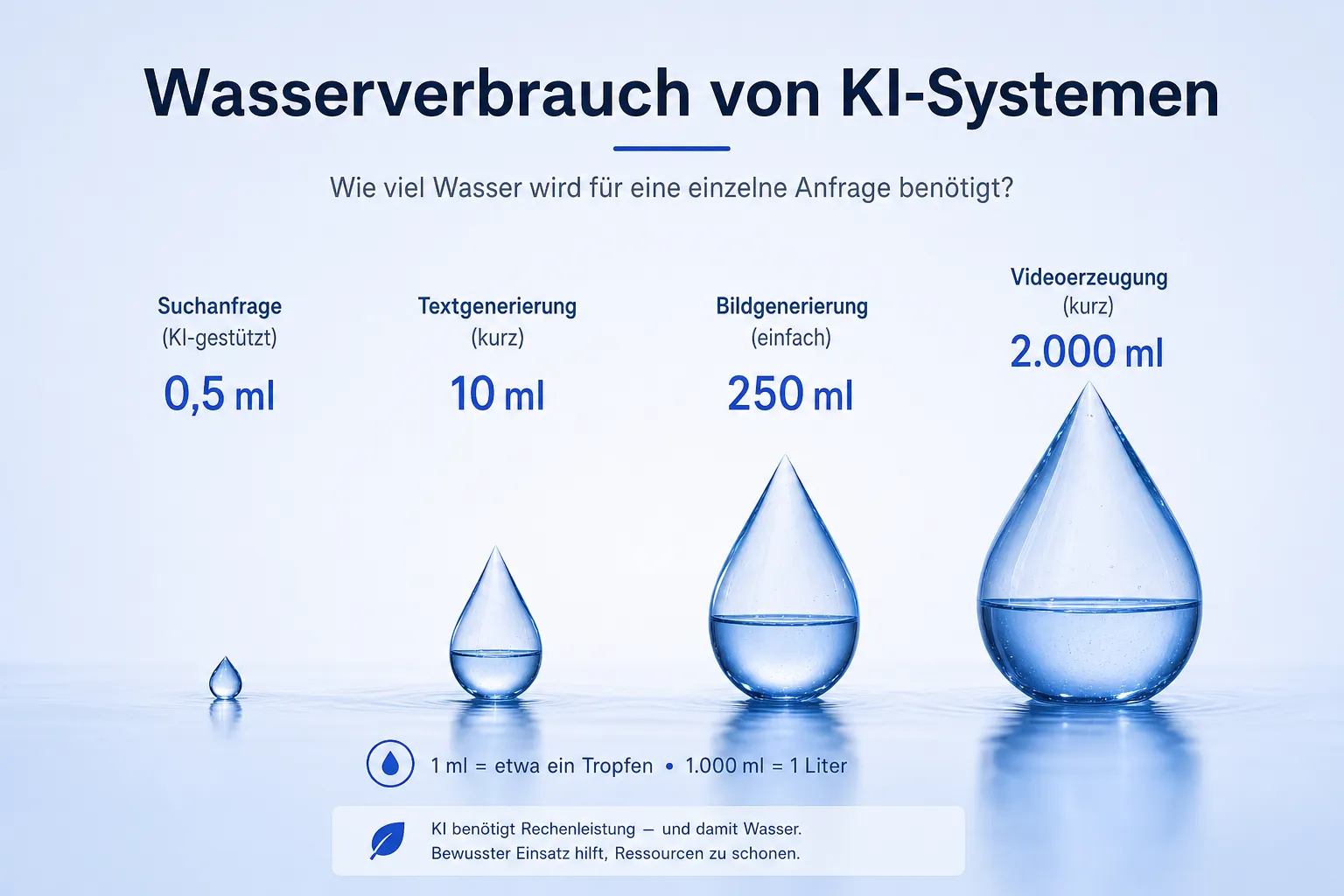
Using AI in everyday life quickly introduces new topics. These include recognizing fake videos, developing a social media content strategy, and key factors for change management success. AI's water consumption should also be on the agenda when companies want to evaluate the use of artificial intelligence not just legally, but practically.
Honestly: Don't read everything at once. Start with the article that best fits your next use case. This way, a policy becomes genuine guidance step by step.
You might also be interested in
Sources
- Policy on the use of generative AI in research – University of Freiburg
- KIT - ZML - Digital Teaching - Tools & Technology - Generative AI - AI Policy & Form Generator
- Using AI safely: Why every company needs an AI policy - trurnit GmbH
- The AI Policy of TIB: Guidelines for the use of Artificial Intelligence systems - TIB Blog
About the author

Tim Geier
Tim & AIHe is a trained media manager working hands-on with AI: Tim helps companies roll out AI securely and GDPR-compliantly, turning complex AI topics into clear, actionable steps.
This article was written by Tim together with AI.
Weekly AI news in your inbox
New models, practical tips & expert insights — free for everyone.
Related articles
ChatGPT's Water Usage: What a Query Really Costs
ChatGPT's Water Usage: Why 500 ml Doesn't Apply Per Query and What Factors Really Determine AI Water Demand.
AI in Business Use 2026: Leitfaden für Unternehmen
Erfahren Sie, wie Sie AI im Business 2026 sicher und DSGVO-konform integrieren. Maximieren Sie Effizienz und Produktivität mit innoGPT.

What can generative AI really do? The complete overview for European companies
Find out what AI can do for your business: practical insights into generative AI in Europe, opportunities and risks.