
**TL;DR:**Since February 2, 2025, Article 4 requires companies to foster AI competence within their teams. Since the Digital Omnibus of July 2026, the focus is on proving that you have implemented appropriate measures.
The Article 4 AI Regulation isn't just about high-risk systems. As soon as employees use AI for writing, analysis, or decision-making, you need a clear and understandable plan.
What practically changed in 2026
The Digital Omnibus of July 27, 2026, softened the wording. Companies don't have to guarantee identical competence levels. They must implement measures to promote competence and demonstrate their adequacy.
- Assign specific AI systems to particular roles and teams.
- Train on risks, limitations, and verification steps relevant to each application.
- Document participation, content, and repetition intervals in writing.
A certificate alone proves little. An audit trail with roles, systems, and training content is a better proof.
With the AI Regulation Article 4 there is no fixed number of hours and no general certification requirement. A sales team needs different knowledge than IT. Those creating offers with generative AI must review results and protect confidential customer data.
Standard slides for everyone are the easiest but weakest solution. Article 4 AI Regulation EU requires relevance to actual use. Otherwise, training is just a PDF with an attendance list, a compliance theater with poor execution.
What does Article 4 of the AI Regulation require?
Article 4 doesn't demand a certificate exam. It requires providers and operators to take specific measures to promote AI competence.
Since the adjustment by the Digital Omnibus in July 2026, a guaranteed level of knowledge isn't the focus. What's crucial is whether your company demonstrably imparts appropriate knowledge. The AI Regulation Article 4 evaluates the context of use, not the prettiest participation certificate.
- Consider technical knowledge, experience, and previous training of the individuals involved.
- Include the risks and limitations of the AI systems used in the content.
- Explain when human review remains necessary.
- Align measures with the intended audience for the results.
Those who incorporate AI outputs unchecked into offers, personnel decisions, or legal documents haven't grasped the core issue.
A specific case: A team creates offer drafts with generative AI. The training doesn't need to explain technical model architectures. It must show how employees protect customer data, recognize fabricated statements, and document approvals.
The Article 4 AI Regulation EU doesn't prescribe fixed training hours or a general certification. It also doesn't impose a separate penalty just for lacking AI competence. However, it becomes challenging during audits if no measures are evident.
Honestly: A one-hour standard video for the entire company barely fulfills the intent behind Article 4 AI Regulation. It proves attendance, but not competence related to actual use.
Who is affected by Article 4 of the AI Regulation?
It's not just AI developers who are affected. The obligation applies to any company that offers, operates, or allows employees to use AI systems.
The Article 4 AI Regulation EU covers providers and operators. An operator is also a company that uses a purchased system in everyday work. You don't need a self-built model for this.
- Sales teams using AI for offer drafts, emails, or customer analysis.
- HR departments creating job postings or pre-sorting applications.
- IT teams running internal chatbots, knowledge databases, or automations.
- External service providers working with AI systems on behalf of your company.
A specific example: The marketing department creates product texts with a text assistant. The obligation affects those writing prompts and publishing results. The same applies to the manager approving the use.
Anyone using AI on behalf of the company should be considered. Job titles don't matter much here.
The AI Regulation Article 4 doesn't differentiate between a corporation and a ten-person business. The key is the application. A private chatbot test without work relevance doesn't fall into the same category. However, when customer data, internal documents, or decisions are involved, the distinction becomes thin.
I find many companies overlook their specialized departments. They train IT while sales and HR are already using AI daily. That's often where mistakes occur: fabricated statements in offers or sensitive data in the wrong prompt.
How can companies impart AI competencies?
Don't start with a standard presentation for everyone. Role-specific exercises are more effective because sales, HR, and IT deal with different risks.
The Article 4 AI Regulation EU requires appropriate promotional measures since the revision of July 27, 2026. A certificate doesn't replace practice. If employees continue to copy customer data into unauthorized tools after training, they've learned nothing.
- Document used systems: Note tool, department, task, and processed data.
- Assign roles: Prompt creators need different knowledge than managers approving AI results.
- Train real work situations: Have marketing review a product text and mark unsupported claims.
- Practice limitations: Show when a result should be discarded, reviewed, or decided by an expert.
- Repeat with changes: New models, data sources, or automations require a brief introduction.
AI training only takes effect when employees know in their daily work: What data can go in, what result needs review, and who makes the decision?
A practical example: The HR team creates job ads with a text assistant. The exercise doesn't cover model architecture. It covers discriminatory language, confidential applicant data, and human approval before publication.
With AI Regulation Article 4 this relevance to use is more important than a general AI quiz. Honestly, ten slides about neural networks won't help anyone with the next sensitive prompt.
For internal knowledge assistants, a short workshop directly on the approved system is recommended. innoGPT focuses on concrete team cases instead of canned theory lessons.
What training options are there for AI competencies?
A participation certificate alone isn't enough. For the AI Regulation Article 4 it's crucial that the offering fits the specific application.
Three formats cover different situations. Combine them to avoid subjecting employees to the same slide show.
- Basic training is ideal for teams using text assistants or internal chatbots for the first time.
- Role workshop is suitable for sales, HR, or marketing, as real inputs and verification steps are practiced here.
- Specialist training is necessary for IT, data protection, and managers for automations, data connections, or approval decisions.
Choose the format based on the task, not the prettiest certificate.
A real-world example: Marketing uses AI for product descriptions. In a 60-minute workshop, you'll cover source verification, brand approval, and handling prohibited customer data. A general video about artificial intelligence won't solve these issues.
At the Article 4 AI Regulation EU there are no set training hours or mandatory exams. Since the amendment on July 27, 2026, the focus is on promotion. Honestly, this isn't a free pass for cheap one-off webinars.
Check three points before booking: Does the offer work with your systems? Does it address your data and risks? Is there an exercise or guideline left after the session? If any of these are missing, the training is more for the calendar than the workday.
How can compliance with the requirements be demonstrated?
For oversight, a fancy folder doesn't count, but a traceable audit trail. You need to show which people use which AI systems and what promotion took place.
Don't wait to create evidence until someone asks for it. Since August 2, 2026, practical oversight has become significantly more relevant.
- Maintain a register with AI system, department, task, and responsible person.
- Assign each role the risks and learning content addressed.
- Store participation, exercises, results, and training materials centrally.
- Record when you review content for new tools or processes.
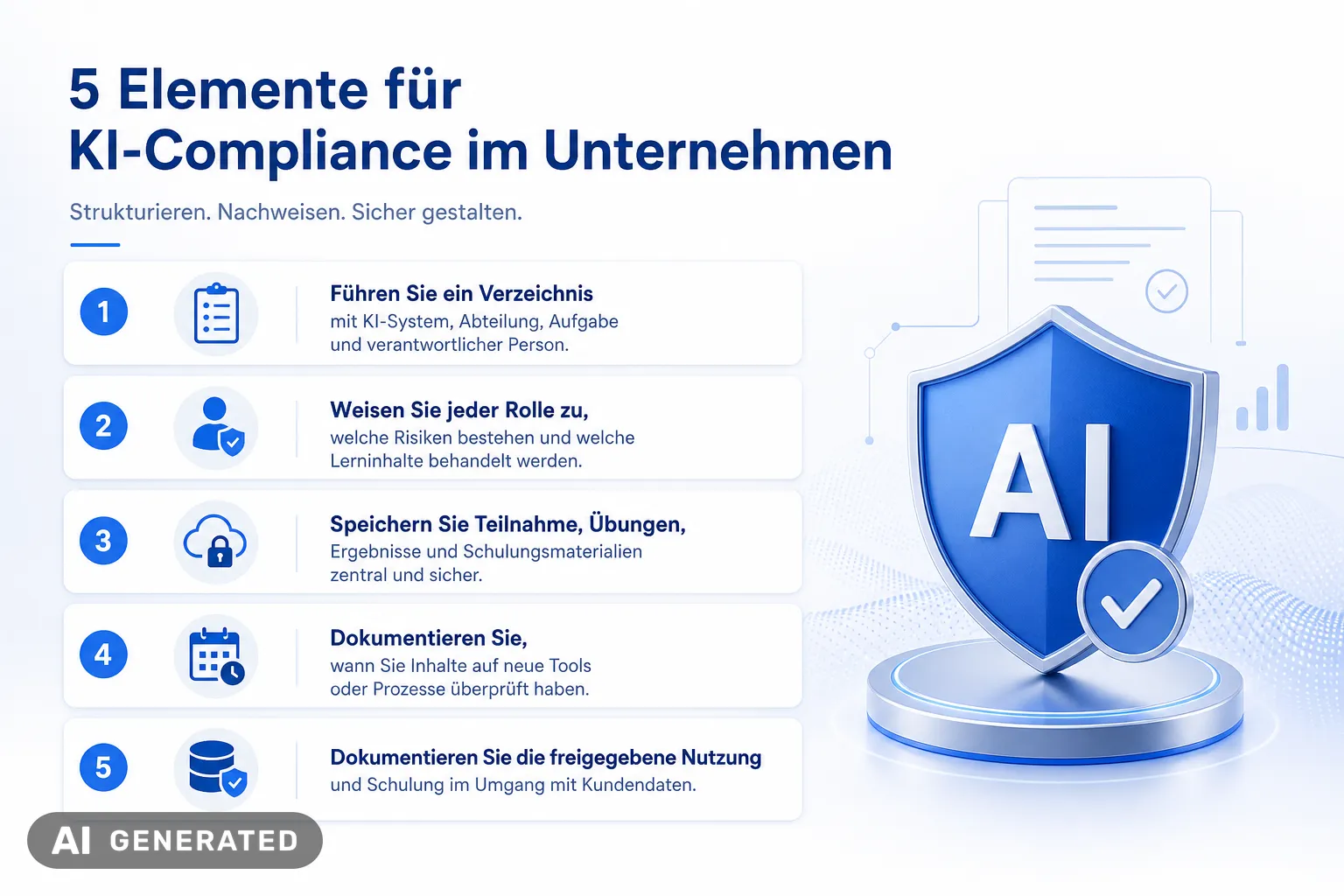
An example: Sales uses a text assistant for proposal drafts. Document the approved use, training on customer data, and an exercise on source verification. Include the date, participants, and the responsible manager.
An attendance sheet proves presence. An audit trail proves that your promotion matches the actual AI usage.
The AI Regulation Article 4 doesn't require a uniform exam. A certificate alone proves little. It's better to randomly check real work outcomes. If personal data still appears in unapproved systems, it's not paper that's missing, but competence.
For the Article 4 AI Regulation EU, a one-time documentation isn't enough. New systems, new data sources, or new roles require updates. Honestly, many companies fail at this because their AI register is never reopened after the first workshop.
Practical examples for implementing Article 4 in small and medium-sized enterprises
SMEs don't need elaborate compliance projects. They need clear everyday rules. This is where the AI Regulation Article 4 shows its impact in daily operations.
A craft business with 35 employees uses a text assistant for offers and site reports. Management sets three rules: No customer data in public AI tools, drafts are always reviewed by a professional, approved templates are stored centrally in the team folder.
- Sales creates an offer with fictional customer data and checks prices, scope of services, and disclaimers.
- Administration creates a meeting report and marks statements that shouldn't be included without original notes.
- IT documents which systems process data and who grants new access.
Start with the AI use that's already happening. Uncontrolled chatbot use is more urgent than the perfect training plan.
A mechanical engineering company with 120 people takes a different approach. It separates office, design, and service. Designers may only use AI for internal research. Service staff can draft responses but must not enter machine data or customer tickets.
For the Article 4 AI Regulation EU this separation counts. A joint presentation for all roles misses practical application. Honestly, this is where many companies fail: They train terms but not decision-making on the screen.
In my experience, a pilot with one department works better than a blanket approach. After four weeks, the manager reviews three real outcomes. If prohibited data or unchecked statements appear, the company immediately adjusts rules and exercises.
FAQ
Conclusion
AI competence isn't a certificate project. The Article 4 AI Regulation requires you to promote appropriate competence and document your efforts. For companies, it's not the pretty participation certificate that counts, but the connection between system, role, and actual use.
My advice: Treat the AI Regulation Article 4 like any useful work instruction. First, record which systems are in operation and what data they process. Then assign each role specific rules and a suitable exercise. Finally, collect training evidence, version statuses, and approvals in an audit trail.
- Maintain an AI register: Record system, purpose, data types, and responsible persons.
- Assign roles: Sales, HR, IT, and managers need different knowledge.
- Document practice: Record exercises, test rules, and refreshers directly on the respective system.
Those who transparently document risks, roles, and learning measures fulfill the obligation better than with a standard slide for everyone.
A PDF with forty slides unrelated to the workflow hardly helps in an audit. That's compliance theater, just without applause. If support processes customer data in a new assistant in the future, update the register, role matrix, and instructions before starting.
The Article 4 AI Regulation EU allows room for measures. This room ends where companies can no longer explain their AI use. In my opinion, that's the practical core: Don't train everything, but empower the right people for their real tasks.
These topics are next
- Transparency obligations of the AI Regulation: Check when users need to know they're working with AI content or a system.
- Labeling requirements under AI Regulation: Clarify which AI-generated texts, images, or media your company must label.
- AI register for companies: Record systems, purpose, data types, responsible persons, and internal approvals in one place.
- AI risks in the HR sector: For candidate selection or performance reviews, general prompt rules are no longer sufficient.
Those searching for “AI Regulation Article 4” rarely need just one training. The key is the interplay of usage, documentation, and clear rules.
A typical stumbling block: Marketing uses an image generator while support tests an assistant with customer data. Both uses need different rules. The first often involves labeling and rights. The second additionally involves data protection, access, and response checks.
The search for “Article 4 AI Regulation EU” doesn't end with a participation certificate. Companies do better with a few clear processes than with a thick compliance folder that no one opens.
You might also be interested in
- AI in the workplace
- AI transparency obligations
- ISO certifications for AI platforms
- What does compliant mean
Sources
About the author

Tim Geier
Tim & AIHe is a trained media manager working hands-on with AI: Tim helps companies roll out AI securely and GDPR-compliantly, turning complex AI topics into clear, actionable steps.
This article was written by Tim together with AI.
Weekly AI news in your inbox
New models, practical tips & expert insights — free for everyone.
Related articles

AI Data Center 2026: EU-Hosting Vorteile
Erfahren Sie, wann sich EU-Hosting für AI Data Center lohnt. Entdecken Sie Vorteile und Best Practices. Jetzt mehr erfahren!
From idea to intelligent chatbot: deploying generative AI securely in your business
Learn how to build your own chatbot and deploy generative AI securely in your business. Practical, clear, and without high barriers to entry.
Programming Your Own AI: A Beginner's Guide
Learn how to program your own AI. Discover proven step-by-step guides, tools, and real insights for your first AI project.