TL;DR: EU Hosting is worthwhile if your company processes personal data, internal knowledge, or regulated processes with AI. Key factors include data location, contractual agreements, access control, and available computing power.
A AI data center is more than just a server hall with a new label. It provides the infrastructure for compute-intensive AI workloads like document analysis, custom assistants, or automated protocols.
In 2025, Germany had 2,980 MW of data center capacity, with 530 MW for AI. By 2030, this is expected to reach 5,000 to 5,500 MW.
EU Hosting isn't a privacy stamp. It must technically and contractually fit your data flows.
When choosing, consider four questions to prevent your team from only shopping based on GPU numbers:
- What is an AI data center? An infrastructure for high computing power, dense hardware, and specialized cooling technology.
- What does an AI data center cost? Electricity, cooling, and reserved capacities shape the costs more than the server price.
- What does an AI data center consume? Globally, data centers consumed around 485 TWh of electricity in 2025.
- Check with AI Hosting Germany to ensure data, backups, and support access remain traceable within the EU.
An AI data center in Europe is particularly suited for HR, legal, and administration, where confidential content often lands in the system. For an AI implementation the hosting question should be addressed before the first pilot operation.
Locations like AI Data Center Munich or AI Data Center Leipzig play a role later. First, we clarify what technically sets such a data center apart from traditional infrastructure.
What is an AI data center?
What is an AI data center?
An AI data center is a specialized infrastructure that efficiently processes large amounts of data. It offers graphics processors, fast networks, storage, and power supply for demanding AI tasks.
What does an AI data center specifically do? It trains models, answers queries, and searches company knowledge. An internal assistant can process contract clauses, manuals, and protocols without employees having to switch between different tools.
- Accelerator chips enable parallel AI operations.
- Direct network connections ensure continuous data flow between servers.
- Efficient cooling removes heat from densely packed racks.
- Access rights and protocols govern the use of data, models, and results.
This is not a technical toy. According to the Uptime Institute Survey 2026 the most common rack density is now over 11 kW, with peaks of 30 kW or more. Traditional server rooms are often unsuitable for this.
An AI data center doesn't buy 'smart AI'. It creates the conditions for AI to work reliably under load.
If you're wondering, what does an AI data center cost, don't just look at the graphics processors. Costs arise from electricity, cooling, network connection, and reserved computing capacity. It's also important to consider how much an AI data center consumes, especially with constantly running models.
An AI data center in Europe or AI hosting in Germany is sensible when dealing with confidential data. For GDPR-compliant AI you should check the data location, backups, and support access. This is part of the AI implementation, not just after the first productive queries.
Differences between AI data centers and traditional data centers
The difference isn't in the sign on the door, but in the load. Traditional data centers typically run email, ERP, databases, and virtual servers. AI workloads demand parallel computing power, fast data paths, and significantly more power per rack.
What makes an AI data center different?
- Hardware: GPUs and AI accelerators perform many operations simultaneously, CPUs handle more general server tasks.
- Network: Models move large amounts of data between storage and computers, slow connections hinder training.
- Cooling: AI data center cooling must dissipate dense hardware, air alone often isn't enough at high loads.
A concrete example: An ERP server processes bookings sequentially. A document assistant, on the other hand, searches thousands of pages, creates responses, and uses a language model in parallel. This requires infrastructure with short paths between storage, network, and accelerator chips. The Uptime Institute Survey 2026 shows why this is relevant: High rack densities are now part of everyday operations for AI.
A traditional data center doesn't become an AI site with just a few GPUs. Power supply, network, and cooling must grow with it.
If you're asking, what does an AI data center consume, don't just look at the server. Power for graphics processors, cooling, and network technology determines the bill. These factors drive AI data center costs more than the pure hardware list.
For companies, the use case is ultimately what counts. Custom knowledge assistants, like AI agents on your own server, have different requirements than an internal wiki. For personal contracts, a GDPR-compliant AI should be directly part of the architectural decision. Otherwise, AI implementation quickly becomes an expensive remodeling project.
Energy consumption and cooling in the AI data center
Power and heat are crucial for the economic operation of an AI infrastructure. The GPUs are just the visible part of the bill.
What does an AI data center consume?
Computing power, network technology, storage, and cooling simultaneously draw energy. Globally, data centers consumed around 485 TWh of electricity in 2025. For 2030, the IEA expects about 950 TWh, reports Gradually.ai.
With AI workloads, the load increases particularly quickly. According to Uptime Institute Survey 2026More and more racks are reaching 30 kW or more. Traditional air cooling simply hits its limits there.
- Air coolingis suitable for lower rack densities and existing server rooms.
- Liquid cooling carries heat away closer to the accelerator chips.
- The power supply must handle peak loads without endangering other systems.
If you only buy GPUs but forget about power and cooling, you're buying very expensive heaters.
Thecooling in an AI data centerdirectly affects the costs. Anyone asking about the cost of an AI data center should not just look for a hardware price. Network connection, cooling technology, space, and long-term operation are also crucial.
For many companies, AI implementation is not a case for their own hardware. AI hosting in Germany uses existing infrastructure and prevents a medium-sized team from suddenly becoming a data center operator. For sensitive data, the location question still belongs in every assessment for GDPR-compliant AI.
Locations of AI data centers in Germany
When it comes to location, it's not the postal code that counts, but electricity, fiber optics, and available space. If one of these points is missing, the AI project quickly becomes an expensive waiting room.
AnAI data center in Munichbenefits from industry, research, and many potential users on-site. According toTagesschau, Telekom is building an AI factory there for industrial applications. This is relevant for workloads with short data paths, such as machine images or production data.
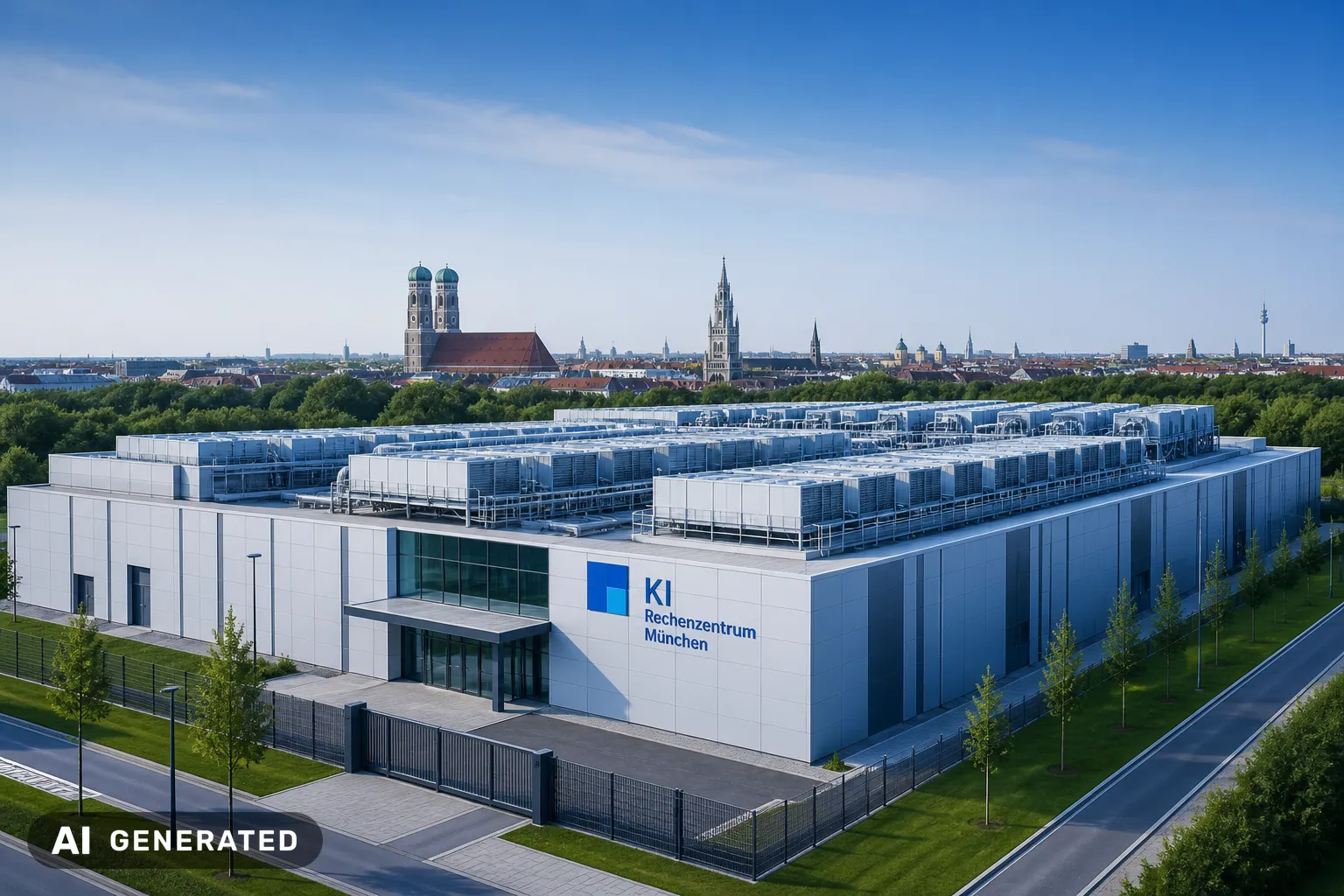
AnAI data center in Leipzigshould be evaluated according to the same strict criteria. Don't just check the rental price. Get written confirmation of network connection, expansion time, and planned cooling in the AI data center.
- Choose locations with confirmed power capacity for your planned workloads.
- Check fiber optic connections to data sources, the cloud, and company locations.
- Request information on redundancy, access, and data processing in Germany.
A location without secure energy planning is not AI infrastructure but a risk with server racks.
ForAI hosting in Germany, the question of location remains relevant even for smaller teams. Anyone runningAI agents on their own servershould document data access and operator roles clearly. ForAI in logistics, short paths to storage and sensor data also matter.
In my opinion, location assessment should be a fixed part of every AI implementation. It prevents later modifications and supports GDPR-compliant AI before sensitive data ends up in the wrong data center.
AI hosting in Germany
AI hosting in Germanyis sensible when internal documents, customer data, or personnel information are processed in AI workloads. The server location alone is not enough. Contract, access rights, and operator roles must also be right.
Practical for German companies: An assistant summarizes sales protocols without employees having to copy files into public chatbots. Otherwise, shadow IT arises there. A clean AI implementation clarifies data flows before the first production test.
How do you recognize suitable hosting?
- **Data processing:**The provider names the data center, subcontractors, and storage locations in writing.
- **Access:**Roles, protocols, and multi-factor authentication limit who can see internal data.
- **Capacity:**Check guaranteed GPU resources for your workloads, not just vague cloud promises.
- **Exit:**Clarify in advance how data, models, and protocols will be exported when changing providers.
A German location without a data processing agreement does not solve a data protection problem. It just moves it to another building.
What is an AI data center for your project? The technical foundation for training, document analysis, or AI agents. What makes an AI data center economically viable? It provides computing power where it is needed in a controlled and predictable manner.
ForAI data center costs, it's not just about the hardware. Anyone asking, "what does an AI data center cost," must factor in electricity, network connection, personnel, andAI data center cooling. What does an AI data center consume? Exactly these infrastructure components run continuously alongside the chips.
An AI data center in Europe offers shorter legal paths and data processing within European frameworks. European capacity is expected to reach almost 21 GW by 2031, reports theWeser-Kurier. Honestly: For sensitive processes,GDPR-compliant AI is more important than the cheapest GPU hourly rate.
Outlook on AI data centers and their development
Power, cooling, and network connections are the decisive factors for the coming years. AnAI data center in Europewill not be competitive with just pretty server photos, but with available energy and short construction times.
Global data center capacity is expected to grow from 88 GW in 2025 to up to 340 GW by 2035. AI could then account for nearly 60 percent of the total data center load, reportsRoland Berger. This significantly increases the pressure on European infrastructure.
- Liquid coolingis increasingly replacing pure air cooling at high rack densities.
- Modular construction expands capacities without building a completely new data center.
- Long-term electricity contracts are becoming more important for companies than just the GPU price.
The Uptime Study 2026 already reports peak rack densities starting at 30 kW. That's precisely why AI data center cooling is becoming a planning issue. A rack packed with accelerators won't tolerate a makeshift air conditioner from the hardware store.
If you're planning AI capacity for three years, you need to contractually evaluate power, cooling, and expansion space together.
How much does an AI data center cost? You can't get an honest figure without considering location and load profile. In terms of AI data center costs, network connection, power supply, and cooling often cost more than expected.
What does an AI data center consume? Besides electricity, it also requires space, water for certain cooling concepts, and a lot of planning time. Therefore, for companies, the specific application counts: AI implementation should be carefully planned first, then capacity booked. For document-based processes, GDPR-compliant AI is often more worthwhile than having your own hardware park.
I think many companies overestimate the benefits of having their own infrastructure. AI agents on your own server are suitable for constant, sensitive workloads. For AI in logistics, proximity to production data and locations often matters more.
FAQ
Conclusion
An AI data center is worthwhile not because of the label. It's worthwhile when data location, access rights, and computing power fit your specific application.
The wrong order would be: booking GPUs first, then clarifying data protection and processes. That produces expensive capacity for a pilot that fails due to missing approvals. Honestly, that's the boring part. And that's exactly why it often gets done too late.
Anyone processing personal data or internal knowledge checks data paths and contracts first. The hardware comes afterward.
These three questions determine the choice
- Does your team process customer files, personnel data, or contract documents? Then GDPR-compliant AI belongs on the technical checklist.
- Is the use case small and clear? Start with a defined process, such as proposal drafts or meeting minutes.
- Do you need your own data access and automated processes? Consider AI agents on your own server instead of public AI services.
What makes an AI data center valuable in the end? Not maximum hardware, but controllable workloads. A logistics operation needs quick evaluations and clear permissions for dispatch data. For that, AI in logistics provides more guidance than a server data sheet.
In my opinion, every AI implementation should start with a test run. Measure processing time, error rate, and access paths. Only when these values are right does the larger infrastructure pay off. Then computing power truly becomes an efficiency revolution with AI, rather than just another IT project.
Sources
AI Data Center Germany – Private and Hybrid AI | BADEN CLOUD®
AI Data Centers: Germany and Europe significantly behind the USA
Artificial Intelligence: Telekom launches massive AI factory for the industry
Why OpenAI isn't building an AI data center in Germany
What features distinguish an AI data center from traditional data centers?
About the author

Tim Geier
Tim & AIHe is a trained media manager working hands-on with AI: Tim helps companies roll out AI securely and GDPR-compliantly, turning complex AI topics into clear, actionable steps.
This article was written by Tim together with AI.
Weekly AI news in your inbox
New models, practical tips & expert insights — free for everyone.
Related articles
ChatGPT Enterprise License 2026 Vorteile
Entdecken Sie, wie die ChatGPT Enterprise License 2026 Ihr Unternehmen unterstützen kann. Erfahren Sie mehr über Vorteile und Anwendungsfälle.

ChatGPT Email Write: Effizient 2026 nutzen
Nutzen Sie ChatGPT, um 2026 effizient E-Mails zu verfassen. Entdecken Sie Vorteile und Tipps für Ihr Unternehmen. Jetzt mehr erfahren!
Talk with Chat GPT: Der Guide für 2026
Entdecken Sie, wie Sie 2026 mit Chat GPT kommunizieren können. Erfahren Sie Tipps und Vorteile für Ihr Unternehmen. Jetzt informieren!