AI in the Classroom: How Teachers Revolutionize Teaching with Secure Generative AI
Learn how AI for teachers is deployed safely and GDPR-compliantly – and how it helps you teach more efficiently.
tl;dr:
- Your digital teaching assistant: Generative AI takes over routine tasks like lesson planning or creating worksheets, giving you back valuable time for your students.
- Data protection first: Using AI in schools is only safe and legally permissible with GDPR-compliant solutions like InnoGPT. US tools are a no-go due to data protection concerns.
- Ready to go immediately: You can use generative AI right away to create creative content. There's no need to upload your own or student-related data to do so.
How AI Becomes Your Digital Assistant in the Classroom
Imagine you're conducting an orchestra. With your pedagogical sensitivity, you ensure perfect harmony in the classroom. And now you're handed a new, incredibly versatile instrument: generative AI. No, it doesn't replace you as the conductor – it enriches your composition and produces sounds that were previously barely imaginable.

This article is your practical guide to confidently mastering this tool. We'll clear up myths and dive straight into practice. You'll see how to enlist generative AI for teachers as a tireless helper to take your instruction to a new level – without getting lost in the data protection jungle.
The Swiss Army Knife for the Teacher's Daily Life
The biggest hurdle in many colleagues' minds? The supposed complexity. But the truth is: you absolutely don't have to be a tech guru to get started! Modern AI applications are often as intuitive as writing an email. It's not about understanding code – it's simply about asking the right questions.
Think of AI like a Swiss army knife that hands you the right tool in countless situations at lightning speed.
- The creative spark: need a gripping intro to the topic of volcanism? The AI delivers three exciting suggestions in seconds.
- The phrasing artist: the parent letter for the next field trip needs to go out? Give the AI the basics and zap – you have a ready-formulated, professional text.
- The differentiation pro: a worksheet needs to cover different performance levels? The AI conjures variants for stronger and weaker students in no time.
Your Role Becomes More Important, Not Smaller
The fear of being replaced by a machine is widespread. But honestly: this worry is unfounded. AI is no replacement for pedagogical competence, empathy, and experience – it's an amplifier. It takes over tiresome routine tasks and thereby creates space. Suddenly, you have more time for what really counts: the individual development of your students, personal conversations, the pedagogical relationship work.
Your job as a teacher is shifting more and more from being a pure knowledge provider to being a learning coach. The AI supplies the building blocks, but you remain the architect of the learning process.
By learning to use this powerful tool confidently, you prepare not just yourself but also your students optimally for a future that will be significantly shaped by AI. It's about humanely shaping technology and using it sensibly.
Data Protection and AI in the Classroom: Why This Isn't a "Could," It's a "Must"
Before we dive headlong into the fantastic possibilities that generative AI offers us teachers, we have to talk about the absolute essentials: data protection. This isn't dry legal mumbo-jumbo – it's our fundamental responsibility. We work with the data of children and young people, and protecting it is our legal and ethical duty. Period.
Many of the well-known, often hyped AI tools from the US are a data protection nightmare for our daily school life. Why? Because the data often ends up on servers outside the EU. What exactly happens to it there is usually a sealed book and in many cases a flagrant violation of the General Data Protection Regulation (GDPR). That exposes not just you but your entire school to a huge legal risk. We simply shouldn't subject ourselves to that.
The Pitfall: US Tools and Their Traps
As so often, the devil is in the details. The terms of use run to pages and are impenetrable, the data flows are hard to trace, and the servers sit in countries where data protection is handled differently – and usually more loosely. Every single input, be it a harmless question for a quiz or the draft of a worksheet, could in theory contain sensitive info that then wanders across the pond. Anyone who wants a feel for the basic requirements can find them in a foundational privacy policy, for example.
In the education sector, there are no compromises when it comes to our students' data. Legal certainty is the ticket that allows us to deploy AI sensibly and without a knot in the stomach in the classroom.
The Solution Is Closer Than You Think: European GDPR Platforms
And this is exactly where European, GDPR-compliant solutions like InnoGPT close the decisive gap. Such platforms are built specifically to give schools and teachers the legal certainty they urgently need to use AI in the classroom.
What does that concretely mean?
- EU hosting: your data stays here! Everything is processed exclusively on servers within the EU and is thereby subject to the strict rules of the GDPR.
- Zero-retention policy: what you enter stays yours. Your prompts and the AI's answers are not stored or misused to train the model. That's your intellectual property.
- Crystal-clear data processing: you have full control and always know what happens with the data. Clear technical and organizational measures ensure everything is above board.
This legal certainty is the key that opens the door to the creative world of AI for us. It gives us the freedom to use the enormous benefits without constantly pondering data protection traps. Only on this secure basis does AI for teachers become what it's meant to be: real, exciting support for our daily lives.
5 Practical Examples: How Generative AI Revolutionizes Your Teacher's Day
Now we're getting down to business! Let's leave gray theory aside and dive straight into practice. Forget the countless hours at the desk – here come five brilliant use cases with which generative AI will really shake up your daily life as a teacher.
1. Lesson Prep in No Time
Hours of prep in the evening or on the weekend? Those days are over! Your new digital assistant can deliver complete lesson plans, creative intros, or gripping discussion questions in a few minutes. You retain full pedagogical control at all times, but save enormous amounts of time on research and structuring.
- Example prompt: "Create a lesson plan for a 9th-grade history class on 'The French Revolution.' Structure the 45 minutes into intro, development, and wrap-up. Suggest a creative method for the intro."
2. Differentiated Worksheets at the Push of a Button
Every student learns differently – we all know that. With generative AI, you can finally do justice to this diversity without burning the midnight oil. With just one click, create worksheets at different difficulty levels or with different levels of scaffolding.
- Example prompt: "Generate a worksheet with 5 math word problems on percentages for a 7th-grade class. Create three versions: an easy one with solution hints, a medium one, and a hard one with an additional problem for fast learners."
The efficiency booster: imagine you only automate the creation of worksheets and parent letters. You could easily gain two to three hours per week – valuable time you can invest directly in conversations with your students!
3. Individual and Constructive Feedback
Good feedback is one of the biggest levers for learning success, but it's also incredibly time-consuming. An AI can help you formulate constructive, motivating responses. It analyzes a text and gives you phrasing suggestions that specifically address strengths and point out concrete improvement potential without demotivating.
- Example prompt: "I have a student's essay here. Summarize the three biggest strengths and give me two friendly but clear phrasing aids for improvement suggestions on the argument structure."
4. Professional Parent Communication
Communication with parents is essential but can cost a lot of time. Whether it's invitations to parent-teacher conferences, info about a school trip, or the reply to a critical email – an AI helps you always hit the right tone. It provides professional, friendly text templates you only need to adjust briefly.
- Example prompt: "Write a short, friendly parent letter informing them about the upcoming field trip for class 5b. State the date, destination, meeting point, and what the children should bring."
5. Designing Fair, Creative Exams
No more repetitive tasks that only quiz rote memorization! Generative AI for teachers is a fantastic sparring partner for developing exam questions that test real understanding and skills. Have it create case studies, creative problem statements, or multiple-choice questions with genuinely plausible distractors.
- Example prompt: "Design three exam questions for 10th-grade biology on the forest ecosystem. One question should be a case study, one a transfer problem, and one a creative task to develop an infographic concept."
AI in the Classroom? Here's How to Turn Fears Into Real Opportunities!
Every new technology initially comes with a knot in the stomach. That's totally normal! Maybe thoughts are swirling through your head like: "Will AI soon make me redundant?", "Isn't all this far too complicated for me?", or "When am I supposed to learn all this?" These worries are absolutely valid, and you're definitely not alone with them.
But let's take another look at this together. This isn't about a machine replacing you and your work. Quite the opposite: generative AI is your personal super-booster for teaching! Think of it as a powerful tool that takes the time-consuming routine work off your plate. So you finally have more room for what really counts: the personal connection to your students.
Fear No. 1: "AI Is Going to Take My Job!"
This is probably the biggest concern weighing on many. But I can reassure you: your role as an educator, as a motivator, as someone who listens and individually guides learners, is irreplaceable. An AI can't dry tears, can't settle an argument, and certainly can't spark those bright eyes when a topic suddenly clicks.
Rather see AI as your tireless assistant. You keep the steering wheel firmly in hand and decide where the journey goes. AI takes over the routine, so you have the strength and the time to focus on what no machine can do – the human side of teaching.
AI is not a replacement – it's a liberator. It frees you from administrative ballast and gives you back the freedom to focus on the core of your profession: people.
Fear No. 2: "I'm Not a Tech Nerd – This Is Way Too Complicated!"
Do you have to be a tech genius for this? Absolutely not! Modern and above all secure AI platforms like InnoGPT are deliberately built to be dead simple to operate. You don't need any programming skills. Honestly: if you can write an email or search for something on Google, you're already well-equipped for handling AI.
It's not about understanding cryptic code. It's about your creative ideas and asking the right questions. The rest is often so simple and intuitive that you can get going immediately.
Fear No. 3: "I'll Lose Control Over the Pedagogical Content."
The skepticism among colleagues is huge – that's no secret. Current figures show that 62 percent of teachers feel insecure when it comes to using AI on the job. Many also worry that important social skills will atrophy when technology takes over. You can read more about the background of this teacher skepticism in this study.
But that's exactly why it's so important to see AI as what it really is: a tool under your full and sole control. You are and remain the gatekeeper for quality and pedagogical sense. Every single worksheet, every lesson plan, and every feedback that an AI suggests first goes through your hands and your critical eye. You decide what enters your classroom. The AI only supplies building blocks and ideas – you are the architect who shapes everything to your vision.
How to Use the Time You've Gained for More Humanity
Hand on heart: what would you do if you suddenly received two to three hours per week as a gift? Time you'd otherwise spend on admin and prep. It's precisely in this simple question that perhaps the biggest and most beautiful opportunity that AI for teachers brings is hidden. Because it's not just about efficiency – it's about rediscovering the core of our profession.
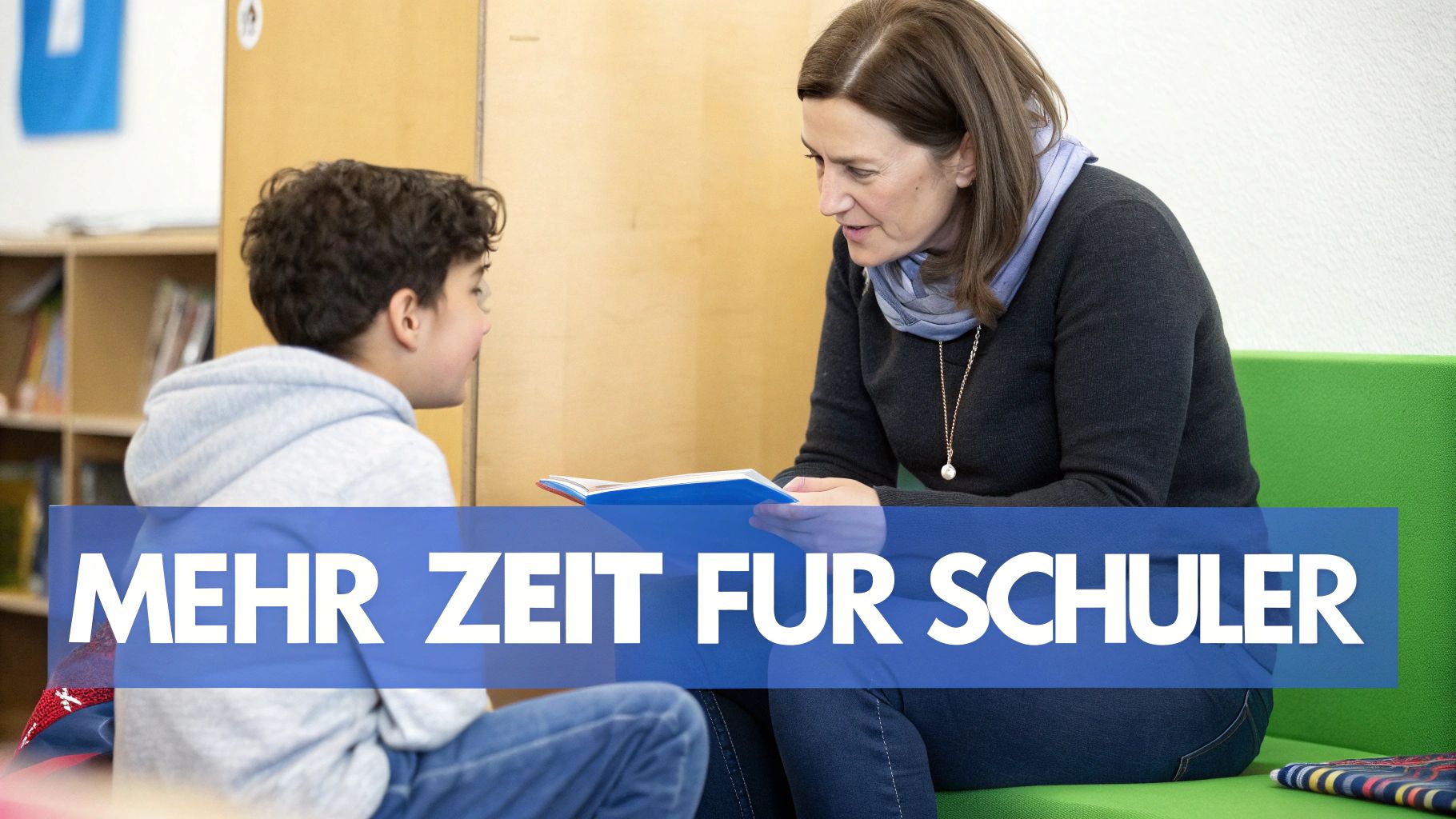
The math is stunningly simple. Just by AI-supported creation of teaching materials and automating parent communication, you can save several hours each week. With a GDPR-compliant AI assistant like InnoGPT, you can handle precisely these tasks in a fraction of the time.
From Time Waster to Quality Time
Let's play this out concretely. Assume you save just these two to three hours per week – which is absolutely realistic when you automate routines. And this time isn't an abstract value – it's your most valuable resource for what really counts.
What could you do with this time?
- Conduct individual student conversations: finally have the time for the five-minute hallway chat that often moves more than an entire class period.
- Launch creative projects: instead of just ticking off the curriculum, you suddenly lead exciting interdisciplinary projects that truly captivate your students.
- Foster social skills: you have more buffer for mediating conflicts, for practicing real teamwork, and for everything that strengthens class cohesion.
- Simply be more present: less stress from admin tasks means more mental space to truly attend to the moods and needs in the classroom.
AI isn't an end in itself. It's a tool that gives you the freedom to be more of an educator and less of an administrator. The technology handles the routine so you can focus on the human relationship.
The Student Perspective in Focus
But this newly won time isn't just a gain for you – it's above all a gain for your students. They immediately notice when you're more present and less rushed. By confidently using AI tools in the background, you also prepare your class quite naturally for an AI-shaped future. You show them how to use technology as a tool for problem solving without neglecting the pedagogical basics like critical thinking and creativity.
A Few More Questions? Here Come the Answers!
You made it this far – fantastic! You're probably already bubbling over with ideas on how to deploy AI as your new favorite classroom tool. But maybe a few questions are still buzzing in your head. That's totally normal!
This section is exactly for that. We've collected the most common questions from the teachers' lounge and give you honest, hands-on answers so you can start with a really good feeling.
Do I Now Have to Become a Tech Nerd to Use AI?
No, absolutely not! That's really the biggest misconception when it comes to AI for teachers. Modern, secure platforms like InnoGPT are deliberately built to be dead easy to use. Forget complicated code or technical jargon.
Let's be honest: if you can write an email or search for something on Google, you already have everything you need. The magic lies in having good ideas and asking the right questions – not in being a computer whiz. The technology is your tool, not the other way around.
What Data Am I Actually Feeding Into the AI?
Here we have to distinguish clearly. For 99% of your daily tasks – building worksheets, sketching out lesson plans, or drafting the next parent letter – you need no personal data at all. You just give the AI thematic instructions that are completely anonymous.
The golden rule: never, truly never, enter sensitive student data into an AI! Unless the tool was officially approved by your school as GDPR-compliant for exactly this purpose and contractually safeguarded. With data-protection-compliant solutions, you're on the safe side as long as you stick to general, anonymous tasks.
How Do I Ensure the AI's Output Is Pedagogically Sensible?
Simple: you remain the boss in the ring! The AI is your assistant, not your replacement. That's the decisive point. You, as an experienced teacher, always keep pedagogical control and the final decision.
View the AI's suggestions as an initial rough draft, a creative spark. Your task is then to polish, adjust, and perfectly tailor this draft for your class. Your subject matter expertise and your pedagogical gut instinct are irreplaceable. The AI provides the building blocks, but you are and remain the architect of your classroom.
Doesn't All This Technology Make Teaching Totally Impersonal?
A completely valid concern! But practice shows: the exact opposite is the case. When you use AI wisely, it takes over the time-consuming, repetitive routine tasks. And what do you gain? Time!
Suddenly you have more breathing room for what really counts: the personal relationship with your students. More time for a conversation in the hallway, for individual feedback, or simply for listening. The technology doesn't create more distance – it gifts you the freedom for more human closeness.
Enough theory? Ready to finally try out your personal teaching assistant yourself? Experience now how a secure, GDPR-compliant AI solution like InnoGPT wins you back precious time and takes your classroom to a new level.
Related articles
Talking with AI: Why Voice Interaction Is the Future – GDPR-Compliant
Discover how to safely talk with ChatGPT while staying GDPR-compliant. Practical tips for privacy-compliant AI communication.
Use ChatGPT – Safely: The GDPR-Compliant Alternative for Businesses
Learn how to use ChatGPT safely and avoid GDPR risks. Discover innoGPT as the GDPR-compliant alternative that protects your data.
App Development with AI: Secure Apps Without Coding Skills
Learn how to create an app with AI without coding—build secure, GDPR-compliant prototypes and internal tools.