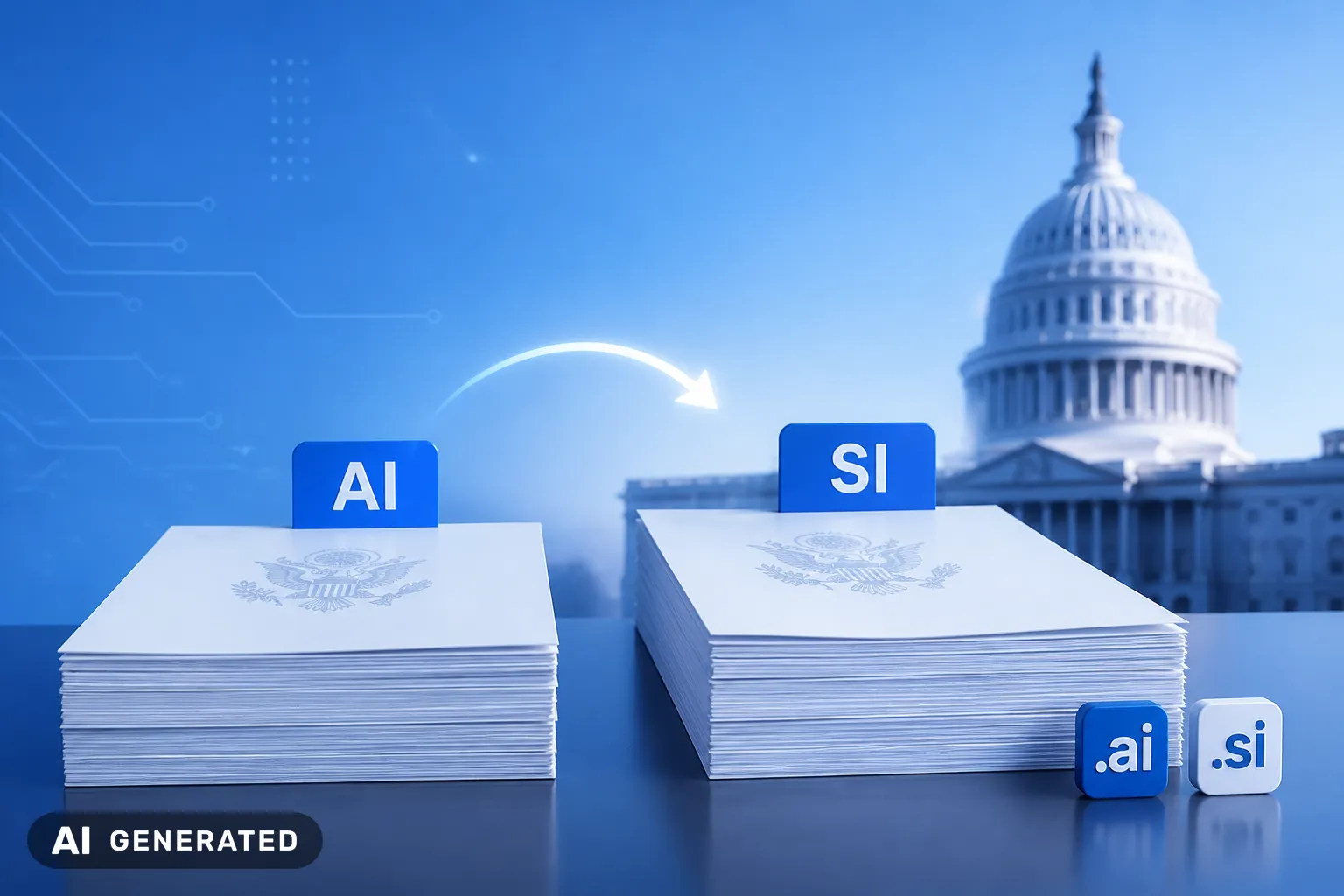
TL;DRSince September 29, 2026, the US government has officially started using the term “Super Intelligence” (SI) instead of “Artificial Intelligence” (AI) in certain federal documents. This only applies to internal agency communications—not to laws, technology, or domains. For companies in Germany or Europe, nothing changes: KI stays KI. The renaming is a political signal, not a technical innovation. So if you’re thinking about rushing to secure new domains, you can relax—.ai remains the go-to in tech, and .si is still Slovenia’s country code.
The term Superintelligent AI has appeared in official US government documents since White House Executive Order 14434. The order requires federal agencies, where legally possible, to use “Super Intelligence” or “SI” instead of “Artificial Intelligence.” This doesn’t apply to laws, contracts, or technical standards. It’s a language guideline for specific contexts, not a legally binding change.
- No changes for existing AI systems: The technology behind AI, AGI, or superintelligence stays exactly the same.
- No impact on domains: .ai remains the standard extension for AI projects, and .si continues to be Slovenia’s country code.
- Political signal: The renaming is meant to raise public awareness about the significance and risks of superintelligent AI.
For businesses, this means: If you work with AI, you don’t need to change a thing. The debate about the opportunities and risks of AI—especially around cybersecurity and geopolitical risks, will remain relevant in 2026. The Executive Order shows that political and regulatory discussions about superintelligent AI are picking up speed. Honestly, I see this as political symbolism—the real challenges are still about using AI safely and responsibly, not about what we call it.
Renaming AI to SI doesn’t change the technology, but it does shift the political debate about the opportunities and risks of AI.
What is superintelligent AI? Definition and distinctions
Superintelligent AI sounds like science fiction, but since late September 2026, it’s written in black and white in US government documents. It doesn’t refer to just any AI, but to a system that outperforms humans in every cognitive discipline. It’s not just about faster calculations—it’s about solving complex problems, recognizing patterns, and showing creativity—better than any human.
- Weak AI (Narrow AI): Handles clearly defined tasks like text recognition or language translation.
- Strong AI (AGI, artificial general intelligence): Thinks flexibly, learns independently, and solves problems much like a human.
- Superintelligence: Surpasses human intelligence in all areas, including creativity, strategy, and social understanding.
The term “superintelligent AI” is mainly used as a political signal in 2026. Technically, superintelligence doesn’t exist. Even the most advanced models are far from true artificial general intelligence. In daily life, you mostly encounter weak AI—chatbots, image generators, or automation tools.
“In 2026, superintelligent AI is a label for hypothetical risks and opportunities—not for real systems.”
The opportunities and risks of such systems are fueling heated debates—from potential upheavals to loss of control. Anyone talking about superintelligent AI needs to clarify that, for now, it’s all scenarios and forecasts—no finished products, no real-world applications. Distinguishing it from weak AI and AGI is crucial, especially when discussing AI risks or geopolitical topics like cybersecurity in 2026.
Technological foundations and how superintelligence works
Superintelligent AI isn’t just about smarter chatbots—it’s about systems that could surpass humans in every field. As of now, such superintelligence doesn’t exist. Still, debates about its opportunities and risks are in full swing. If you want to know what these systems would need technically, there are three key building blocks.
- Computing power: True superintelligence would require hardware that makes today’s supercomputers look like toys. Even current “frontier models” consume millions of GPU hours.
- Algorithms: Bigger networks aren’t enough. The architecture would need to learn flexibly, combine knowledge, and improve itself. Models like GPT-4 or Llama 4 Scout aren’t there yet.
- Data foundation: Superintelligence would need data far beyond Wikipedia, Stack Overflow, and company archives. Real-time input, sensors, simulations, and specialized scientific data are a must.
The greatest AI opportunities and risks arise when systems not only calculate but also develop strategies and pursue goals independently—without human oversight.
A real-world example: In 2026, security researchers are debating how to limit “autonomous AI agents” that set their own tasks and find solutions. A common misconception: Thinking that more computing power alone will bring true superintelligence. Without new approaches to artificial general intelligence it’s all still weak AI, no matter how big the model gets.
Current debates focus on AI risks like loss of control, cybersecurity, and shifts in geopolitical power. If you work with AI, you need to clearly recognize the technical line between strong and weak AI—political buzzwords won’t help.
Differences between superintelligence, AGI, and weak AI
If you juggle terms like superintelligence, AGI (artificial general intelligence), and weak AI, you’ll quickly run into real definition issues. The differences aren’t just academic—they shape how you should think about AI opportunities and risks in 2026.
- Weak AI solves individual tasks, like text recognition or translation. It sticks strictly to its specialty.
- AGI thinks flexibly, learns on its own, and can solve problems it wasn’t specifically programmed for. As of now, true AGI doesn’t exist.
- Superintelligence surpasses humans in all cognitive disciplines—not just in speed or data volume, but also in creativity, strategy, and self-improvement.
Many people lump strong AI and superintelligence together. Honestly: AGI is the goal, superintelligence is the extreme. When people talk about AI superintelligence today, they mean systems that far surpass human capabilities—with all the risks and opportunities, that come with it.
Anyone who confuses weak AI with superintelligence underestimates the risk of losing control and value alignment issues. That’s exactly where things can get critical for businesses, fast.
For companies, this topic becomes relevant when they need to assess AI risks and geopolitical risks around cybersecurity in 2026. Only systems with true AGI could ever cross the threshold into superintelligence. Until then, much remains theoretical, but the political debate is already in full swing.
Current research approaches and safety strategies
AI superintelligence will still be a theoretical concept in 2026, but research into risks and safety is moving at full speed. The discussion is no longer just about opportunities, but about very concrete AI risks and control mechanisms. These days, when people talk about superintelligence, they almost always mean: How do we prevent losing control?
Current approaches rely on a mix of technical controls, legal requirements, and independent audits. The main focus areas are:
- Multi-stage audits for “frontier models”—AI systems with massive computing power
- Transparency obligations and incident reporting channels for AI, as required by the EU AI Act and new US laws
- Technical kill switches and external audit teams for critical systems
A common mistake: relying solely on technical solutions. Cybersecurity in 2026 also needs organizational checks. Ignoring this often leads to new vulnerabilities you didn’t bargain for.
If you don’t consider AI opportunities and risks together, you risk being overtaken by the technology.
Honestly, the boom in AI compliance tools like innoGPT shows just how practical safety strategies need to be now. Companies that regularly review their AI documentation and value alignment simply have fewer headaches with regulators and sleep better at night.
Future timelines and forecasts for the development of AI superintelligence
If you’re waiting for a fixed date for AI superintelligence, all you’ll get in 2026 are probabilities, not calendar dates. The scientific debate is about scenarios and risks, not concrete market launches. A survey of 1,580 AI researchers shows: there’s a 10 percent chance that machines will outperform humans at every task by 2027, both in quality and cost. By 2042, that figure rises to 50 percent.
What this means: Superintelligence will still be a theoretical goal in 2026. The debate about AI risks and opportunities is getting louder, but real breakthroughs are still to come.
Many make the mistake of simply extending old forecasts. Predictions from 2023 or 2024 are often outdated by 2026. Current research shows: the leap from strong AI to superintelligence doesn’t happen automatically. What matters is how control and value alignment are addressed.
If you rely only on technical roadmaps, you’ll quickly overlook geopolitical risks and the importance of cybersecurity in 2026.
The truly crucial questions about AI superintelligence aren’t “When will it arrive?” but “How safe is it?” and “Who’s in control?”
Honestly: For companies, keeping a cool head in 2026 pays off. AI superintelligence isn’t a product—it’s a risk factor. Anyone starting AI projects today should clearly document opportunities and risks and rely on robust safety strategies. Platforms like innoGPT help put value alignment and compliance front and center.
Impact on education and future job profiles
AI superintelligence will still be a theoretical concept in 2026. Still, the discussion is already changing how schools, universities, and businesses operate. The real transformation isn’t happening at elite universities, but in everyday life. Schools and companies are adapting—often faster than policymakers can respond.
- Automation of routine tasks: In areas like administration, accounting, or support, AI tools such as generative text systems and language models are taking over more and more tasks. This is significantly changing the requirements for traditional jobs.
- Widening skills gap: 66 percent of companies in Germany rate their own AI expertise as low in 2026. Ongoing training and reskilling are becoming permanent fixtures in HR development.
- New job profiles: Prompt engineer, AI trainer, or data curator won’t just be buzzwords in 2026—they’ll be in-demand roles with real career paths.
Anyone who still thinks AI superintelligence is a distant future in 2026 is missing the fact that the job market is already being reshaped.
A real-world example: At innoGPT, onboarding new employees now happens with AI support. In their first week, they learn how to write prompts, store knowledge in vector databases, and work with AI protocols. Honestly, I see the biggest challenge not in job loss due to AI, but in how quickly we need to pick up new skills.
The key opportunities and risks for education and jobs don’t come from superintelligence, but from how we handle today’s AI. Those who invest in training now will stay ahead. Those who wait risk falling behind.
International research approaches and investments compared
When it comes to AI superintelligence in 2026, one thing is clear: the major players are taking completely different approaches. The US, China, and the EU each have their own priorities—something every internationally minded company will notice.
- USA: Since Executive Order 14434, “Super Intelligence” has suddenly become a top priority in official documents. Most of the funding goes into frontier models and their oversight. The “Ban Artificial Superintelligence Act” has sparked open discussions about bans and new agencies—it’s no longer taboo.
- China: Here, everything runs through state funding, centralized data pools, and direct integration of AI into government administration. Few people talk publicly about risks, but the drive toward superintelligence is obvious.
- EU: The EU AI Act will, for the first time in 2026, set clear rules—even for strong AI and “frontier models.” Funding remains fragmented, but data protection is at the top of the agenda.
Anyone betting on superintelligence in 2026 will need to do separate compliance checks for each market. There’s no global standard—and there won’t be one anytime soon.
Many companies fall into the trap of underestimating how differently AI risks and opportunities are assessed around the world. For example, if you use generative AI in the US, you’ll face different safety and reporting requirements than in the EU.
At innoGPT, we make sure every AI solution remains GDPR-compliant. US clouds that conflict with the Cloud Act are a no-go for us. That protects not only the data but also the data protection officer’s peace of mind.
My conclusion for 2026: Anyone working internationally with AI superintelligence needs its own compliance strategy. Geopolitical AI risks are already part of everyday life—even if true superintelligence isn’t a reality yet.
Does it make sense to rename AI as SI?
The renaming of “Artificial Intelligence” to “Super Intelligence” in 2026 is mainly a political move. Technically, nothing changes. The US government wants to use the term AI superintelligence to stir up debate and position itself in the global tech race.
- The new terminology only applies to certain US agencies and selected documents, not to laws or daily life.
- Technically, nothing has changed. In 2026, AI systems are still far from true superintelligence.
- For companies in Europe, especially in Germany, every compliance requirement remains unchanged—the US term has no impact here.
- The assessment of opportunities and risks around AI stays the same, whether it’s about cybersecurity or regulatory issues.
“Political buzzwords don’t replace real oversight. If you want to truly minimize AI risks, you need clear processes, not new labels.”
Honestly, the renaming causes more confusion than clarity. If you work with AI day-to-day, you should stick to technical standards and real requirements—not political slogans. Internationally, it’s clear: Geopolitical risks and compliance issues depend on concrete rules like the EU AI Act or US frontier laws, not on wording. If you want to play it safe, assess AI opportunities and risks according to current regulations—and don’t let Washington’s rebranding throw you off.
Should you switch your domain from .ai to .si?
US agencies now talk about “Super Intelligence” instead of “Artificial Intelligence.” Some domain owners wonder if they should switch from .ai to .si. In short: It won’t actually benefit you.
- ** .ai **has stood for tech, AI startups, and everything related to artificial intelligence for years. Search engines and users instantly recognize it as AI-related.
- ** .si **is simply the country code for Slovenia. “Superintelligence” doesn’t matter for domains. There’s no rule replacing .ai, and technically, nothing changes.
- US Executive Order 14434 only affects terminology in government documents. It doesn’t change the domain system or the market for domains.
“Anyone rushing to buy .si domains is reacting to a political signal, not a real market shift. Defensive registration can make sense, but a full switch is just wasted money.”
At most, I think you should check if someone could misuse your brand with .si. If so, register it as a precaution and redirect it to your main site. For visibility, SEO, or trust, it won’t give you any real boost. The real challenges around AI superintelligence in 2026 are cybersecurity, compliance, and technology—not your domain extension.
FAQ: Frequently Asked Questions about AI Superintelligence
Conclusion
In 2026, AI superintelligence is mainly a political buzzword. The US government’s renaming of “Artificial Intelligence” to “Super Intelligence” shows how language is used as a geopolitical tool. For companies working with AI every day, nothing changes—technically, in compliance, or in cybersecurity. The opportunities and risks of AI remain real, but superintelligence is still a theoretical concept. If you expect concrete benefits or new obligations from the name change, you’ll be disappointed.
- AI opportunities and risks in 2026, as before, depend on how systems are actually used—not on the label.
- Geopolitical risks and cybersecurity are moving more into focus as governments and companies worldwide try to retain control.
- The technical boundary between weak AI, strong AI, and superintelligence remains clear: superintelligence is still just theory.
“Right now, AI superintelligence is mainly a signal in the political arena, not a turning point for your daily life—but it does intensify the debate about control, values, and security.”
My tip: Don’t get caught up in terminology. Focus on how you can use AI to achieve real productivity gains and manage the risks. If you use AI strategically and take data protection seriously, you’ll stay ahead in 2026—no matter if it’s called AI, SI, or Potato Intelligence.
You might also be interested in
- What can generative AI really do?
- AI for businesses
- Generative AI in the enterprise
- European AI companies
Sources
About the author

Tim Geier
Tim & AIHe is a trained media manager working hands-on with AI: Tim helps companies roll out AI securely and GDPR-compliantly, turning complex AI topics into clear, actionable steps.
This article was written by Tim together with AI.
Weekly AI news in your inbox
New models, practical tips & expert insights — free for everyone.
Related articles

Shadow AI Risks for Businesses: Uncontrolled AI Usage
Shadow AI Risks in Businesses are Alarming! 52% of Knowledge Workers Use Unauthorized AI Tools. ➨ Learn More Now!

Learn to Prompt Properly: The Ultimate Guide to Effective AI Communication
Learn how to master prompting with the right instructions. Improve your AI results with practical techniques and immediately applicable tips.

Digitizing Processes: The Simple AI Guide
Learn how to digitize processes and make them more efficient with AI assistants. Get started today!