
On this page
Anyone searching for how to sell AI chatbots usually means one of two things: how do I introduce AI in sales so that people actually use it? Or: how do I convince my own management? Both are less a product question than a rollout question.
TLDR
- Do not sell the chatbot, sell a clearly defined use case with a verifiable result.
- Make shadow AI visible: otherwise customer data ends up in private accounts.
- Clarify before rollout which company knowledge the AI may use and who reviews results.
- Governance, GDPR and measurability decide the approval, not the feature list.
- Budget for implementation, training and support. A licence alone changes no one's working day.
The demand has been there for a while. According to Haufe Akademie, 81.2 percent of the sales professionals surveyed used AI several times a week. The survey ran from January to March 2026. At the same time, 50.7 percent were unable to assess AI's impact on revenue.
Frequent use alone does not prove economic value. And it says nothing about where the data ended up.
That contradiction is the real starting point. In most sales teams AI is already in daily use, just uncontrolled, scattered across private accounts and with no access to company knowledge. The task is therefore not to introduce AI, but to move existing usage into governed, measurable enterprise AI.
innoGPT is built for exactly that step: all relevant models through one access point, connected to your own company knowledge, with governance and GDPR compliance in one platform.
Selling AI Chatbots Inside a Company Means Use Case, Not Technology
Whether you offer AI solutions or want to establish them in your own organisation, the mistake is the same: a tool gets presented instead of a completed task. A model name explains to nobody which work disappears.
Ask about the bottleneck in daily work first. For a sales team with many first meetings, preparing briefing documents is something entirely different from handling incoming enquiries.
- Which task regularly costs the sales team time?
- Which information does a representative need for that task?
- How does the team recognise that the result is usable?
An example: after a trade fair there are meeting notes on new contacts. The AI summarises the interest discussed and the open questions for the responsible representative, based on those notes and the approved product documents.
The value lies in a faster overview, not in an automatic purchase commitment.
If details are missing from the notes, the AI must not add them as facts. The representative checks the summary against the original notes. According to Haufe Akademie, 27.97 percent of respondents used AI for texts and briefing documents, which is exactly this kind of preparatory work.
A convincing demonstration shows this one task with a real sample document from your own organisation. The team sees the result and decides whether it genuinely removes work.
Making Shadow AI in Sales Visible
Before discussing new tools, an honest inventory pays off. Sales representatives today often write quote texts, follow-up emails and meeting notes with private AI accounts. Customer data, prices and contract details leave the company unnoticed in the process.
This shadow AI is not a discipline problem. It appears because there is a real need and no approved alternative. A ban only pushes usage further underground.
Work through these points before deciding on licences:
- Usage: Which AI tools does the team use today, and for which tasks?
- Data: Which customer or contract information gets entered into them?
- Gap: Which of those tasks would an approved platform handle better?
- Responsibility: Who approves content and who reviews results?
The way out of shadow AI runs through an offer that beats the private account: one access point that bundles all relevant models, knows your company knowledge and operates within your own rules. Usage then moves voluntarily to where it is logged, controllable and measurable.
Shadow AI does not disappear through policies. It disappears through a better offer.
AI Chatbot Comparison Based on Enterprise Requirements
A useful AI chatbot comparison checks whether a solution fits the specific task and your own rules. A long feature list does not answer that question.
Compare against concrete requirements and have the processes demonstrated:
- Model choice: Can several models be used through one access point, or are you tied to a single provider?
- Company knowledge: Which sources can be connected, and does the system show citations for its answers?
- Governance: How are roles, access rights, approvals and logging handled?
- Security: Where is the data held, which sub-processors are involved, is training done on your input?
- Operations and cost: Compare licence, setup effort and possible extra charges for model usage or connections.
The task determines the requirements. For prepared meeting notes, an internal assistant with access to approved documents is enough. If CRM information should feed in, you need a governed connection and clear read access.
innoGPT bundles all relevant models in one interface, connects them with your own company knowledge and offers connections to SharePoint and Salesforce as well as single sign-on. For your own use case, have it shown which data a connection may actually read or write.
Test the same task with the same approved information at every provider. Then check whether the answer is traceable and whether the work step runs without detours.
A demo account does not prove that a connection behaves as intended in your environment.
Connecting Company Knowledge Instead of Comparing Models
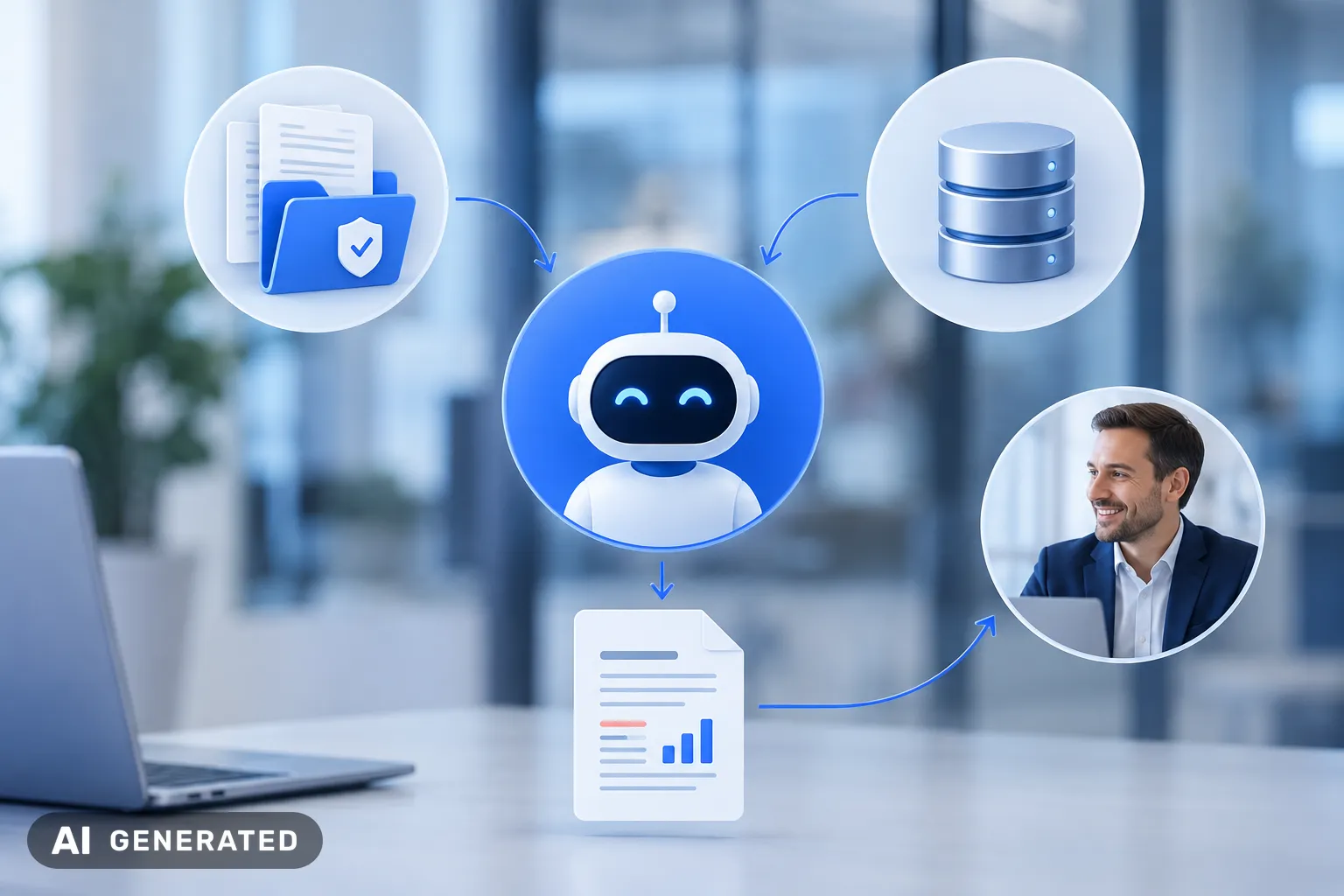
The difference between a general chatbot and enterprise AI is not the model. It is the context. A model without access to product documents, price lists and customer history writes plausible text that misses your business.
A concrete process: a sales representative prepares a quote for an existing customer. The assistant receives the relevant customer record and searches approved product documents for service descriptions.
Define before setup which information flows where:
- Knowledge source: Select approved product documents and remove outdated price lists from the data set.
- CRM access: Clarify which customer fields may be read for quote preparation.
- Output: Have the assistant produce a draft including the citations it used.
- Handover: The representative checks services and prices before sending.
Start with read-only access to the CRM. If entries should be changed later, the team tests write permissions and possible duplicate records in a test environment first.
If the AI finds no suitable source, it must say so openly instead of inventing a service description.
Test exactly this case in every demonstration with an unanswerable question. The response says more about suitability than any feature list.
Settling Governance and GDPR Before the Rollout
A GDPR promise does not replace a review of the planned use. What matters is the actual data flow. A sales representative uploads an email with contact details and confidential contract terms. Who receives that data, and for what purpose is it processed?
The data protection review starts with the specific data flow, not with a general seal.
These points belong in every decision document:
- Purpose: Which personal data is needed for which task?
- Contract: Is a data processing agreement required, and which sub-processors are involved?
- Data flow: Storage location, model provider and possible transfers to third countries including the legal basis.
- Retention: Deletion periods for inputs, outputs and logs, plus any use for model training.
- Roles: Who may see which sources, who approves content, who evaluates usage?
Processing personal data requires a legal basis. Consent is not automatically necessary, the appropriate basis depends on the purpose.
innoGPT runs on EU hosting and is ISO 27001 certified. Ask to see the scope of the certificate and additionally check the data flows of the model you choose.
If a system is meant to talk to prospects directly, disclosure belongs in the concept. Article 50 of the EU AI Act generally requires informing people that they are interacting with AI, unless this is obvious.
A Pilot With a Verifiable Goal Instead of an Endless Demo
A clearly defined pilot turns a product demonstration into a sound decision. The team tests one specific task before anyone decides on permanent use.
An example: the sales team wants to sort trade fair enquiries by topic. The assistant receives approved enquiries and proposes a category for each. A sales representative checks the assignment before the team processes the enquiry.
A pilot convinces through a result the team can review, not through a demo.
Put the pilot scope in writing:
- Deliverable: The task, the information used and the agreed work results.
- Effort: Setup, training and support during the test.
- Cost: Pilot price separated from charges for model usage and connections.
- Decision: Who signs off on the result, and when does the pilot end?
Agree together which results the team accepts and how errors get documented. Also record what happens to the configuration after the pilot.
innoGPT's pilot programme runs for 90 days and covers up to 50 users. It includes workshops, use case development, data integration and personal support. The terms after the pilot belong on the table too: ongoing fees, contract term and what happens to the settings already created.
Convincing People Internally: Rollout With Support
A licence alone does not bring AI into daily work. A rollout needs time for training, questions and adjusted processes. This is where most introductions fail, not on the technology.
Training on Real Tasks
Training works when everyone handles a familiar task themselves. A sales representative writes a follow-up email after a customer meeting, for instance.
In the workshop they phrase the request, review the draft and correct unsuitable statements. Keep the version that works as a template, so colleagues can use and adapt it later.
Support After Launch
After training, the team needs a contact person for errors and questions. When employees report unsuitable wording, the responsible person reviews the template and discusses the correction.
innoGPT provides workshops and personal premium support for this. The pilot programme also includes use case development and support with data integration.
An introduction session does not replace support. The first real questions come up during work, not in the workshop.
An AI chatbot comparison should list these services explicitly. Ask whether training and support are included in the price or charged separately.
Making Success Measurable
Success shows in completed tasks, not in the number of messages.
Measure time, quality and usage together. Many chats do not automatically make a system better. If employees ask the same question repeatedly because answers are missing, usage rises without matching value.
Define before the pilot which task you are comparing. For searching product information, these metrics work:
- Handling time: Time from enquiry to reviewed answer, with and without the assistant.
- Answer quality: Share of answers that are factually correct and traceable to approved sources.
- Correction effort: For how many answers do employees have to fix errors or add information?
- Usage: How many employees use the assistant for the agreed task?
- Coverage: What share of AI usage now runs through the approved platform instead of private accounts?
A worked example: ten comparable enquiries each take five minutes less with the assistant. The team saves 50 minutes in total. Reviewing the answers belongs in both measurements, otherwise the comparison is flattering. Enquiries of differing difficulty distort the result further.
innoGPT's analytics show usage and cost per team, which makes visible where AI actually lands. Whether the answers are factually right remains for the relevant department to check.
Do not attribute revenue to AI too quickly. In the Haufe Akademie sales study, 50.7 percent of respondents were unable to assess AI's impact on revenue.
What Does Enterprise AI Cost and When Does It Pay Off?
The monthly licence is only part of the calculation. Ready-made SaaS solutions often cost around 15 to 500 US dollars per month. Depending on the provider, usage-based fees are added. A custom-built solution, by contrast, can cost well over 150,000 US dollars. So also budget for setup, preparing your company documents, connections, ongoing maintenance and training.
Do not decide based on a general time saving. Calculate concretely:
- handling time saved × internal cost per hour
- duplicate work and search time in company knowledge avoided
- minus licence, usage, maintenance and integration costs
The formula: ROI = (savings + additional revenue minus costs) / costs × 100. If the assistant frees up 20 hours a month for the inside sales team, that is a solid advantage only if the time genuinely goes into more valuable work.
Stay cautious with forecasts. In a Gartner survey, only 4 percent of service and support leaders achieved the expected ROI of their AI initiatives. According to Deloitte, 28 percent of companies reported revenue increases from AI. Both show that the benefits are possible, but not automatic.
Agree on concrete target values for the first eight to twelve weeks, such as fewer manual enquiries, a specific acceptance rate for answers, or a measurable share of staff actively using the approved platform. Only once those values are met can an expansion be justified economically.
FAQ on Introducing AI in Sales
Conclusion
Anyone who wants AI to stick in sales is not selling a tool, but a clearly defined process with a verifiable result. A feature demo convinces nobody who carries responsibility for data and quality.
The benchmark for any AI chatbot comparison is therefore simple: does the solution support the agreed task using approved information? Can review, rollout and operation be planned transparently? And does it bring usage back from private accounts into the company?
A successful pilot delivers not only good answers, but a sound decision about further use.
The next step is worthwhile only once answers and review effort are right. If answers are incomplete, check sources and process first. A larger rollout will not fix problems that are already visible in the pilot.
Plan the support from the outset. innoGPT's pilot programme runs for three months and includes workshops, data integration and premium support. In the end what counts is the result of your own task, not the length of the feature list.
Sources
About the author

Tim Geier
Tim & AIHe is a trained media manager working hands-on with AI: Tim helps companies roll out AI securely and GDPR-compliantly, turning complex AI topics into clear, actionable steps.
This article was written by Tim together with AI.
Weekly AI news in your inbox
New models, practical tips & expert insights — free for everyone.
Related articles
Zive alternative: innoGPT — workplace AI from Germany
Chat, knowledge base, search and tasks in one platform — bootstrapped, EU-hosted, ISO 27001-aligned.

From Data Graveyard to Living Knowledge Base: Your AI-Powered Knowledge Management Software
Discover how our AI-powered knowledge management software transforms your company data into instantly accessible knowledge. Get answers to your questions fast!
Learn to Prompt Properly: The Ultimate Guide to Effective AI Communication
Learn how to master prompting with the right instructions. Improve your AI results with practical techniques and immediately applicable tips.