
Imagine you have an incredibly intelligent assistant just waiting for you to get started. The prompt is exactly that: your direct instruction to this assistant, meaning the artificial intelligence. It's the starting whistle for your conversation, your command or question that kicks off the whole process.
What exactly is a prompt and why is it your most important tool?
Have you ever wondered how to coax truly impressive results out of an AI like ChatGPT? The answer is astonishingly simple yet so effective: it's the prompt. It's the key that unlocks the enormous potential of AI for you.
Think of it as a stage direction for an Oscar-winning actor. The clearer and more inspiring your instruction, the more brilliant the performance. A vague shout leads to a lame scene; a precise instruction to a masterpiece. It's exactly the same with AI.
The best part? You can get started right away! For generative AI you don't need your own huge datasets or months of preparation time. Your curiosity and a clear idea, packaged in a good prompt, are all you need to begin.
The building blocks of a strong instruction
A strong prompt is the direct line to a strong answer. Whether you just need a quick piece of info or want to draft a complex business report – the precision of your input determines the value of the output. Basically, every good instruction consists of these three ingredients:
- The task: What exactly should the AI do? Be direct: "Write," "Summarize," "Analyze."
- The context: Which background info is crucial? Give the AI the necessary toolkit.
- The format: What should the result look like? Concretely: as an email, a table, or in bullet points.
Technically speaking, the prompt is the text from which the AI model calculates the most probable word sequences. Since ChatGPT conquered the world in late 2022, the term has also taken hold in Germany and sent the old word "input request" into retirement. Many people today even equate generative AI directly with ChatGPT, which was trained on hundreds of billions of words. You can find more on this in the fascinating ChatGPT statistics on jens.marketing.
The four elements of a perfect prompt
Writing a really good prompt isn't rocket science – it's craft. Think of it as a cooking recipe: only when all the ingredients interact in the right proportions does the dish become a delight. It's exactly the same with your instructions to ChatGPT. A perfect prompt is built on four key elements that work hand in hand to deliver the result you envision.
These four building blocks are the foundation of every successful conversation with an AI. They turn a vague idea into a crystal-clear work instruction.
- Role: Give the AI a clear identity! Tell it to respond as an experienced marketing strategist, a creative social media manager, or a meticulous editor. That immediately changes the whole tone.
- Task: Be concrete and say unambiguously what needs to happen. Use strong, active verbs like "Create," "Analyze," "Summarize," or "Write." No hedging!
- Context: Feed the AI all relevant background info. Who is your target group? What is the exact goal of the text? Which facts must the AI absolutely know?
- Format: Specify what the result should look like. Do you need a professional email, a punchy bullet list, a clear table, or a smoothly readable blog article? The more specific you are, the better.
This graphic sums it up: your prompt is the decisive link between the AI and the result you want to hold in your hands at the end.
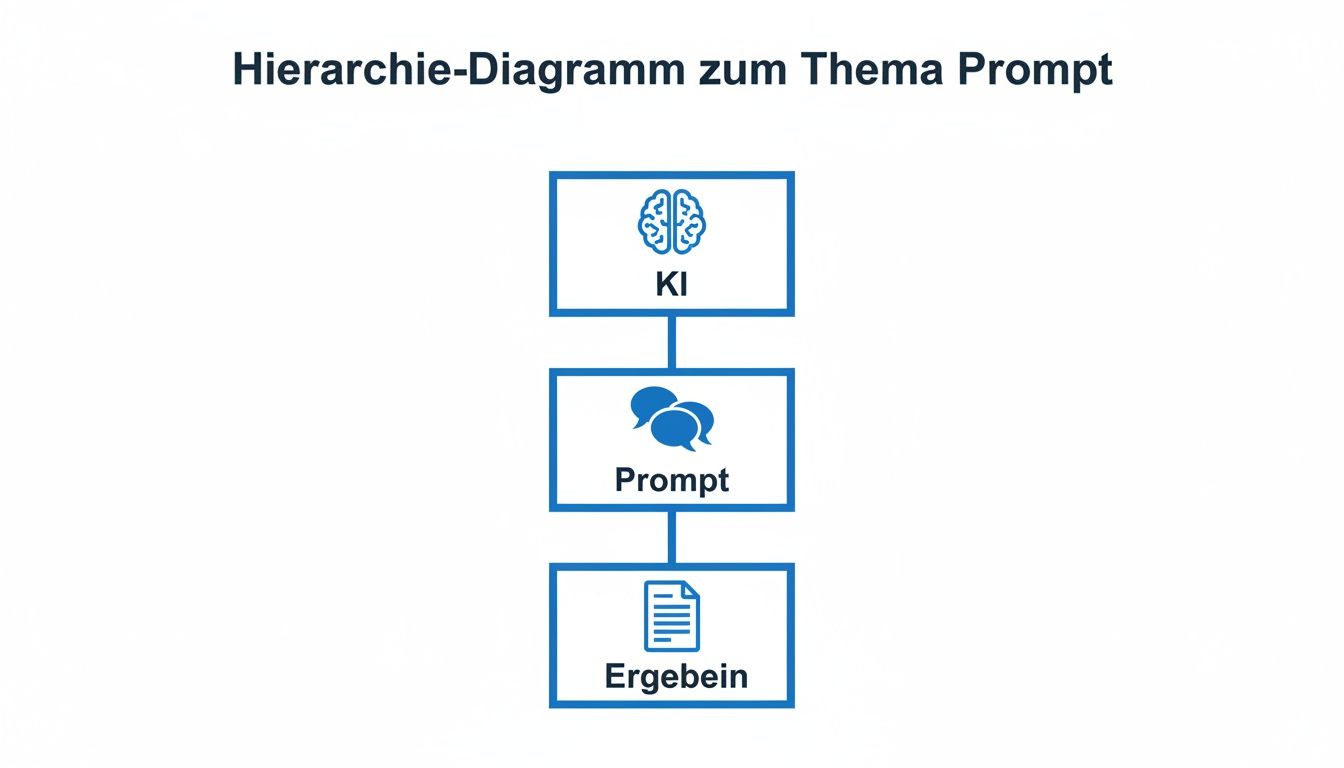
You see it immediately: the quality of your output depends directly on the quality of your input. The prompt remains the central control.
From a simple prompt to a perfect one
Let's see what this means in practice. A simple request like "Write something about new shoes" delivers at best a generic text that you can't do anything with. But when we bring our four magic elements into play, that lame question transforms into a powerful instruction that produces impressive results.
This comparison shows how the four key elements turn a simple prompt into a precise and effective instruction for ChatGPT.
| Element | Simple prompt | Perfect prompt |
|---|---|---|
| Role | None assigned. | "You are an experienced social media manager for a sustainable fashion brand." |
| Task | "Write something about new shoes." | "Create three creative Instagram post captions for our new sneaker collection." |
| Context | No information. | "The collection is called 'Urban Explorer,' the sneakers are made from recycled materials and are aimed at young, environmentally conscious city dwellers. Emphasize comfort and stylish design." |
| Format | Not defined. | "Each caption should have a maximum of 150 characters, contain a call to action ('Discover now!') and 3 relevant hashtags." |
See the difference? The perfect prompt leaves no room for misinterpretation and reliably guides the AI to the desired result.
A well-structured instruction saves you an enormous amount of time in post-processing. Instead of having to touch things up five times, with a precise prompt you often get a 90% finished result on the first try.
If you'd like to dive even deeper into the art of prompting, you'll find plenty of valuable tips and examples in our article on the meaning of "to prompt" in German. Master these four elements and you'll unleash the true power of ChatGPT.
Prompt examples to kickstart your work
Enough gray theory – time to get practical! Here's a treasure chest of prompt examples you can copy, adapt, and try out right away. See for yourself how a clever instruction becomes a true game changer.
We'll start off easy with super-useful everyday prompts and then move on to the more complex tasks that immediately take work off your plate. You'll be amazed at what's possible with good prompts!
Simple prompts for quick wins
These examples are perfect for getting a feel for the thing and saving time right away. They're short, punchy, and give you exactly what you need for everyday tasks.
- For quick brainstorming: "I'm writing a blog article about the benefits of remote work for small businesses. Give me 10 creative and appealing headlines for it."
- For crystal-clear summaries: "Summarize the following text for me in five concise bullet points. Important: each bullet may have a maximum of 15 words. [Insert text here]"
- For the sparking idea: "I need a name for my new podcast for young founders. It's about marketing and personal development. Give me 20 suggestions that sound modern and are memorable."
Advanced prompts for the job
All right, now let's step it up! These prompts are much more refined and use the four building blocks (role, task, context, format) to conjure professional results for typical business needs.
A really good prompt at work doesn't just handle a task – it raises the quality to a new level. You give the AI the guardrails and get a thought-through, structured draft that serves as a perfect launch pad.
Example 1: Create a social media editorial calendarYou are an experienced social media manager for a German B2B software company launching new project-management software. Your task: create an editorial calendar for LinkedIn for the first launch week. The target audience is project managers and team leads. I need it as a table with the columns: day of the week, post topic, short text draft (approx. 50 words), call to action, and a fitting hashtag recommendation.
Example 2: Craft a persuasive sales emailTake on the role of a sales pro. Draft a short, likable cold-outreach email. My product is an AI platform for automating internal communication. The recipient is the managing director of a mid-sized company with 150 employees. Put the benefit – saving time, boosting efficiency – front and center. The email should sound personal, not at all promotional, and end with a clear question that makes the recipient want to reply.
Fired up and hungry for more? Then take a look here – we've got plenty more ChatGPT questions and examples that you can use straight away.
Common prompt mistakes: how to navigate around the biggest reefs
"This AI just doesn't get what I want!" Sound familiar? This moment of frustration is almost a classic. But here's the good news: the AI is rarely the problem. Usually it's the way we talk to it. See this section as your personal boot camp for spotting the typical pitfalls and elegantly avoiding them.
Many mistakes happen because we chat with a machine as if it were a colleague in the office. But that's exactly where the trouble lies. Vague phrasing is the arch-enemy of any good result. A command like "Write something about marketing" can only go wrong – it's like shouting at a chef: "Make me something to eat!"
Where things most often get stuck
Often it's simply a matter of missing the right details. A prompt without context is like a ship without a compass – it drifts aimlessly on the sea of data. Just as fatal is giving the AI no clear role or fixed format.
Before every prompt, just ask yourself these three questions:
- Is my instruction really crystal clear? Instead of "Keep it short," try: "Summarize the text in three bullet points. Each point may have a maximum of 15 words." That's a command the AI can work with.
- Does the AI have enough material? Give it all the important background info. Who is the text for (audience)? What should it achieve (goal)? What tone should it hit?
- Who should be speaking here? Assign the AI a clear role. Should it answer as an experienced marketing strategist, a critical data analyst, or a creative social media manager?
Really good prompts are becoming a key skill. Generative AI is no longer a gimmick in the German working day. According to surveys, professionals use ChatGPT mainly for text creation and research – both tasks where the quality of the input directly determines the output. You can find more fascinating insights on the adoption of ChatGPT in Germany at doit.software.
When you avoid these typical mistakes, something magical happens: useless gibberish turns into precise, valuable results. And the best part? You save yourself countless correction loops and a lot of frustration.
How to use prompts securely and efficiently in your company
The true magic of prompts really unfolds in everyday company life, where efficiency and data security are paramount. But how do you tap into the power of ChatGPT without putting sensitive company data at risk? The answer lies in internal enterprise AI platforms built specifically for these challenges.
Imagine not every employee constantly reinventing the wheel. Recurring tasks, like creating proposals or answering customer inquiries, can be turned into secure, standardized workflows with clever prompts. That not only saves enormous amounts of time, it also ensures consistently high quality across all your communication.
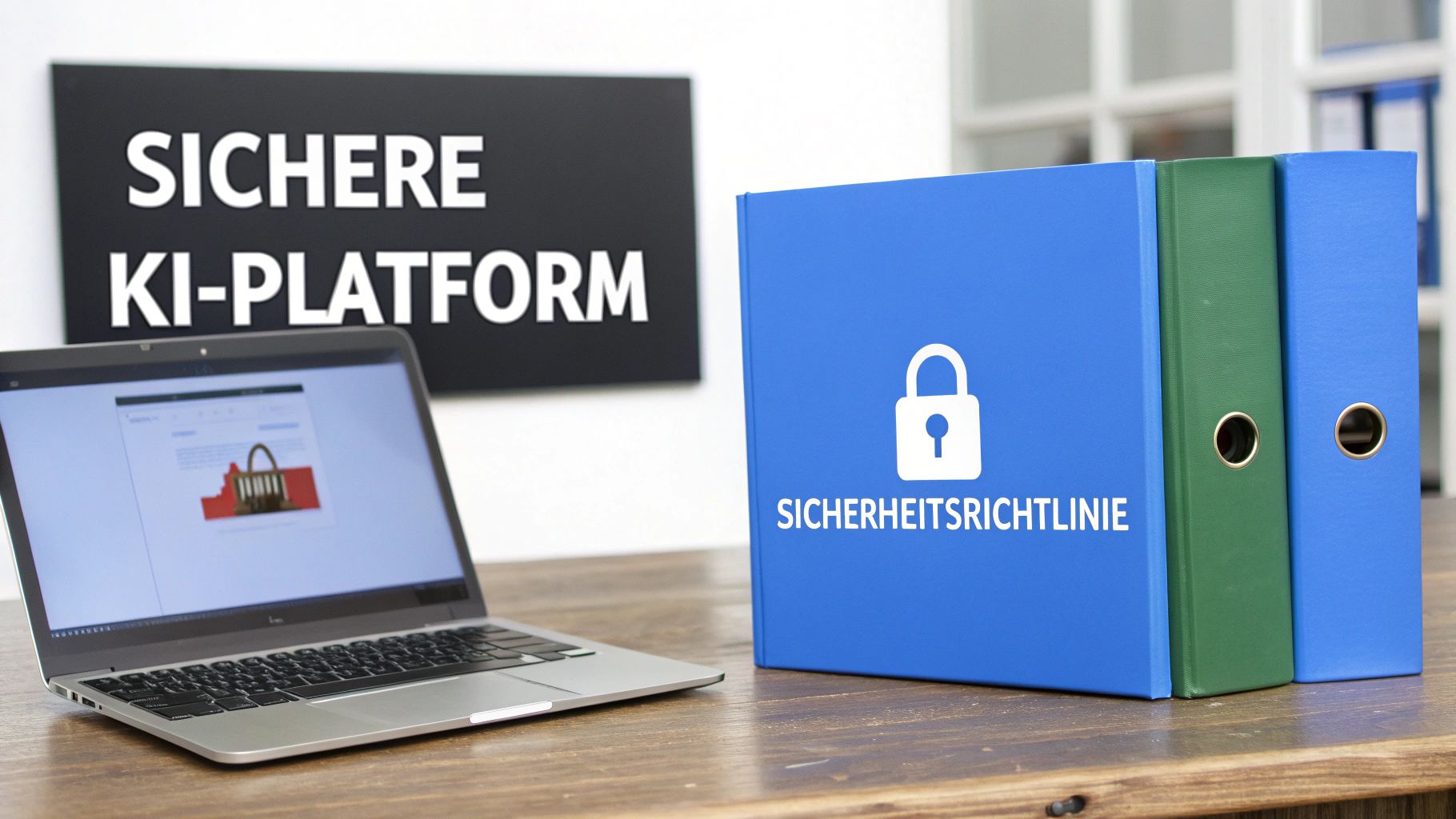
Your data, your knowledge, your AI
The decisive advantage of such systems is that you can feed them with your own company knowledge. Simply upload internal documents – QM handbooks, product catalogs, security policies, whatever you have. This way you create tailor-made AI assistants that always reply based on your vetted knowledge base and in the right corporate wording.
This is exactly where a simple prompt becomes a powerful tool in the enterprise context. A German survey shows that AI tools can boost productivity by an average of 5–25 percent when used correctly. Even the IHK Munich recommends testing generative AI for text drafts – but insists on clear guidelines. You can find more in the IHK's recommendations on AI use.
GDPR and security front and center
When you use prompts in the company, three terms are absolutely non-negotiable:
- GDPR compliance: Your data and that of your customers must always be protected. Period.
- Zero retention: It must be guaranteed that your inputs are not used to train public AI models.
- EU hosting: Data processing should happen exclusively on servers inside the European Union to meet the highest data protection standards.
Platforms like innoGPT were developed precisely for this. They create a secure, shielded environment where you can exploit the full potential of prompts – without worrying about your valuable data. That way a brilliant technology becomes a genuine and, above all, secure competitive advantage.
Your questions about prompts, answered
Finally, let's clear up the typical questions we come across again and again. See this section as your personal FAQ that clears away any remaining doubts and turns you into a real prompting pro.
Does a prompt always have to be a question?
No, absolutely not! That's perhaps the biggest misunderstanding of all. Don't think of a prompt as a question, but as the starting gun for a task. It's your director telling the AI what to do.
It can really be all kinds of things:
- A clear command: "Draft a professional email to introduce a new customer to our first joint project."
- A specific instruction: "Summarize this scientific article in three simple sentences."
- A creative prompt: "Give me five unique names for a new coffee brand centered entirely on sustainability."
It's exactly this versatility that makes generative AI such an incredibly flexible tool in your working day.
How long should a good prompt be?
There's no rule of thumb that always fits. A strong prompt is as long as necessary and as short as possible. The golden rule: give the AI every shred of information it needs for a brilliant result, but leave out unnecessary fluff that only confuses it.
Sometimes a single, punchy sentence is enough for a quick definition. But if you're having a complete marketing plan developed, your prompt can easily consist of several paragraphs. There you explain exactly the role, context, target audience, and format you envision.
Always remember: the precision of your prompt directly determines the quality of the result. The clearer you say what you want, the less you have to correct afterwards.
Can I tell the AI what NOT to do?
Yes, absolutely! It's actually an extremely powerful technique for keeping a firm hand on the reins. It's also called "negative instructions." By showing the AI clear red lines, you prevent it from drifting in a direction you don't want.
A great practical example: "Write a social media post about our summer party. The tone should be casual and enthusiastic, but please don't use slang or emojis under any circumstances." That's how you set crystal-clear guardrails.
Do German prompts work as well as English ones?
Plain and simple: yes! Modern language models like GPT-4 have been fed a gigantic amount of multilingual data and deliver absolutely first-class results in German. Still, in fairness, most of the original training data was English.
What does that mean for you? For 99% of tasks in German day-to-day work, well-crafted German prompts are perfect and get you to the goal. Only for extremely specific niche topics or very technical jargon can an English prompt sometimes squeeze out that last spark of precision. Dedicated enterprise solutions like innoGPT, however, are tailored to the German market anyway to deliver top performance.
Ready to unleash the power of professional prompting securely in your company? innoGPT offers you a GDPR-compliant AI platform with EU hosting, where you can use your own company knowledge and build secure, efficient workflows. Try innoGPT free for 7 days now!
Weekly AI news in your inbox
New models, practical tips & expert insights — free for everyone.
More on: Prompt Engineering
The Ultimate Prompt Library for Generative AI: ChatGPT Prompts in English as PDF
100 ready-to-use prompt templates for 10 business functions — with an explanation of the 5 most important prompt methods. Free PDF download from innoGPT.
Mastering German AI Prompts: The Key to Professional Results
Discover the best sources for a professional ChatGPT prompt in German. Includes templates and tips for marketing, sales, and more. Optimize today!
The Best AI Prompts for Learning: How to Use Generative AI as Your Personal Learning Coach
Discover the best ChatGPT prompts for learning and turn AI into your personal study coach. Maximise your learning results with targeted instructions!
How to Query AI Correctly: Get the Most from Generative AI Assistants
Discover how to query AI safely and effectively to get fast, helpful answers that actually move your business forward.
Learn to Prompt Properly: The Ultimate Guide to Effective AI Communication
Learn how to master prompting with the right instructions. Improve your AI results with practical techniques and immediately applicable tips.
AI Prompts in German: The Guide for Professional Use in Europe
Discover our German AI prompt guide and learn how to write precise prompts and use generative AI safely.